What are oceans?

Oceans are huge areas of salty water. They cover about two-thirds of the surface of our planet.
They are home to lots of amazing living things, such as fish, dolphins, whales, crabs and seaweed.
There are five oceans in the world.
All five oceans are connected to each other and water flows between them.
Watch – Explore the oceans
Watch this video to learn more about the wonders of the ocean!
Jump aboard and explore the oceans of the world with Patrick and Omi.
PATRICK: I never knew how amazing oceans were until I went to the seaside with my friend Omi. She really loves oceans.
OMI: You've got to see for yourself. Put these on.
The ocean’s packed with life. So it's really important that we look after it.
There are tonnes of different fish, plus mammals and other creatures like crabs and worms.
Some are so tiny, you can barely even see them. And there's the largest mammal alive, the blue whale.
In some places, oceans are so deep that there are parts that have never been explored, and creatures that have never been discovered.
PATRICK: Ahh! Can we go back up now?
Ah, this is much better.
OMI: People travel on seas and oceans every day.
Some people do it for sport. Some do it for work.
Some people even travel with their cars.
Look! You can park your car on a ferry and it will take you from one place to another.
PATRICK: They must be the biggest boats in the world.
OMI: Not nearly – look over there.
PATRICK: What's that?
OMI: A container ship. They take toys, cars, computers, all sorts of stuff from one country to another.
They’re so big that each one of the little boxes on its back is actually the size of a lorry.
PATRICK: But if one ship’s that big, how big are the oceans themselves?
OMI: So big and so powerful!
They cover more than two thirds of the whole world!
PATRICK: You're right Omi. Oceans are truly amazing.
OMI: Yes, and what's even better is that's where the narwhals live. I really, really love narwhals!
Geography

Oceans cover more of our planet than land.
Some parts of the ocean are so deep that they could cover Mount Everest - the world's tallest mountain!
Have a look at the information, videos and activities to learn more our amazing planet and oceans.
The world's oceans
The five oceans of the world are:
the Pacific Ocean
the Atlantic Ocean
the Indian Ocean
the Southern Ocean
the Arctic Ocean
Have a look at this slideshow to learn more about each one.

Image caption, Pacific Ocean
The Pacific Ocean is the world’s largest ocean. It covers about one-third of the Earth's surface. It stretches from the continents of Asia and Oceania on the east, to North and South America on the west.


1 of 5
Watch - The world and its oceans
You can learn even more about our planet and the oceans in this video.
Hello, I'm Earth. I'm where you live. You and a few billion others.
People live all over me on bits of land called continents.
There are seven:
North America
South America
Africa
Europe
Asia
Oceania
and Antarctica.
Over two thirds of my surface is covered in water. Most of it is held in the five oceans:
The Atlantic Ocean
The Indian Ocean
The Pacific Ocean
The Southern Ocean
and The Arctic Ocean.
I orbit around the sun. Not that fast! It actually takes me a year.
There's an imaginary line that runs around my middle, which is always closest to the sun.
There it is, the Equator.
It marks the difference between my two parts: the northern hemisphere and the southern hemisphere.
This cold part at the top is my most northern point and is called the North Pole.
I also have another cold part at my bottom - I mean, my most southerly point - which is called the South Pole.
I have a lot going on, don't I?
So take care of me, please, because I'm your home.
Activity - Pirate Bunnies game
Hop on Captain Carrot’s ship and explore the oceans in this fun geography game.
Pirate Bunnies World Adventures. game
KS1 Geography game

Discover more on KS1 Geography
Learn more about the oceans and continents with these articles.
Oceans of the world
KS1 Geography
The continent of Antarctica
KS1 Geography
The continent of Oceania
KS1 Geography
Science

The oceans are home to many living things.
There are around 240,000 species known to live in Earth’s oceans, but scientists think there may be millions more still waiting to be discovered!
Have a look at the information, videos and activities below to learn more about ocean habitats.

Ocean habitats
Ocean habitats are large and wet.
A habitat is the place where an animal or plant lives. It gives them everything they need, like food, water, and shelter.
Some ocean habitats are shallow, sunny, and warm, while others are deep, dark, and cold.
They are hotter near the equator and colder near the North and South Pole.
The living things in these different ocean habitats are adapted to survive them.
Watch - Ocean habitats
Learn more about the plants and creatures that live in the different oceans in this video.
We are here.
But have you ever wondered what plants and animals live in the ocean and how they survive underwater?
Well, pack your swimsuit, we're off to find out!
Look at all these fish! Big fish! Small fish! And so many colours.
And there's seaweed growing here. Doesn't it look like a plant? But it's an algae.
Seaweed grows close to the surface because it uses the sun to make its own food. Just like a plant!
And what's that? It's lots and lots of plankton!
Plankton is made up of tiny plants and animals. These plants are at the beginning of most of the ocean's food chains.
Look! A right whale having its dinner.
Whales are the biggest animals in the world and most only eat plankton, one of the smallest. They must have to eat a lot!
They can stay underwater for an hour, but come to the surface to breathe.
So, ocean habitats are large and wet.
Ooh, I'm off to find a boat.
Activity - Ocean colouring
Grab your crayons, felt tips, or colouring pencils and get ready to do some ocean colouring.
You can print off this colouring sheet or draw your own underwater scene.
Oceans colouring activity sheet. activity
Topic packs

Discover more on KS1 Science
You can learn more about ocean habitats and other habitats around the world in these articles.
What is a habitat?
KS1 Science
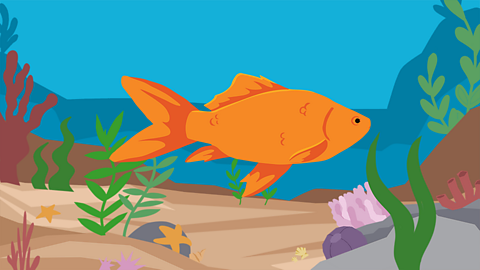
What is an ocean habitat?
KS1 Science
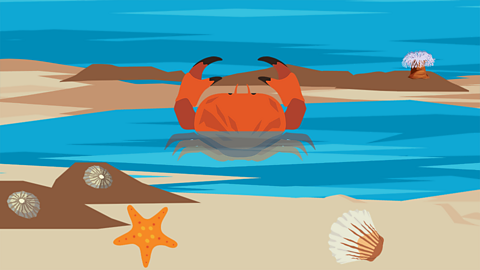
What is a coastal habitat?
KS1 Science
Citizenship

It is important to protect our sea life by keeping our oceans clean.
Ocean pollution can make animals ill and damage their homes.
Learn more about the problem of ocean pollution and what we can do to help.

Plastic waste
Just as we take care of where we live by keeping it clean and tidy, we need to keep animals' homes clean and tidy too.
Sadly, lots of the plastic we use ends up in the ocean.
Plastic should not be in the ocean, so we call this pollution.

How can we help keep our oceans clean?
There a lots of things we can all do to help our oceans and the wildlife that lives there. These include things like:
- recycling our plastic waste
- reusing old things
- repairing broken toys
Watch - My environment
Watch this video to learn more ways we can help to keep our oceans clean.
Sahera: Be careful everyone, litter picking can be dangerous if you don't look where you step.
Becky: Yuck! Where did all this mess come from?
Beth: Well, from people leaving or throwing their rubbish on the ground instead of putting it in the waste or recycling bin.
Lucy: Yeah, litter is so dangerous. It makes a mess that could hurt people and animals. My dog cut his paw on some broken glass once and needed an operation.
Beth: Sorry to hear that, Lucy. Litter isn't even always just on the ground - sometimes it ends up in the sea and that causes more problems for the environment.
Harry: Fish in the sea might eat it thinking it's food and get sick.
Sahera: It's really sad. Litter isn't the only thing that's harmful to our environment. There's also air pollution caused by fumes from factories and vehicles. Pollution is harmful to life on the planet.
Lucy: Yeah, humans, animals and plants all need clean air and water. Everyone has the right to live in a safe, clean and healthy environment, but cleaning up is just one way we can take care of the environment. Can you think of any others we could try?
Harry: Save electricity by turning things off when you're not using them.
Mo: We could plant more trees.
Lucy: Re-using water bottles and recycling.
Becky: We should walk more instead of always using cars.
Ariana: Keep learning about the Earth and what we can do to look after it.
Sahera: Our actions can have big effects, sometimes even in far away places. If you leave litter on the beach here, your rubbish could get washed into the sea and swept across the ocean. So cleaning up here can help the rest of the world.
Beth: I think you all deserve a snack after all your hard work.
All: Yay!
Sahera: Remember, if you're out and can't find a bin for your rubbish, you should take it home and put it in the bin there instead.
Discover more on KS1 Citizenship
Learn more about how you can look after where you live with these articles.
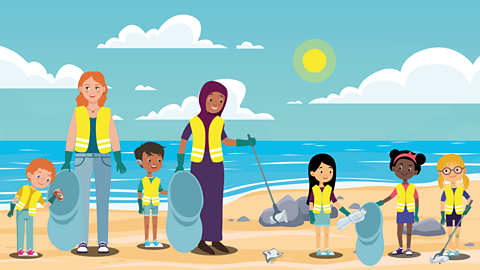
Looking after the environment
KS1 Citizenship
Getting involved in the community
KS1 Citizenship

Rights and responsibilities
KS1 Citizenship

Quiz - Oceans
Now put your knowledge of oceans to the test with this quiz.
More resources from Bitesize for teachers
You can find many more amazing resources on oceans from Bitesize for teachers.
World Oceans Day assembly
Bitesize for Teachers
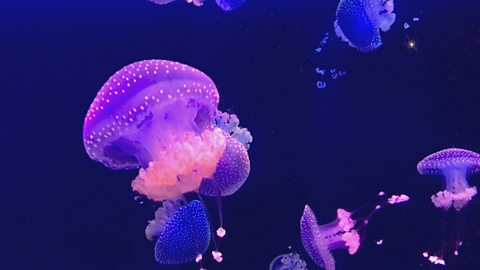
The oceans of the world
Bitesize for Teachers

Life beneath the waves
Bitesize for Teachers

Where next?
Play Bitesize Primary games. game
Fun and educational primary games in science, maths, English, history, geography, art and design, computing and modern languages.