Sign up to the BBC Bitesize newsletter! External Link
For home education news and stories plus updates on the latest Bitesize content, register for our newsletter today.

If you’re home educating your child, one of the things you may have considered is when and how your child will mix socially with others and navigating relationships that exist outside the home environment.
Socialising with different age groups can bring many benefits, although there can of course be challenges too.
We've spoken to Chartered Member of the British Psychological Society, Dr Vivian Hill, to get some insights on how to approach mixed-age socialisation and learning.
What is mixed-age socialisation?
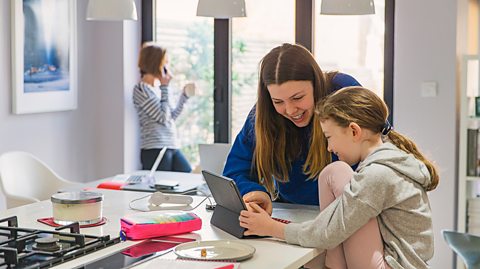
Mixed-age socialisation is when children of different ages spend time together, whether that’s in lessons, the playground, clubs or other environments. It can include siblings mixing at home but also, crucially, stretches beyond the home environment to other peer and adult interactions.
Socialisation is how children, and adults, learn to become part of wider society, through experiencing different social relationships and learning what kind of behaviours are ‘acceptable’.
That doesn’t mean a child hiding their personality or diminishing their own individuality but it could mean them learning to regulate behaviours such as biting, hitting or being overly assertive.
What are the benefits of mixed-age socialisation?
According to Dr Hill, who has previously worked in schools with mixed-age classrooms where two or more year groups, such as Year 3 and Year 4, are combined, there are many benefits to children of different ages playing and spending time together. It can enhance:
- Social and emotional skills
- Cooperation and empathy
- Communication skills
- Problem solving skills
- A sense of community
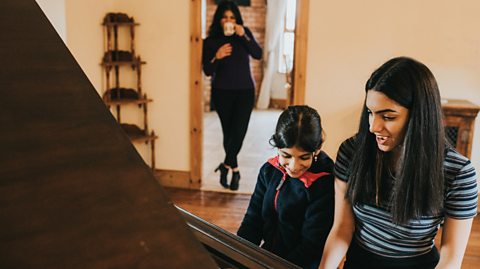
Mixed-age socialisation can also support older children in developing mentoring and leadership skills and give younger children exposure to role models and potential mentors.
The challenges come when some older children, for example, behave in a more controlling or dominant way towards younger children, which can deter those less dominant children from mixing socially.
However, Dr Hill suggests regular interactions with a wide range of different ages can lead to children potentially better understanding each other’s differences, which may in turn nullify the impulse for children to tease or even bully.
What is mixed-age learning?
Mixed-age learning involves children of different ages learning with or alongside each other. In a school environment, this could mean children from two different year groups being in the same classroom.
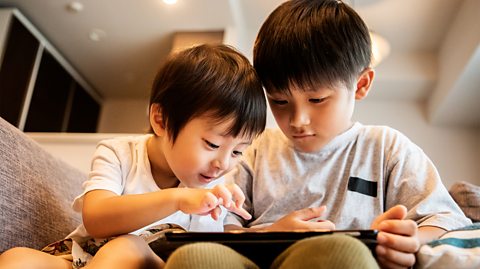
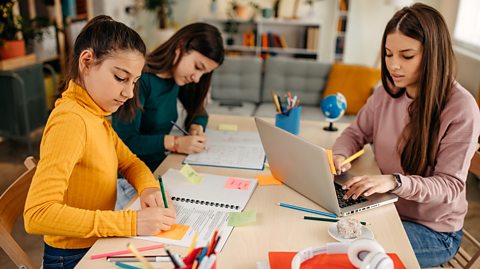
At home, mixed-age learning could mean siblings or other home-educated children of different ages and abilities learning together or side-by-side.
In either scenario, the ‘teacher’ will need to decide on their learning approach: combining the ‘curriculum’ so children are all learning the same content at the same time, albeit potentially in groups arranged by ability; or splitting the learning by age and teaching the children separately.
It often depends on what is practical!
What are the benefits of mixed-age group learning?
The benefits of mixed-age group learning include many of the same skills and development as mixed-age socialisation, eg enhanced communication and problem-solving skills.
Dr Hill says mixed-age learning can also help secure an educational concept for a child who then has to communicate that concept to another child.
For example, an older child or child who’s at higher attainment needs to be confident in their own techniques before they can show another child how to use a dictionary or a creative way to use parenthesis in writing.
For younger children, they’re learning the concept, but they’ll also be exposed to different forms of problem solving. They’ll learn how to share a problem, share strategies and solve it together - alongside the benefits of working with role models, as mentioned above.
Dr Hill adds that some parents may worry this kind of learning could have a negative impact on ‘brighter’ children and reduce their academic achievements, but in her experience it can lead to more positive attitudes, including building a child’s sense of capability and autonomy.
That’s not to say there aren’t challenges with mixed-age learning - there are. It requires a lot of planning from you, the parent, or teacher.
Children of different ages, abilities and with Special Educational Needs and Disabilities (SEND) will have different needs, including different attention spans and learning environments in which they function best.
This means a different approach may well be needed for each individual child.
How to teach different ages at home
If you’re home educating children of different ages, try these five strategies to get the best out of each child:
- Identify any individual needs each child has, whether that’s SEND or any sensory or other issues that impact their learning. Then set up the learning environment so that it caters to each child.
- Think about which subjects your children could learn together and which they’ll need to learn separately. For example, aspects of geography could be fun to learn all together for children aged seven to 11, but a child taking Physics GCSE may need to learn separately or with a specific group.
- Consider ‘paired reading’, which can have benefits for both the younger and older reader. However, Dr Hill cautions that it will depend on the children and the dynamics of their relationship. For example, if a younger sibling finds reading more intuitive than their older sister or brother, they may use that information to tease or hold power over them.
- As soon as your children are capable, encourage independent learning. This doesn’t mean you leave them to it but it could be, as Dr Hill suggests, you engage directly with an older child while the younger one is having some TV or crafting time. Then you set the older child an independent writing activity and engage directly in learning with the younger child. It will all depend on the ages and stages of your children.
- Use online and in-person home education groups as a way for children to learn and socialise together. Dr Hill reminds us that all children will need to learn how to become members of society. Through mixing they learn how to negotiate and become more resilient, as well as being exposed to a range of interests in the wider world.
Where can I find out more about mixed-age learning?
You can use BBC Bitesize for Teachers to find resources for different age groups and learning discussions you may want to have at home.
Explore our parenting articles for advice about how to help your child get on with other children and helping your child to deal with rejection.
Where can I find more support for home education and parenting?
The BBC Bitesize home education collection is designed to support you and your child’s learning at home with free resources for early years and foundation stage (EYFS), primary and secondary-age students.
Bitesize Parenting is the go-to place for the whole parenting community to find stories, expert advice and fun activities.
If your child has special educational needs and / or disabilities, be sure to check out the Parenting SEND collection. Bitesize also has a collection of Sensory Stories, an immersive video series that transports you on unique sensory adventures, for children with additional or complex needs.
For more information about home education, these BBC News articles cover the rise in families deciding to educate their children at home and, from 2021, the impact of Covid on home education.
