Sign up to the BBC Bitesize newsletter! External Link
For home education news and stories plus updates on the latest Bitesize content, register for our newsletter today.

Problem solving is one of the core life skills that organisations like UNICEF, the United Nations agency for children, believe are, “crucial for personal growth and active citizenship.”
It’s the art of thinking about and finding solutions to issues or challenges. It can apply to any area of your child’s life, from their studies to their interpersonal relationships, so it’s worth thinking of ways you can encourage them to problem solve in different situations.
Why is children’s problem solving useful?
“They’ll have a more sophisticated understanding of a skill or concept if they do it through problem solving.” – former headteacher Michael
Michael Whitworth, former headteacher and parenting and schools coach, says: “Problem solving is about equipping children with techniques to draw upon instinctively and when they face difficulties. It’s a very practical skill academically, and it’s a key life skill generally."
“Children who can problem solve become more independent more quickly," Michael continues. "They’re better able to find answers and are more confident generally.” Whereas those who are less skilled in problem solving are, “more likely to give up easily when they get stuck or encounter difficulties”.
Michael adds that problem-solving activities can help children retain information: “They’ll have a more sophisticated understanding of a skill or concept if they do it through problem solving.”

Problem-solving strategies for your kids
Anita Cleare is a parenting coach and author of two books: The Work/Parent Switch and How To Get Your Teenager Out Of Their Bedroom. She says the best approach is to get your child “involved in solving real problems”.
In essence, most problems are solved using the same six steps:
- Identify the problem
- Come up with ideas of how you might solve it
- Evaluate which of those options might be most helpful
- Choose an option as a solution
- Give the solution a go
- See how well it worked - and, if necessary, go around the cycle again
Anita advises going through each step in turn with your child so they can learn this process. It's something that will have become second nature to us as adults.
You can also coach your child through the steps above when they have a problem. She suggests talking out loud when you’re solving day-to-day problems yourself, so you're modelling the process too.
How do you solve a problem?
Say your child wants to go outside and play with a football, but they don’t have any shoes on… and they can’t tie their shoelaces! That’s the ‘problem’ your child would like to solve. Together with your child you might come up with a few options:
a) ask mum/dad/sibling to tie their shoelaces
b) wear slip-on shoes instead
c) learn how to tie their shoelaces
Your child then needs to think about which is the best option in this scenario.
Option a) would work if someone is available to help them with their laces.
Option b) might work but will they be able to play football in slip-on shoes?
Option c) is a good long-term choice but will it take them too long right now?
Your child can then choose which option is best in the current circumstances, put that option into action and see how it worked out.
Let’s say in this scenario your child chose option b) but their shoes kept flying off when they kicked the ball. Ask them afterwards to evaluate their choice and consider whether there might have been a better solution.
At this point, your child might decide to practise tying their shoelaces so they can implement option c) in future.
Or, if shoelace tying is difficult or irrelevant due to a disability, your child might decide on option a) initially then problem-solve future alternatives to tying shoelaces, such as velcro fasteners. The learning never stops!

Problem-solving activities for kids
You don’t need to go out of your way to find problem-solving activities for your child. Opportunities will pop up all the time at home and in everyday life.
Anita Cleare elaborates: “In play, we can prompt young children to consider different options when they’re constructing or creating. In family life, parents/carers can involve children in making decisions about problems that involve them, such as what to do at the weekend or where to go on holiday."
"If you have more than one child, this is a brilliant opportunity to practise collaborative problem solving where everyone’s views and preferences need to be taken into account and negotiated. Even children as young as three can give ideas and help choose solutions."
“If children have challenges in their social lives, such as difficult friendships or bickering between siblings, rather than imposing solutions or offering advice, parents can coach children through the problem-solving cycle by asking questions like ‘What ideas have you got?’ and ‘What have you tried so far?’”
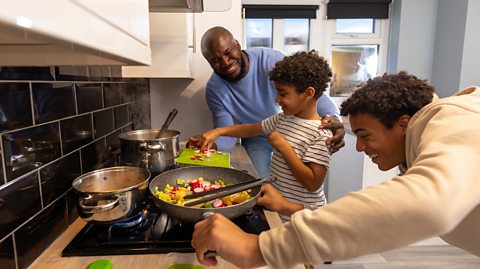
You can also incorporate problem solving into:
- housework and chores
- baking, eg: how to get a cake to rise
- DIY, eg: putting up a shelf, or joining wood without screws
- budgeting with pocket money
- building a garden vegetable patch
Parenting and schools coach Miranda Perry gives the example of a child who wants to play on their sports team the next day but their kit is dirty. Talk them through the issue, their options and what they think they can do about it.
Or if an older child wants you to give them a lift to a friend’s house but you’ve already agreed to pick someone else up at that time: “Present those problems to your teenager. They’ll come up with a solution remarkably quickly because they’re motivated to do so.” An incentive can go a long way towards a child embracing their own problem solving!
Where can I read more about problem solving?
If your child is sporty, check out these football challenges which will get them thinking while keeping them active: Manchester United, Southampton, Cardiff City, Stoke City.
For more insights on the teenage brain, read our article: Teenagers - it’s not you, or them.
To build on your teaching around problem solving, try reading about seven life skills you can develop in home education and how to encourage your child to learn independently.
Where can I find more support for home education and parenting?

The BBC Bitesize home education collection is designed to support you and your child’s learning at home with free downloadable resources, advice articles and videos for children aged two-to-five years old, five-to-11 years old and 11-to-16+ years old.
Bitesize Parenting is the go-to place for the whole parenting community to find stories, expert advice and fun activities.
If your child has special educational needs or disabilities, be sure to check out the Parenting SEND collection. Bitesize has a collection of Sensory Stories, an immersive video series of unique sensory adventures for children with additional needs.
For more information about home education, this BBC News article covers the rise in families deciding to educate their children at home.
