Sign up to the BBC Bitesize newsletter! External Link
For home education news and stories plus updates on the latest Bitesize content, register for our newsletter today.

Chores, chores, chores. They can seem endless as a parent. You may already ask your child to help out around the house, or you may prefer to just get it done quickly and efficiently yourself.
Whatever your approach, there are benefits to your child getting involved in chores that go beyond reducing the household to-do list. They can give a child a sense of autonomy, confidence and belonging, and can easily be incorporated into education at home.
What are chores?
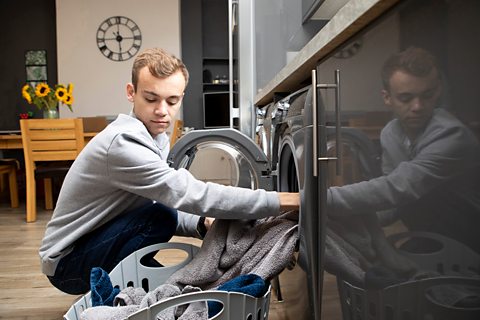
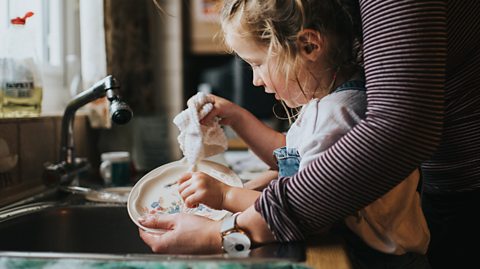
Chores are the routine household tasks that need doing, whether that’s setting the table, doing the washing up, dusting, hoovering, putting the laundry away, etc!
However, the word ‘chores’ can be a bit of a misnomer when it comes to family life, according to chartered member of the British Psychological Society Professor Vivian Hill: “Chore – it just conveys ‘dull’, ‘uninteresting’, ‘uninspiring’. Whereas if you see it as your contribution to things running smoothly then you’ll actually see it as something that has some value.”
Perhaps you can reframe chores as: ‘Let’s tidy up the lounge so we can watch a film’ or: ‘Let’s who can sweep up the most dirt before Grandma comes’?
Why are chores beneficial?
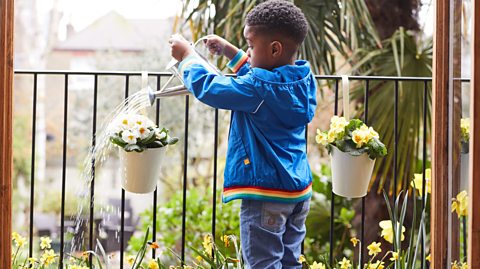
There are many ways chores can benefit your child:
- Increased confidence and resilience
- Independence
- Communication
- Teamwork
- Problem solving
- Tackling loneliness
- Building empathy
- Dealing with the mundane
Professor Vivian Hill believes getting your child involved with chores is about a sense of connectivity and belonging: “We’ve all become very solitary. That’s a real consequence of social media, spending lots of time just in your own mind, with a device in hand rather than connecting and doing things."
She advises: "For young people who might be feeling a bit lonely and not as well integrated in their family or social network, the more you’re engaged [in chores] the more you do have that sense of belonging, which will reduce their sense of isolation.”
Contributing to chores can teach a child about feeling a sense of achievement and autonomy, which can boost their wellbeing and sense of self.
“There’s benefit to all of us in learning some things in life are mundane. Not everything is as exciting as we might wish!” - parenting coaches and consultants Miranda Perry and Michael Whitworth
Should children do chores?
The question of whether children ‘should’ do chores is one for you to answer yourself. However, if you think about what they can gain, in terms of their confidence, sense of belonging and broader development, once you show them how, then you can see some good reasons to get your child involved.
If you’re struggling with engaging your child around the house, read our article: How can I get my child to help out with the household chores?
Age-appropriate chores for children
Which chores you suggest for your child will depend on their individual likes, needs and developmental stage.
Children are more likely to engage in chores when they’re fun and when they’re linked to something they already enjoy. Using music, timers, reward stickers and other incentives can all help.
Miranda Perry recommends linking the chore to the desired outcome, especially for older children. For example, if your child loves netball but they don’t have a clean kit, how are they going to solve that problem? Hopefully they’ll see that if they load the washing machine, they’re helping out but also getting the clean kit, the ‘outcome’, they want too.
If you’re home educating, chores offer many learning opportunities, whether it’s putting socks into pairs, measuring the right amount of washing liquid or, especially for older children, figuring out time and task management.
Michael Whitworth recommends starting small with chores. Where possible, tag the chore onto an existing habit. So, when your child takes their clothes off at night, they put them into the laundry basket straightaway, rather than on the floor: “Fit it into the flow of the day, so everyone picks their clothes up and puts them into the basket.”
You can create coloured baskets or labels for different washing if you have space. If you’re consistent, tasks like this will eventually become a habit in the same way as daily tooth brushing.
But both Michael and Miranda caution you not to set the bar too high for yourself. It requires a lot of energy to change habits, and to get children consistently involved around the house. Some days you’ll feel on top and others you won’t. Choose your ‘red lines’ and stick with them. For example, you may decide the state of your teenager’s bedroom is up to them, but the cleanliness of the kitchen and living room is a family affair!
Where can I find more support for home education and parenting?
The BBC Bitesize home education collection is designed to support you and your child’s learning at home with free downloadable resources, advice articles and videos for children aged two-to-five years old, five-to-11 years old and 11-to-16+ years old.
Bitesize Parenting is the go-to place for the whole parenting community to find stories, expert advice and fun activities.
If your child has special educational needs or disabilities, be sure to check out the Parenting SEND collection. Bitesize has a collection of Sensory Stories, an immersive video series of unique sensory adventures for children with additional needs.
For more information about home education, this BBC News article covers the rise in families deciding to educate their children at home.
