How is baking a science?
Whether it's making it ourselves or heading to our favourite bakery to secure the goods, we all have a favourite, go-to baked treat. Some were invented right here in the UK, like Bakewell pudding, bara brith, barmbrack and Dundee cake.
Whereas other staples have origins dating back centuries to other countries across the globe. Thanks to travel, trade and of course, local recipes passed down through the generations, we can now bake or buy them to enjoy from the comfort of our homes. With shows like The Great British Bake Off on air, it's hard not to love baking in all its forms.
But did you know that your cakes, biscuits and pastries are all the result of lots of complex chemistry and physics? Well, BBC Bitesize spoke to a couple of experts to find out exactly how scientific baking really is.
What makes pastry puff?
Lots of what you bake will involve some combination of flour, butter and water (plus or minus some other ingredients). The key to making them turn into something delicious is usually how they’re arranged.
Take puff pastry, for example. The puffy pastry dough is simple - flour, salt, water. What’s not simple is how you then put it together with butter.
Chemist and co-founder of chemistry company Carbometrics Dr Andy Chapman previously explained that butter is “an emulsion of water in oil… so tiny droplets of water that are suspended in solid fat”. This is crucial in how a homemade puff pastry works.

When you have your dough, you roll it out, place layers of butter onto it, and fold until you have three layers, then repeat. This process is called laminating and it creates “exponential growth” in the layers, until you end up with thousands of them.
So what happens in these layers when the pastry is baked? Dr Chapman explained: “The fat melts and becomes a lubricating matrix between the layers of dough, so they don't stick together.
“And then, very critically, because butter is this emulsion of fat and water, and the temperature in the oven is above the boiling point of the water, the water turns into steam, and the steam is what blows open these layers.”
This is why butter has to be cold when you work with puff pastry, otherwise it melts into the dough and can’t provide the layers necessary to create the distinctive feathered structure.
Why does bread get bubbles?
Bread is a staple in lots of our lives. We’ve been making and eating it for thousands of years and, according to Professor Grant Campbell at the University of Huddersfield, there is one thing about bread that makes it so special: bubbles.
He previously explained: “That's the distinctive thing about bread, that's what gives it its appealing palatability - it's what gives it its mystery.
“When you knead your dough, the dough then rises. And in ancient times, that was mysterious, that was amazing. These days, of course, we understand that it's due to yeast. But back in the day they had no idea why this happened.”
But how do the bubbles get there in the first place, and how do they then keep their shape? The answer to that, Prof Campbell says, is gluten.
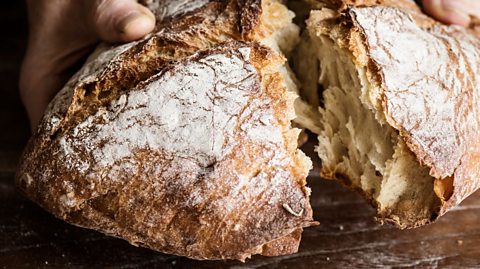
Gluten, he explained, “enables you to form a dough with just the right amount of stretch and flow, to be able to retain the fermentation gases produced by yeast in order to rise, and produce raised bread.”
It’s produced in the bread when you knead it: “Gluten is protein. Protein is long chains of amino acids, and the kneading process aligns those chains, makes them line up.”
Air is also incorporated at the kneading stage, but the magic really starts happening when bread is left to prove. This is when the dough is left to rest at a certain temperature for a bit, and during this process, the yeast in the dough will produce carbon dioxide gas. This gas then diffuses into the bubbles that were made when kneading and makes them grow.
But, as Prof Campbell explains: “those bubbles need to be there to start with; you cannot create bubbles from nothing.” The strong gluten ensures that not all of these bubbles pop, and depending on the type of bread you’re making, it could lead to a very tight or very open structure. Sourdough, for example, has lots of very big bubbles, making the structure quite open.
What does tempering chocolate mean?

When you’re baking, there are lots of other elements that will make your final product look pretty and taste great. One such thing is chocolate, and to get it into a state that’s easy to work with, it must be tempered.
But what does this mean? Put simply, it’s the process of heating and cooling chocolate in order to give it different characteristics. Dr Chapman previously said that “chocolate is quite like butter, in the sense that it's mostly fat, and it has a few other things floating around in it like sugar crystals and cocoa”.
He has an analogy that helps him describe what happens in the tempering process - he said to imagine the fat in the chocolate as having a structure that looks like a chair. He explained: “When you've got liquid fat above its melting point… you've got a completely random sea of chairs in front of you - there's no order to that structure at all.
“But when you cool it down, you start to order that structure and form crystals… you start stacking those chairs, and there are different ways in which you could imagine stacking chairs. You could stack them properly as you form a nice pile, you could put them seat-to-seat, back-to-back… there would be different ways.”
Out of all those different ways of stacking the chairs, Dr Chapman said one will be more stable than the rest. And it’s the same with chocolate - there are apparently six ways the fat crystals can arrange themselves, and there is one in particular that bakers and chocolatiers are striving for when they attempt the tempering process.
Dr Chapman said what you’re looking for is “that it looks shiny, it snaps, and it doesn't melt in your hand."
This article was published in December 2021 and updated in August 2026.
