Sign up to the BBC Bitesize newsletter! External Link
For home education news and stories plus updates on the latest Bitesize content, register for our newsletter today.

If you’ve taken the decision to home educate your child, you may have concerns around managing your time, teaching certain subjects, and whether you’ll put them in for exams.
You may be wondering what you and your child’s social circle will look like, how much home education is going to cost, and whether you’ll get along when you’re together most of the week!

Top home educating fears
BBC Bitesize has spoken to parents and experts to put together some top tips on home educating parents’ main concerns, and how to overcome them.
1. Cost
You may be worried about the cost of supplies or the impact of a reduced income if giving up a job to home educate. Many parents who home educate say it doesn’t have to cost a lot, the key is to plan out your budget so you understand your financial commitments.
Here are some options if you’re worried about money:
Make sure you’re maximising your benefits entitlement
Price up exams costs and textbooks, buy second-hand or borrow from the library where you can
Make the most of home educator discounts at museums and attractions plus cheaper off-peak and term-time travel costs
Share the cost of tutoring and educating your child with other home-educating parents
Find work that has flexible hours or allows you to work from home, so you can plan your ‘school’ and work days/evenings around it
Consider a side hustle, such as blogging, vlogging, selling clothes, crafts or other goods online
Read more in our article on how to apply for funding for home education in the UK.
2. Access to facilities and resources
Many home educating parents are worried they’ll have access to fewer resources than a school would. However, there’s a wealth of information available for free online (as well as subscription-based models), and at your local library and many museums.
BBC Bitesize has educational videos, quizzes, games and more resources for early years children, children aged 5-11 with free downloadable activities, and children aged 11-16 with downloadable learning resources.
If your child previously attended school, you may be able to negotiate continued access to the school’s online subscriptions and apps. Speak to your child’s headteacher before you deregister them. Home education charities and groups also have access to online discounts for their members.
Emma from Gloucestershire home educated her two children. She recommends tapping into online groups and sub-groups which share what kind of resources are available. “If you get into your local home ed group it can be a massive resource, you’ll be talking to people who are at all sorts of stages in their home ed journey.”
Libraries also have a wealth of free resources you can use.
3. The curriculum and what to teach your child
Many home-educating parents see their role as a ‘facilitator’ for their child’s learning, encouraging them to pursue their interests, picking up their own research skills, and becoming an independent learner.
Gloucestershire mum-of-two Emma recommends ‘strewing’: leaving books, toys or objects out for your children to discover, and seeing where that takes their learning.
Many parents also teach subjects via life skills such as cooking, cleaning, fixing items and shopping.
Other parents find following the National Curriculum (Curriculum for Excellence in Scotland) useful for teaching the core English, maths and science subjects, some use tutors for these or other specialist subjects, such as modern foreign languages, and others do it all themselves, with a more structured approach.
Check out the BBC Bitesize home education collection if you need some ideas to get you started.
The choice of what to teach will ultimately be yours, but a good starting point is following your child’s interests. If you’re worried about a lack of accreditation, you could also discuss with your child what they want to do when they’re older. This may change over time but it can help you understand where you’re trying to get them to.
Home-educated children can take GCSE or IGCSE exams or Scottish Highers as private candidates, or your child could take Functional Skills, which focus on essential skills like numeracy and literacy. The level 2 functional skills qualification is equivalent to a GCSE grade 4.
There’s no obligation for your child to have accreditation, but many employers, apprenticeship or further education providers ask for GCSE maths and English grade 4, or a level 2 functional skills in those subjects.
If you’re looking ahead to higher education, some universities will insist on qualifications like A-levels or equivalent, where others, particularly arts and humanities courses, will be more open to individual applications.
Most students apply through UCAS (University and Colleges Admissions Service) and gain ‘tariff points’, either through exam grades or things like volunteering and passing exams in a musical instrument, to get into a university. Your child will usually also need a reference for their UCAS form that is not from a relative.
4. What to do about further education and if my child outpaces me
“I’ve found it easier to learn the elements of maths that I struggled with before.” – Emma, home educating parent
Some parents are concerned about difficulties around further education, and what to do if their child outpaces them.
Wendy Charles-Warner from charity Education Otherwise makes the point that you’re not expected to know everything: “The parent is not a teacher but a guide and facilitator who brings their maturity to helping the child to understand information. Parents also learn alongside their child and share their child’s excitement.”
Emma Beal home educates her three children in the New Forest. She says: “One of the most beautiful things about home education is that you can absolutely learn together and there are so many resources out there on the internet to help you. Outsourcing certain subjects to online classes or tutors certainly helps too if you’re still struggling. I've found that with my weakest subject, now that I have the right motivation (my children), and all the pressures of school removed, I’ve found it easier to learn the elements of maths that I struggled with before.”
When it comes to further or higher education, again be led by your child’s interests and ambitions, tailor your plans accordingly. For example, if they want to be a landscape gardener, think how you can research this together, understand which core subjects they’ll need, what courses they can apply for, and then focus your studies and any outdoors activities on that.
BBC Bitesize Careers has hundreds of job profiles and inspiration articles to help you research. Find out which GCSEs your child should take if they want to work in many popular professions.
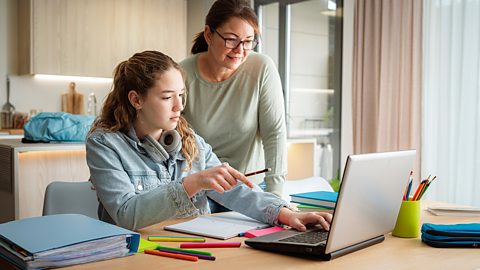
5. Fielding criticism from family, friends and wider society
Some people feel criticised by their own family or friends, or by society more broadly. While you may have a thick skin and not be phased by this, for others it can cause an added degree of stress. Other parents feel home education is underestimated or undervalued.
Emma Beal says: “Take a deep breath, and let it go. Most of the time criticism from family and friends says a lot more about them than it does about you. If you know you’re doing your best for your children, then everyone can just get over it. The family members of ours that have questioned us from a place of deeply caring about us usually just want to be involved and know we really know our stuff. It takes a lot of emotional regulation from us to hold that space for them, but it's made relationships stronger in the end, and everyone in our life either agrees with us, or lets us get on with it.”
Beatrice (not her real name) home-educated her daughter when she was 11: “No one really thanks you for what you do, no one really understands that it is more than a full-time job, on top of being a parent possibly to more than one child, and on top of working your day job… you have to research what will work, you have to have the gumption to phone round people who might be able to help.”
6. Socialisation and isolation from other children and adults
“You will find ‘your village’ and it will be so valuable to your mental and physical wellbeing.” – Emma, home educating parent
You may be worried about your child’s social skills or ability to make friends if they’re at home with you.
Mum-of-three Emma says: “Join Facebook groups! You can start off with big national groups and then be signposted to more local groups. Home educators are all over the country, even in the most rural areas. Talk to other home educators who get it, because people always ask about how the children socialise but often forget about the parents. It can be hard to step out of your comfort zone, but you will find ‘your village’ and it will be so valuable to your mental and physical wellbeing.”
As mum Beatrice puts it: “Other parents and carers get it. They see you and they will have your back.”
Another option for making friends (for you and your child) are museum home education days, evening classes for something you’re interested in, sports and activity clubs.
Sue Armstrong, Clinical Services Manager at relationship charity Relate, says: “Whatever your reasons for educating your child at home, as they grow up they need to be able to navigate the world of communicating with their peer group and with adults, so frequent and varied contact with others will enable them to develop their social skills.”
It’s worth making those steps to break the ice with other children and parents where you can.
7. Have I got the commitment, discipline and organisation needed?
Home education is a big commitment of time and energy, so it’s understandable if you’re worried about taking on the responsibility. Find out as much information as you can beforehand, and write out a sample timetable if it will help you visualise what you can achieve in a week.
Emma Beal says: “The only way I have managed to do this myself is to have a daily rhythm so we all know what to expect. It's all about working out what rhythm works best for each individual family. For example, we have activities and outings with outdoor time in the mornings, followed by lunch then home ed and my work time in the afternoons. From other home educators I’ve spoken to over the years, having a rhythm to your day at the very least sets you up for success in ways winging it never will.”
If you find you’re struggling to cover everything you want to, look at some of the tips above for sharing the load with other parents, or you could consider a flexi-schooling set-up if your child was previously registered at a school.
When it comes to getting your child to do the educational work, Wendy Charles-Warner avoids the word discipline and uses the ‘f’ word instead: fun! “The most effective way to engage a child and encourage learning is to make it fun; the less it appears to be like school the more the child will enjoy it.”
8. Feeling undervalued and burnt out
If you feel undervalued, it can lead to feelings of stress and burnout. Try and remind yourself why you’ve chosen to home educate, and surround yourself with as many supportive people as possible. Focus on what’s important to you and your family, not what other people think.
Try this NHS exercise on reframing negative thoughts.
Find people you can offload to, and who can also tell you their worries. Practise taking it in turns to listen with a partner or ally, without offering advice or judgement.
Understand the importance of self care, try to get out of the house by yourself, even if just for an hour once a week. The same applies for your child, they need space away from you and from their studies to enjoy time with friends, doing hobbies and their favourite activities.
Some parents struggle with being at home all day and find home education slow paced. If that’s you then find a higher-intensity activity to do when you’re not ‘on duty’, whether that’s an online HIIT class, going for a run or a cycle.
9. Will it affect my relationship with my child?
If you’re worried about the impact of too much time together with your child, and whether it will negatively affect your relationship, Sue Armstrong from Relate recommends building in some time apart, and time spent with other adults and peers:
Make a clear distinction between ‘home time’ and ‘school time’. “Make some kind of ‘decompression time’, as often happens when a child is going to and from school either with their parent or on their own, so they (and you) can make that transition.” That could be “spending time in their room, in the garden, or doing something completely different for a short while”.
Find another trusted adult your child can let off steam to, in the same way they’d chat to you about their school teacher if they’d had a day at school. “So that they can go and talk to someone else who will listen to them, on those occasions when, as in any relationship, things get a bit tense.”
It’s harder for a child to go home at the end of a day and leave their teacher ‘at school’ when you’re both their main teacher and their parent. “If there’s been some tension or problem during the day with your child, acknowledge it with them and if it can’t be resolved then and there, let them know that, for now, it’s put to one side and you’ll both return to it the next day, but that home life will carry on as usual.”
10. Learning difficulties may be missed or overlooked
Some parents fear their child’s learning difficulties may be overlooked or not noticed due to a lack of comparison with their peers.
If you have concerns about your child’s learning, you can request that your local authority (LA) carries out an education, health and care (EHC) needs assessment. The LA will assess whether your child has special educational needs (SEN) and whether they need special educational provision, such as special materials or additional support, via an EHC plan.
You can also get assessments done privately, but these can be costly. You know your child best so trust your judgement on whether you think they have additional needs when it comes to their education. You can also chat to your child’s GP and specific charities.
BBC Action Line has further information on charities and support if you’re concerned your child may have additional needs.

Where can I find more support for home education and parenting?
The BBC Bitesize home education collection is designed to support you and your child’s learning at home with free resources for early years and foundation stage (EYFS), primary and secondary-age students.
Bitesize Parenting is the go-to place for the whole parenting community to find stories, expert advice and fun activities.
If your child has special educational needs and / or disabilities, be sure to check out the Parenting SEND collection. Bitesize also has a collection of Sensory Stories, an immersive video series that transports you on unique sensory adventures, for children with additional or complex needs.
For more information about home education, these BBC News articles cover the rise in families deciding to educate their children at home and, from 2021, the impact of Covid on home education.
