Charles' home education story
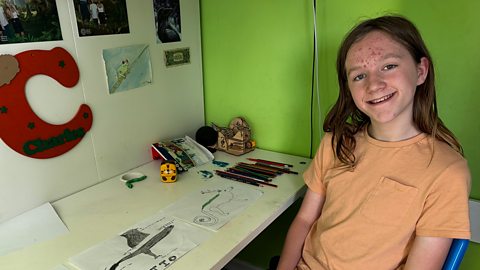
Emma, Charles' mother, realised early on that traditional schooling wasn't for him. They settled on home education, which they felt was a better fit for Charles, socially and emotionally. Charles and Emma spoke to BBC Bitesize and discussed their home education journey and topics such as:
- Forest school
- Being creative
- Future ambitions… and more!
You can see Charles and Emma talk about their story below, and read on to find more tips and advice for home education.
Video: Charles and Emma discuss their experiences of home education
Charles: What home education is to me… it's not having to sit at like a desk for hours, get more time outside in nature. It's also learning about stuff that I want to learn about. We can choose what we learn about as well as the normal subjects. Home education definitely gives me a lot more time to do my hobbies, to play with friends. A big misconception is that home educated kids don't socialise a lot, but I go to loads of groups. I play outside.
Shark attack!
Forest School is basically just a group where you get to connect with your friends in nature.
Got you.
There's three different Forest Schools in a way. There's one for kind of like toddlers, one for like kind of seven to eight year olds, and the one for like my age, like 11 to 14.
Wouldn't this be like an awesome base if you got some sticks around with some bracken.
At Forest School, I've learned skills like leadership, teamwork, crafting. I've done a bit of whittling. One time I got a stick. I like, took off the bark. Like, I think I whittled some kind of pattern into like a handle and pretended it was like a sword.
Right guys, let's see who can find the biggest acorn.
I really enjoyed doing arts recently I've been making original creatures, like fantasy animals. This one, the Crystath, which is a rhino covered in jagged crystals and its horn is made of crystals. This ones called the Perytia, which is a blind flying creature with a spiked tail. I get my inspirations from a couple different things. I like to take an animal and mix it with some kind of elements like water, nature.
Emma: It was quite obvious when Charles was very small that traditional schooling wasn't going to work for him, just from a, not from an academic point of view, but from a social and emotional point of view. Being in a room full of, you know, up to 29 other people with only one adult to emotionally support him wasn't going to be an environment that he could thrive in.
Charles: In a typical home education day, I'm sitting down at the table with my brother and sister. We're all just doing our own work but if we need help, Mum will help us. I don't really see, like, a switch between my Mum when she's teaching us. She's still just my Mum. When I'm older, I want to work with children, be a Forest School leader maybe but I also want to be a social media influencer. One of the things that has inspired me to do this is seeing younger children like our friends or sometimes we meet up with the younger groups.
Albert's third, I'm fourth, Betsy's fifth.
Emma: His friends range from five to 15, and he has deep connections with all of these people and I think that it's not something he would have got if he wasn't home educated. And every time I see him playing with his friends, skipping into Forest School or going to a Stem club, I feel really solidified in that decision that this was the right, right thing for him because he's just such a happy, um, lovely boy who just loves his life. And that's all I want for him is to love learning, love his life, and love his friends.
Charles: Wait you go bridge! You go there. I'll go on the bridge! Got you!
Where can I learn more about different styles of home education
If you want to learn more about the different styles and methods of home education, check out our guides on worldschooling, outdoor learning, flexi-schooling and autonomous learning.
For more subject specific content, be sure to read our guides on how to teach history, geography, science and English at home.
And for more general home education advice, we've got articles on how to home educate in the UK, how to apply for home education funding and how to deregister a child from school.
Where can I find more support for home education and parenting?
The BBC Bitesize home education collection is designed to support you and your child’s learning at home with free resources for early years and foundation stage (EYFS), primary and secondary-age students.
Bitesize Parenting is the go-to place for the whole parenting community to find stories, expert advice and fun activities.
If your child has special educational needs and / or disabilities, be sure to check out the Parenting SEND collection. Bitesize also has a collection of Sensory Stories, an immersive video series that transports you on unique sensory adventures, for children with additional or complex needs.
For more information about home education, these BBC News articles cover the rise in families deciding to educate their children at home and, from 2021, the impact of Covid on home education.
Sign up to the BBC Bitesize newsletter! External Link
For home education news and stories plus updates on the latest Bitesize content, register for our newsletter today.

