As Commission sources put it, with just two million people and living standards almost on a par with Greece or Portugal, it could join in a fortnight.
At the opposite end of the spectrum, Poland, with 40 million people, relatively low incomes and a vast and inefficient farming sector, will be the hardest country to integrate.
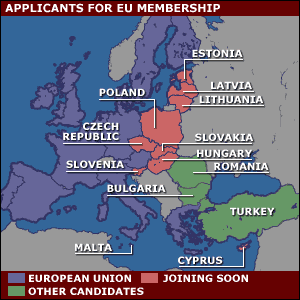
Click here to see a map of EU applicants
It is widely believed in Brussels that Poland is being offered membership at this stage not on the strength of its performance but out of a political imperative.
Corruption, a weak administration and a stagnant economy are Poland's main black spots.
High unemployment persists there and in Slovakia and Lithuania, which are also being criticised for widespread corruption.
Ethnic divisions
The Czech Republic has somewhat restructured its economy, previously damaged by corrupt practices and shady networks of influence.
This brings it almost up to level with Hungary, long a good performer but one which has now been warned over discrimination against the large Roma - or gypsy - minority.
Czechs and Slovaks have received similar warnings.
For their part, Latvia and Estonia have also been told to do more to integrate their large Russian communities.
The only two countries without a Communist past, Cyprus and Malta, are the most prosperous future EU members.
But Cyprus is also the EU's most intractable puzzle, a rich country fringed by a separatist northern backwater with the potential to inflame the eastern Mediterranean.
Finally, bar a few technicalities, Malta - the smallest applicant with its 300,000 people - will fit snugly into the new architecture of Europe.
But with roughly half its population against membership, it may yet find that it cannot honour its invitation.




 E-mail this story to a friend