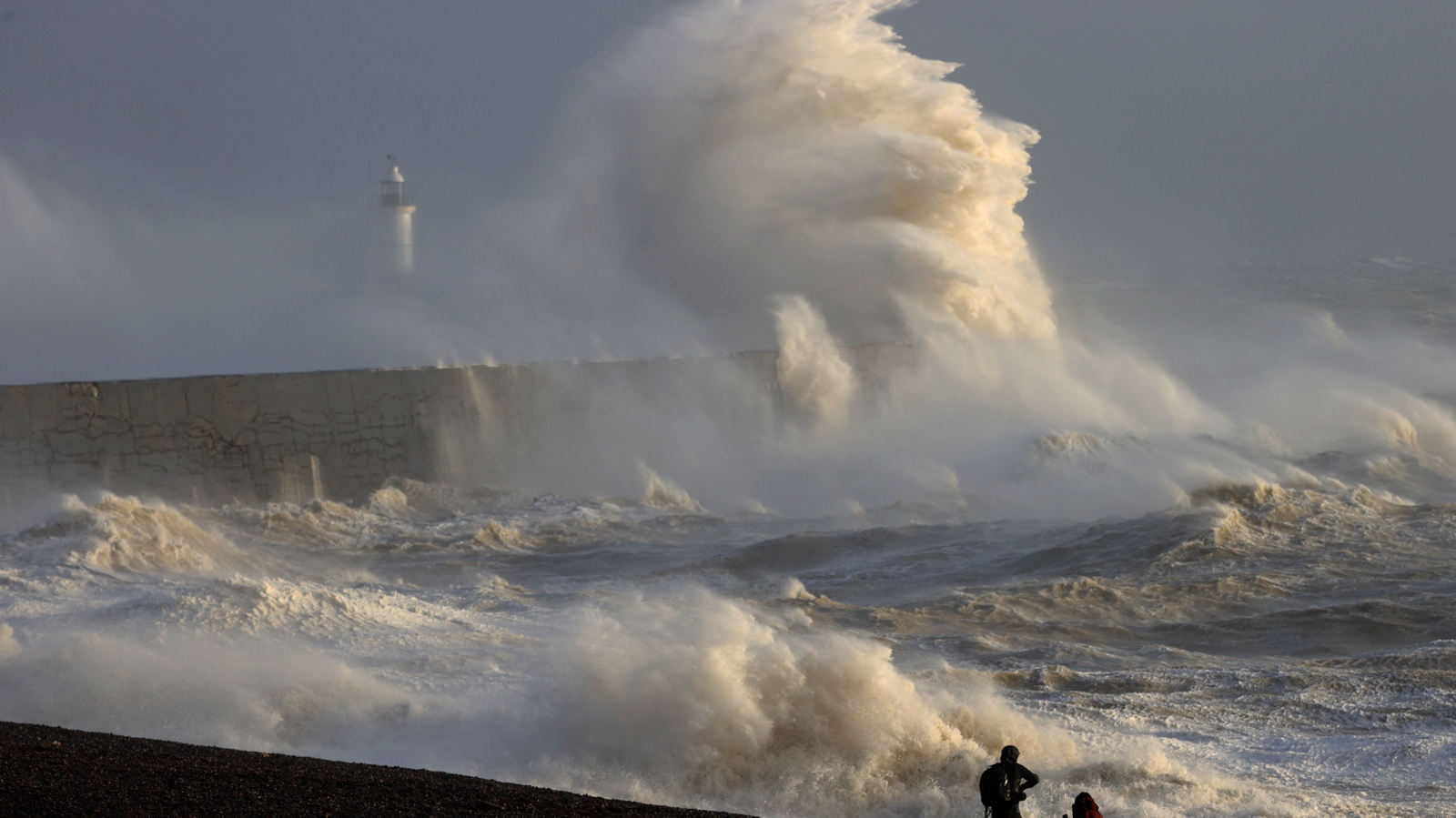
What difference has ten years of storm names made to UK?

- Published
Monday marks ten years since Storm Abigail became the first officially named UK storm.
Abigail lashed north-west Scotland from 12 to 13 November 2015 bringing gusts of up to 84mph (135km/h).
Since November 2015, the UK Met Office, in conjunction with Met Éireann, the Irish weather service, and KNMI, the Dutch weather service, have named a total of 70 storms.
Every September a new list of potential storm names is published by the three weather agencies to mark the start of the season which runs from autumn to summer. More recently names have been suggested by members of the public too.
Why are storms named?
Before the storm naming system came into effect, the most notorious storms were usually known by the day on which they fell - such as the Burns Day storm in 1990 or the St Jude's Day storm of October 2013.
However, giving a storm a name before it hits has become an important tool for the media, weather agencies and the public to engage people when warning of the potential dangers to life and property.
Will Lang, Chief Meteorologist at the Met Office, said: "Storm naming is more than a label, it's a public safety tool that makes severe weather easier to remember, talk about and follow."
According to the Met Office the strategy works. In August 2025 when Storm Floris hit, 93% of people living in the amber alert area were aware of the warning.

Storm Eunice ripped part of the roof from the O2 Arena in east London in February 2022
When are storms named?
Storms in the UK are named based on the expected impact, according to the Met Office's National Severe Weather Warnings service.
This is calculated by considering both the potential damage and disruption the weather may cause, and the likelihood of those impacts occurring.
Usually these impacts will result in an amber or occasionally a rare red weather warning being issued.

The severity of Met Office weather warnings - red, amber and yellow is judged by using this matrix based on how high the impacts of a weather event could be and the likelihood of the event happening.
Storms are usually named due to the strength of the winds but other impacts such as rain or snow can also be taken into account. Storms Bert and Darragh in 2024 and Storm Babet in October 2023 for example, were notable for the amount of rainfall and flooding caused. Storm Desmond in 2015 saw the highest daily rainfall of any named UK storm (267mm).
Two rare red weather warnings were issued for Storm Eunice in 2022. It was one of three named storms to impact the UK in just one week in February. The others were Dudley and Franklin. Eunice was the most severe storm to affect England and Wales since February 2014.
Storm Éowyn in January 2025 was the strongest windstorm for over a decade. Red warnings for were issued for Northern Ireland and parts of Scotland.
It was named three days before impact and the media was credited with raising public engagement in and awareness of the severe weather warnings.

Storm Éowyn in January 2025 was the strongest windstorm for over a decade
Storms which affect the UK usually also have impacts in other areas of north-west Europe.
So sometimes Met Éireann will name a storm first because it will have a severe impact in Ireland, but will produce more benign effects in the UK and the Netherlands.
Storm Jocelyn in January 2024 is a good example as it caused more damage in the Republic of Ireland.
How are storm names chosen?
Lists of names from A to W are issued in September which is the start of every storm season.
In line with the US National Hurricane Centre naming convention none start with Q, U, X, Y and Z.
Since storm names are suggested in collaboration with the Irish and Dutch weather services they reflect the diversity of all three countries and can result in some unusual choices.
Some names are some suggested by members of the public and some can be inspired by real-life people, public figures and even pets.
In the most recent storm list, "Bram" is for Bram Stoker, the Dracula author, while "Dave" was suggested by a member of the public to celebrate "my husband who snores three times louder than any storm".
"Ruby" named after a beloved grandmother, was the most popular name beginning with R nominated for the current season.
However, since all lists begin with A and end with W, it is generally unlikely that names further down the list will actually be reached.
For example, there have never been more than 12 named UK storm names in a season. Names from the list the list starting with M , N. O etc have never been used. The busiest storm season was in 2023/24, which ended with Storm Lilian.
The quietest season in the last ten years was 2022/23 with Antoni and Betty both named in August just before the end of the season.
Ex-hurricanes keep their names
Storm Ophelia hit the UK in October 2017 bringing wind gusts of up to 90mph on the 30th anniversary of the Great Storm of 1987.
Ophelia was in fact an ex-hurricane named by the US National Hurricane Center. When storms are named by other weather agencies they are retained.
Similarly Storm Herminia in January 2025 kept its Spanish name as it swept across the UK.
Storm Amy was first on the UK list this current season. It was named in early October. Storm Benjamin which affected the UK later the same month, was in fact named by the French Met Service. In early November we saw Storm Claudia, named by the Spanish Met Office.
This means though that the next storm name on the UK list is Storm Bram, not Dave.
How does climate change impact the likelihood of named storms?
Detecting long-term trends is challenging as windstorm activity naturally fluctuates from year to year and across decades.
Currently there is no clear evidence of an increase or decrease in either their number or intensity.
Scientists are more confident that the coastal impacts of windstorms, from storm surges and high waves, will worsen as sea-levels rise.
Climate change is making our weather more extreme and a warmer world means that when it does rain, that rain will tend to be heavier with more flooding risks.
- Published2 January 2024
- Published3 September 2025