Stunning sky gazing events to come in 2026

This combined photo shows four stages of the total lunar eclipse observed from Goyang, in South Korea, 3 March 2026
- Published
This year the night sky over the UK has already brought some spectacular events with supermoons, meteors and a planetary line-up and there's plenty still to come.
The main UK event for some will be a partial solar eclipse in August with up to 90% of the Sun obscured, and there will be a partial lunar eclipse in the same month.
You can also expect it to be another year of dazzling sightings of the Northern Lights as activity on the surface of the Sun remains high.
Plus there is also a blue Moon, lots of full Moons, and array of meteor showers.
Full Moons, supermoons and a blue Moon

The Worm Moon in early March seen near Wigan
March's Worm Moon coincided in some regions of the world with a rare total lunar eclipse making it appear red. This so-called Blood Moon, was visible in Asia, Australia and parts of the Americas but sadly not in the UK.
The Wolf supermoon in January was the first of the year and the fourth supermoon in row.
There are two others in 2026 - the Beaver Moon on 24 November followed by the Cold Moon on 23 December.
They happen when the Moon is at its closest point to Earth in its orbit, appearing up to 15% brighter and 30% bigger than regular full ones.
This year there will be an extra full Moon on 31 May, known as a blue Moon. This is the name given to the second full Moon in a calendar month.
We usually get 12 full Moons a year, but as this doesn't quite match up with the lunar cycle roughly every two and half years we get an additional one. As it only happens every few years it is where the expression 'once in a blue Moon' comes from.
If you want to take a picture make sure you turn off the flash on your phone, activate night mode and use ambient light. Oh, and check the BBC Weather forecast.

The Wolf supermoon in January looked huge as it rose over Heathersage in Derbyshire
Catch a shooting star

A meteor streaks across a dark night sky speckled with stars
The next dazzling meteor shower display will be the Lyrids on 22 and 23 April, followed by the Eta Aquariids on 6 and 7 May
Then the Perseids will blaze a trail in mid-August and later on in mid-December the Geminids will be overhead again.
You shouldn't need any special equipment to see these just clear skies and some patience.
The annual Quadrantid meteor shower was active from the end of 2025 to mid-January, and has been known to produce more than 100 meteors an hour on a clear night.
Deep partial solar eclipse
The UK will see a significant partial solar eclipse on 12 August, where up to 90% of the Sun will be eclipsed by the Moon, depending on where you are in the UK.
It will begin at 18:17 BST, with the maximum happening at 19:13.
Across parts of Europe a total solar eclipse will be visible - where the Moon completely covers the Sun. For example in Iceland, parts of Greenland and northern Spain, as well as the Arctic.
This astronomical phenomenon requires the Sun, Moon and Earth to be in complete alignment.
The next full solar eclipse in the UK will not happen for another 64 years, on 23 September 2090, according to the Royal Observatory in Greenwich, external.
Partial lunar eclipse

A partial lunar eclipse is visible above Surrey Quays, London, in March 2025
A partial lunar eclipse will also be visible from the UK later that month. This happens when the Earth is between the Sun and the Moon and part of its shadow covers the Moon.
It takes place on 28 August and around 90% of the Moon will be darkened by the Earth's shadow.
Lunar eclipses are safe to view with the naked eye as they only reflect sunlight. Check the BBC Weather forecast beforehand online or on your app and hope for a cloud-free sky.
Another good year for the Northern Lights
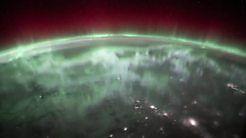
The Northern Lights, or aurora borealis, graced our skies many times in 2025 as the Sun's 11-year cycle of activity peaked.
Solar activity is expected to remain elevated for the first part of 2026, before it starts to decline to reach a the solar minimum around 2030.
The displays are caused by charged particles from the Sun colliding with gases in the Earth's atmosphere around the magnetic poles. The most vivid auroras occur when the Sun emits large clouds of particles called Coronal Mass Ejections.
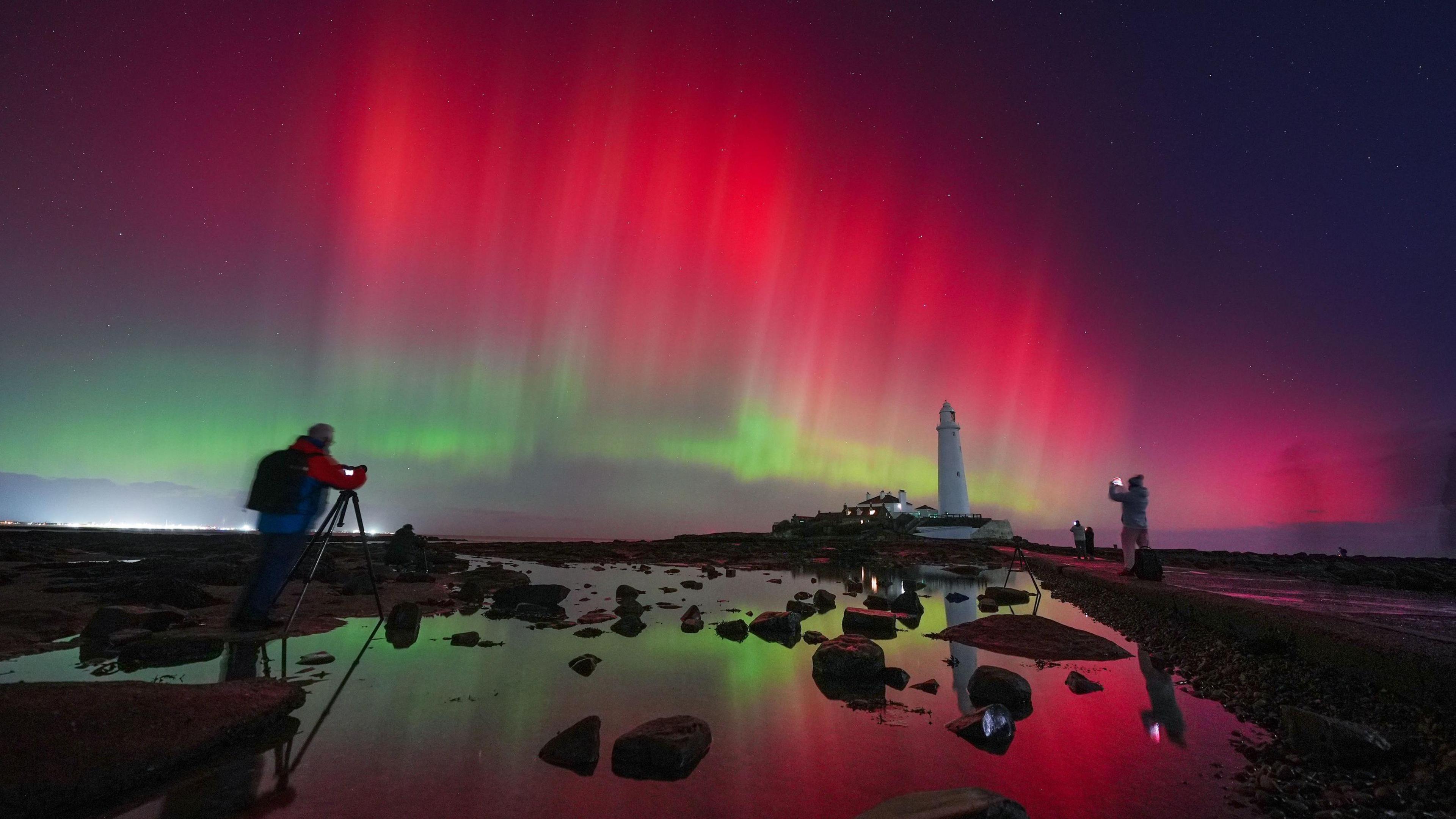
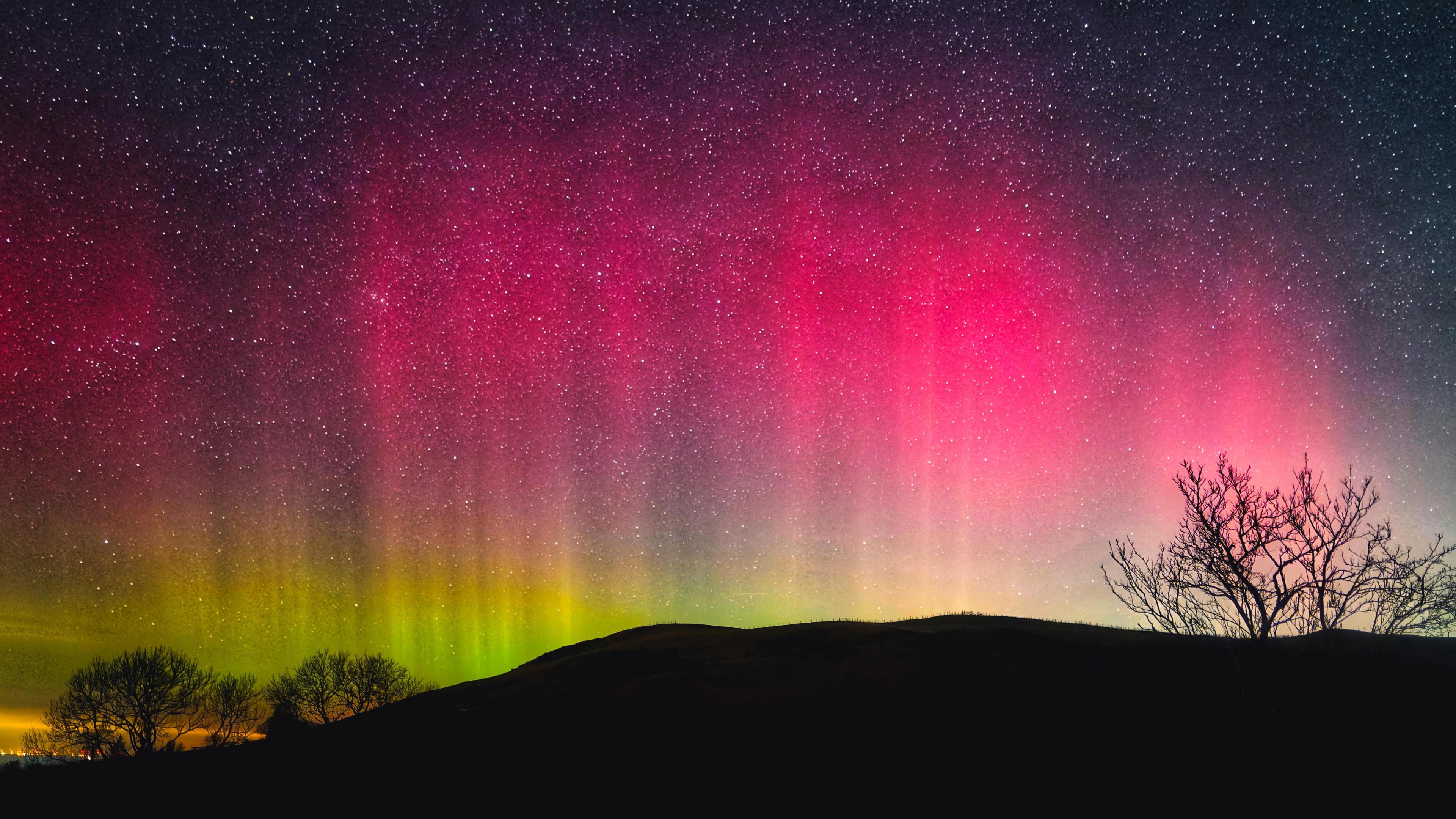
Auroras appear as bright, moving areas of light in the sky that range in colour from red to purple and green to blue. They were spotted the length and breadth of the UK last year and photographed by the BBC Weather Watchers.
- Published29 December 2025
- Published26 March 2025
- Published13 February 2025