Celestial events still to look forward to in the December night sky

Stonehenge at night with starry sky on winter solstice.
- Published
December has been a magical month for stargazers and even though we're hurtling towards the close of the year there's still a lot to come.
A mysterious ancient comet, more meteors and a space station flyby are all on the celestial calendar for the rest of the month.
We've already had a third consecutive supermoon lighting up night skies with the added interest of a rare double lunar halo and the Northern Lights also putting on a dazzling show.
Of course getting to enjoy them generally depends on clear weather conditions so keep a check the viewing potential where you live at BBC Weather.
The winter solstice and the start of astronomical winter
Whatever the weather the winter solstice marks the shortest day of the year in the northern hemisphere. It's when the Earth's axis is tilted at its furthest point from the Sun.
It is also the longest night here and the start of astronomical winter.
The solstice is actually a specific moment, not a whole day and in 2025 it happens at 15:03 GMT on 21 December.
We have solstices because the Earth is tilted on its axis by 23.5 degrees, which affects which part of the planet's surface the Sun is directly overhead at any given time.
Technically it's not something you can go out and watch but as celestial events go it is a moment a lot of people really look foward to, marking the slow shift away from shorter, darker days.
Interstellar Comet 3I/ATLAS

Comet 3I/ATLAS will make it's closest and only encounter with the Earth this month
Just a couple of days ago on 19 December the Comet 3I/ATLAS was at its closest point to Earth but you will have needed a telescope to see it.
It is an interstellar object (only the third ever detected) meaning it originates from outside our solar system. It is not bound to the Sun and will never return.
It was first discovered in July and recent observations show that 3I/ATLAS has developed a faint bluish hue, suggesting a possible colour change - the third shift in its colouring since its discovery.
It's thought to be about seven billion years old - much older than our solar system - and can provide valuable clues about planetary formation in other star systems.
Speculation has arisen in some quarters about it being an alien object, but NASA has thoroughly dismissed these claims.
Ursid and Quadrantid meteor showers
The Ursid meteor shower will run between 17 to 26 December, peaking between the 22 and 23 but generally has a rate of just 10 shooting stars an hour, so not easy to spot even on a clear night.
Don't despair though as the Quadrantids are active from 28 December and are one of the strongest meteor showers of the year. They peak between 3 to 4 January 2026 over the UK.
Meteors, or shooting stars, are tiny pieces of debris from a comet or an asteroid that pass through the Earth's atmosphere, at speeds of up to 150,000mph (241,000km/h). They vaporise and create beautiful streaks of light as they disintigrate.

The Geminid meteor peaked on 20 December
International Space Station flyby

International Space Station in the skies above New Zealand
The International Space Station should be visible above the UK for approximately four minutes at 05:56 GMT on 25 December.
Although it will be dark, the spacecraft will be high enough to reflect the sunlight, so might make it easier to see.
It will be the third brightest object in the sky after the Moon and Venus and appear as a single, fast-moving bright star, easily spotted with the naked eye.
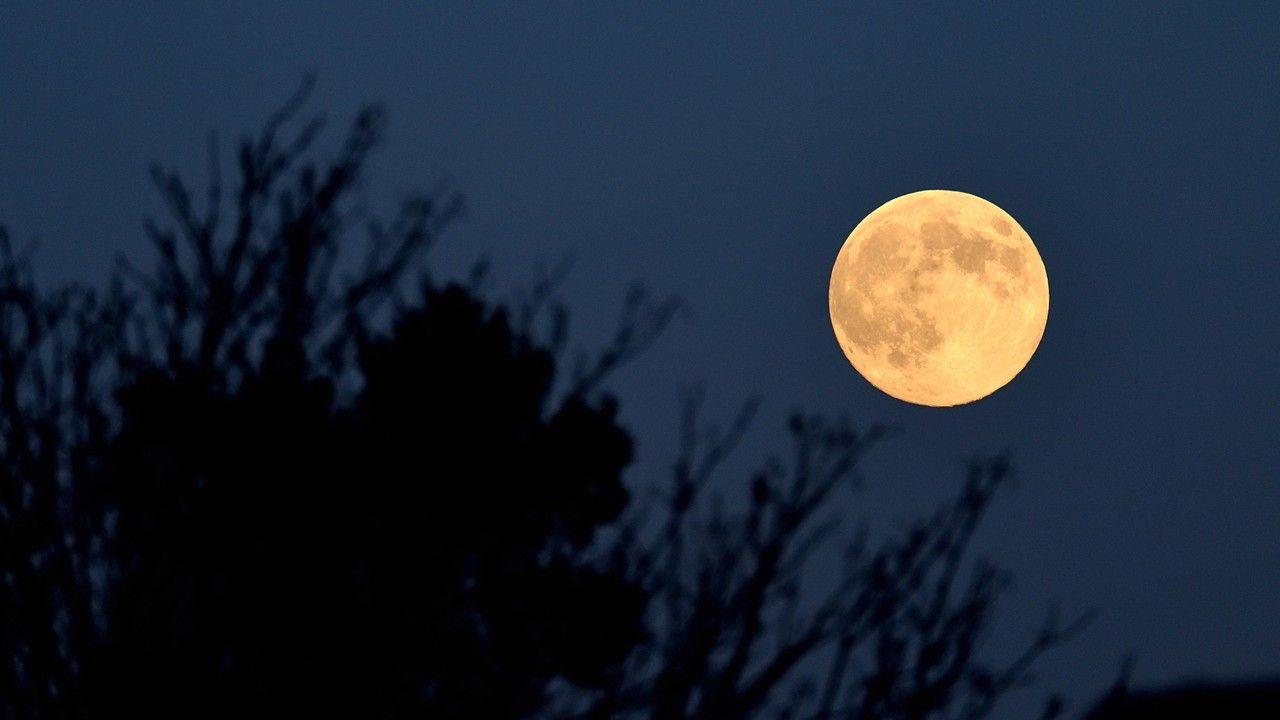
And whilst you may have marvelled at the Cold Moon earlier in December, a fourth consecutive supermoon is on its way in early January. This one is known as the Wolf Moon and the last chance to see the Moon looking so big and close in our night skies until November 2026.

- Published5 December 2025
- Published10 December 2025