A rare double lunar halo and the Northern Lights dazzle stargazers

The Northern Lights were visible in Elgin, Moray, on Wednesday night
- Published
Stargazers enjoyed a double whammy with vibrant Northern Lights and a dazzling lunar halo in just one night.
Indeed a lucky few on Wednesday also witnessed a rare double lunar halo.
A Northern Lights show of vivid tones of purple, pink and green were seen at least as far south as Norfolk and fairly strong geomagnetic activity was recorded.
The clearer skies overnight in northern and eastern parts of the UK helped to boost the viewing conditions.
What are the Northern Lights?

Bright pink and greens of nature's own magnificent light display seen over Norfolk
The Northern Lights, also known as the aurora borealis, happen when charged particles emitted by the Sun, collide and interact with gases in the Earth's atmosphere.
The Sun continuously releases these charged particles, called the solar wind, but when there is a larger concentration of these particles - known as a geomagnetic storm - this greatly increases the chance of seeing an aurora.
The Earth's magnetic field acts as a shield to protect it from the solar wind, and redirects these charged particles towards our polar regions.
There they collide with atmospheric gases like oxygen and nitrogen and in doing so transfer energy to the gases. These gases then release that energy as light.
It is the interaction with different gases at different altitudes that release the coloured lights we see in our night skies.

People in Findochty, Moray, saw some stunning displays Wednesday evening
What are the Northern Lights?
- Published2 January 2025
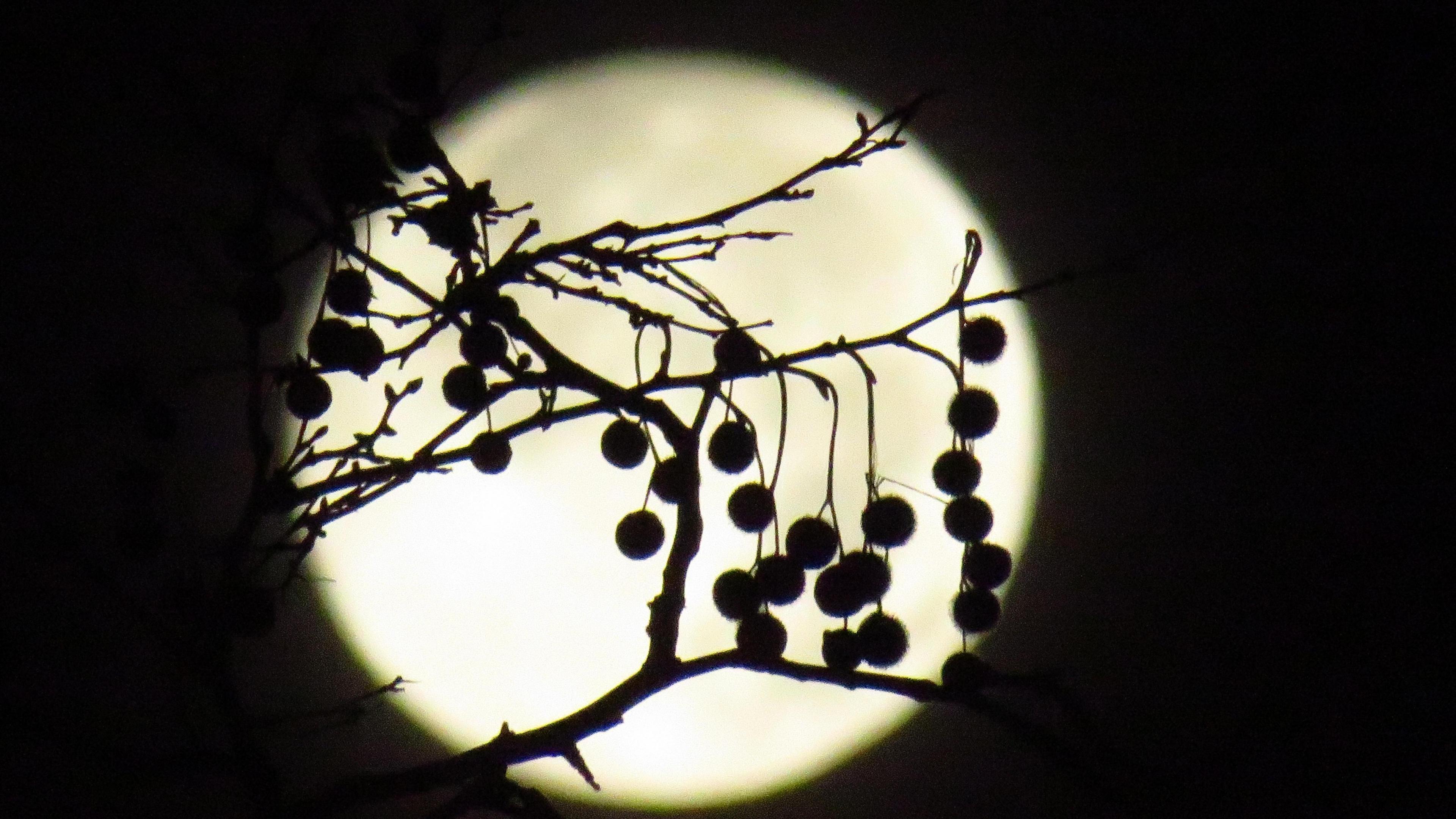
What is a lunar halo?

The lunar halo was visible over Hunstanton, Norfolk
A lunar halo is an optical phenomenon which appears as a bright ring of light circling the Moon. It's created when light from the Moon is refracted by the ice crystals in high altitude cirrus clouds.
Refraction is when a wave of light or sound is bent when it passes from one transparent medium to another. In this case light is moving through the air and then through ice.
In weather folklore, a ring of light around the Moon means impending unsettled weather, often rain or snow. This does have a scientific basis too, as a Moon halo is often seen when a weather front is approaching.
The first sign of the front is high level cirrus cloud and therefore a halo is often a predictor of rain on the way. True to science this happened on Wednesday night, and rain had arrived in Northern Ireland and other western parts of the UK.

A bright Moon and it's halo from Stratford-upon-Avon, Warwickshire
A double lunar halo is a rare occurrence, again they occur when moonlight is refracted or bent as it passes through the atmosphere, but twice this time.
This could happen when the light passes through two layers of ice crystals high in the atmosphere or through two differently shaped ice crystals. The result is two distinct concentric rings around the Moon.
The circles usually appear white, but can be reddish on the inside and bluish on the outside - and nowhere near as distinct as a rainbow.

Breedon on the Hill in Leicestershire, was one of the places were a rare double lunar halo was spotted
Will there be an aurora or lunar halo visible on Thursday night?
A lunar halo is less likely on Thursday night as a weather front will be clearing away, so the high cloud will have moved eastwards. The next front and its high cloud will be over Ireland by dawn, so possibly here.
As for the aurora, it looks like there will be some left over solar energy and another viewing is possible, but more likely to be limited to northern Scotland. Skies here, however, are more expected to be cloudier under the remnants of the Thursday weather front.
The best viewing might be over the Northern Isles between showers when the cloud breaks.
- Published4 December 2025
- Published11 December 2025
- Published10 December 2025