School Radio > Music > KS2: Anglo-Saxons
Part 1 - Part 2 - Part 3 - Part 4 - Part 5 - Part 6 - Resources - Teacher's Notes
Tutorial: 'The end of the Anglo-Saxon dynasty'
Tutorial: 'End end of the Anglo-Saxon dynasty'
The activities during the tutorial include:
- Listening to and clapping along to the steady beat. Identifying how the tempo of the song is slow.
- Looking at the contrasting jumpy, fast rhythms (eg ‘Let us now return…’) and more steady word rhythms (eg ‘And find out what becomes…’) of the first verse. Clapping the different rhythms.
- Recognising and practising the rising pitch sequence - ‘The times are always changing…’ - in the chorus.
- Identifying the places in each verse when the music rises in pitch and practising singing these sections (in lines three and seven).

Song: 'The end of the Anglo-Saxon dynasty'
Song: 'The end of the Anglo-Saxon dynasty' (Vocal)
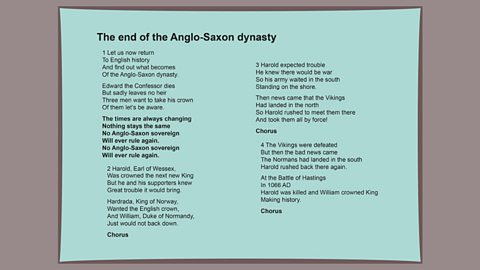
Let us now return
To English history
And find out what becomes
Of the Anglo-Saxon dynasty.
Edward the Confessor dies
But sadly leaves no heir
Three men want to take his crown
Of them let’s be aware.
Chorus:
The times are always changing
Nothing stays the same
No Anglo-Saxon sovereign
Will ever rule again.
No Anglo-Saxon sovereign
Will ever rule again.
Harold, Earl of Wessex,
Was crowned the next new King
But he and his supporters knew
Great trouble it would bring.
Hardrada, King of Norway,
Wanted the English crown,
And William, Duke of Normandy,
Just would not back down.
Chorus
Harold expected trouble
He knew there would be war
So his army waited in the south
Standing on the shore.
Then news came that the Vikings
Had landed in the north
So Harold rushed to meet them there
And took them all by force!
Chorus
The Vikings were defeated
But then the bad news came
The Normans had landed in the south
Harold rushed back there again.
At the Battle of Hastings
In 1066 AD
Harold was killed and William crowned King
Making history.
Chorus
Key elements of the song are:
- Tempo: the song is slow, reflecting the solemn content of the lyrics.
- Rhythm: contrasting 'jumpy', fast rhythms and more steady rhythms.
- Pitch: the rising note patterns in the verses and chorus.
Click here for the lyric sheet (pdf).
Song: 'The end of the Anglo-Saxon dynasty' (Children's choir)
Let us now return
To English history
And find out what becomes
Of the Anglo-Saxon dynasty.
Edward the Confessor dies
But sadly leaves no heir
Three men want to take his crown
Of them let’s be aware.
Chorus:
The times are always changing
Nothing stays the same
No Anglo-Saxon sovereign
Will ever rule again.
No Anglo-Saxon sovereign
Will ever rule again.
Harold, Earl of Wessex,
Was crowned the next new King
But he and his supporters knew
Great trouble it would bring.
Hardrada, King of Norway,
Wanted the English crown,
And William, Duke of Normandy,
Just would not back down.
Chorus
Harold expected trouble
He knew there would be war
So his army waited in the south
Standing on the shore.
Then news came that the Vikings
Had landed in the north
So Harold rushed to meet them there
And took them all by force!
Chorus
The Vikings were defeated
But then the bad news came
The Normans had landed in the south
Harold rushed back there again.
At the Battle of Hastings
In 1066 AD
Harold was killed and William crowned King
Making history.
Chorus
Song: 'The end of the Anglo-Saxon dynasty' (Backing track)
Let us now return
To English history
And find out what becomes
Of the Anglo-Saxon dynasty.
Edward the Confessor dies
But sadly leaves no heir
Three men want to take his crown
Of them let’s be aware.
Chorus:The times are always changingNothing stays the sameNo Anglo-Saxon sovereignWill ever rule again.No Anglo-Saxon sovereignWill ever rule again.
Harold, Earl of Wessex,
Was crowned the next new King
But he and his supporters knew
Great trouble it would bring.
Hardrada, King of Norway,
Wanted the English crown,
And William, Duke of Normandy,
Just would not back down.
Chorus
Harold expected trouble
He knew there would be war
So his army waited in the south
Standing on the shore.
Then news came that the Vikings
Had landed in the north
So Harold rushed to meet them there
And took them all by force!
Chorus
The Vikings were defeated
But then the bad news came
The Normans had landed in the south
Harold rushed back there again.
At the Battle of Hastings
In 1066 AD
Harold was killed and William crowned King
Making history.
Chorus
You can also choose to sing with the Children's choir version of the song - good for encouraging your group to join in.
Once you have learnt the song you can polish your performance by singing with just the Backing track version.
Drama: 1066 - Year of the three kings
Drama: 1066 - Year of the three kings
Narrator: January 1066. The king - Edward the Confessor - is dying and has no children to follow him on the throne. It is said that, years before, Edward named William Duke of Normandy as his successor. But it is also said that Edward changed his mind; now he wants Harold Godwinson, the Earl of Wessex, to become king.
Harold: Your Majesty, you sent for me. I am here.
Edward: Harold, you have been a strong ruler in Wessex. You are a fine soldier, the noblemen respect you, the people love you. They will follow you. Harold Godwinson, I name you as my successor.
Harold: But Your Majesty, it is said -
Edward: It is true. William of Normandy was my choice. But a better person has come forward and that person is you.
FX: A church bell tolling
Narrator: King Edward was buried on January the 6th. On the very same day the witan confirmed Harold as King of England. Across the sea in Normandy, Duke William was furious.
William: Villain! Harold Godwinson has stolen my crown!
Earl: He says that Edward named him heir.
William: He is lying! Edward wanted me for the throne. He gave me a solemn promise. The throne of England is mine and I will have it!
Earl: It is too late, my Lord. Harold is already crowned.
William: It is not too late! Gather together my nobles. If England will not give us the crown then we must cross the water and take it.
Narrator: Harold knew that William would be angry. He told his army to expect an attack from the Normans. But when news of an invasion came, it wasn’t the one Harold was expecting.
Captain: My Lord, we are under attack.
Harold: I knew it! We will march south to meet William in the morning.
Captain: Not William, my Lord… We are attacked in the north by Hardrada, king of Norway! He has already defeated our nobles in the north.
Harold: So now Hardrada thinks he can take my crown as well? Let him try! We will march north and send him back into the sea.
Narrator: Harold knew that it was only a matter of time before he would have to fight William, but before that, a different battle lay ahead. Hardrada and his Viking army were resting after battle. They thought it would take Harold’s army weeks to make the journey north; Harold had other ideas.
FX: Horses. Men marching
Harold: Keep them moving.
Captain: The men need to rest, my Lord.
Harold: There is no time to rest.
Captain: Yes, my Lord.
FX: Louder marching. Drum beat
Narrator: Harold’s army took Hardrada and his army completely by surprise. They fought a battle - the Battle of Stamford Bridge.
FX: Sounds of battle
Narrator: Hardrada was killed and his soldiers fled back to their ships. Now at last Harold and his men thought they could rest. But almost immediately after the battle, he received the news he had been waiting for…
Captain: My Lord, the Normans have come.
Harold: When?
Captain: Three days ago. Duke William has landed with a huge army. Our troops are all here in the north, there was no one to defend our coast in the south. William’s ships landed and his men just walked onto English soil without even drawing their swords.
Harold: William’s stay in England will be short. We will send him home very soon. Let our men sleep tonight and we will march in the morning.
Narrator: So Harold’s army was on the move again - this time speeding south, where they arrived in London.
Captain: My Lord, we must stay here for a few days. It will give the army a chance to rest while others come to join us.
Harold: No. We will keep going!
Captain: My Lord, we don’t have enough men to fight William at the moment. But every day our army grows, as more and more fighters come to join us. In a few days time we’ll have an army to match the Normans. We must wait!
Harold: We will not wait! Not while there is a foreign power in our land. A Norman has come to steal the crown of England. We cannot wait. We will act now.
Narrator: The English army went south. They collected more soldiers on the way but by the time it reached a village called Hastings, Harold’s army was still small and his men were exhausted.
The morning of October the 14th 1066 - the day of the battle…
Harold: Today we face a mighty enemy. They have greater numbers, they have better weapons, but they do not have our strength and they do not have our courage!
FX: Cheering building through the following
Harold: For we have the blood of Saxons and Angles in our veins! This Angle-land - this England - will never fall. Remember our Anglo-Saxon heroes - and victory will be ours!
FX: Slow drum beat
Narrator: Harold’s men fought bravely throughout that long blood-soaked day, but by evening the battle was lost and Harold lay dead.
Harold’s defeat at Hastings marked the end of the Anglo-Saxon dynasty. On Christmas day 1066 William was crowned king of England and the land became ruled by Normans.
So, 1066 was the year when England had three kings: First Edward the Confessor; then Harold Godwinson; Harold the Second of England; and finally, Duke William of Normandy; William the Conqueror.
Synopsis:
When Edward the Confessor died in January 1066 there were three claimants to the throne of England: Harold, Earl of Wessex; Hardrada, King of Norway and William, Duke of Normandy. It is believed Edward had agreed that William should succeed him as king; it is also believed that he may have changed that decision in favour of Harold. Whatever the facts, Harold succession was confirmed by the witan on the day of Edward's burial.
Harold knew that he would face opposition. First he was attacked by Hardrada in the north, where Harold won a decisive victory at the Battle of Stamford Bridge. Almost immediately he learned that William had invaded on the south coast and began the long march southwards.
The two armies met at the Battle of Hastings. The Anglo-Saxon dynasty came to an end and the time of William I - 'William the Conqueror' - and the Normans began.
Click here for the episode transcript (pdf).
Music activity
Focus: Pulse - or strong beat - that runs through a piece of music / Clapping a rhythmic pattern
- Consider how different lyrics - or word patterns - create different rhythmic patterns in the music.
- Nigel claps different word patterns, using words and phrases from the song.
- Next pupils just read the words on the screen and hear their rhythms (without the presenter saying them).
- They then clap them back.
- Encourage pupils to listen carefully and to clap together and in time.
Full details of the music activity in the Teacher's Notes.
Listening music
A medieval, portable organ played by Catalina Vicens
YouTube link. Watch first 2 minutes.
- The organ existed in Anglo-Saxon times, played in large churches and cathedrals.
- An organ at this time could have been small enough to carry, or it could have been enormous, such as the organ in Winchester Cathedral, where it is believed that sixteen men or boys were needed to pump on the bellows to keep enough air flowing to the organ pipes.
- This music is played on a very small organ - so small that you can balance it on your knee.
- The keys of the organ are played by the fingers of the right hand, while the left hand pumps the bellows at the back of the organ to make a sound.
- Is this music happy or sad? What do you think of when you listen to this music? What sort of Anglo-Saxon occasions do you imagine this type of organ might have been used for?
Resources
Teacher's Notes
Download / print (pdf)
Lyrics. document
Download / print lyrics: 'The end of the Anglo-Saxon dynasty' (pdf)
Music. document
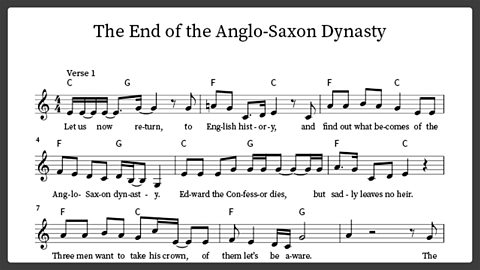
Download / print music: 'The end of the Anglo-Saxon dynasty' (pdf)
School Radio > Music > KS2: Anglo-Saxons
Part 1 - Part 2 - Part 3 - Part 4 - Part 5 - Part 6 - Resources - Teacher's Notes
