School Radio > Music > KS2: Anglo-Saxons
Part 1 - Part 2 - Part 3 - Part 4 - Part 5 - Part 6 - Resources - Teacher's Notes
Tutorial: learn the song 'Alfred the Great'
Tutorial: 'Alfred the Great'
Activities during the tutorial include:
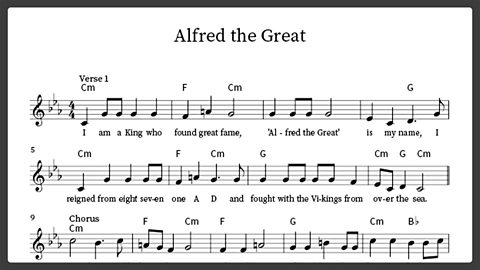
- Identifying how the song is divided into sections called bars.
- Clapping along to the music and explaining that it feels comfortable to count to four - which means there are four beats in a bar.
- Identifying how the notes of the chorus for ‘If you dare’ rise in the pitch and how they fall in pitch on ‘Big fanfare’.
- Practising singing the words of the chorus with lots of energy and confidence, particularly on the words ‘Fight with me, if you dare!’
- Identifying and clapping the fast word rhythms in Verse 2.

Song: 'Alfred the Great'
Song: 'Alfred the Great' (Vocal)
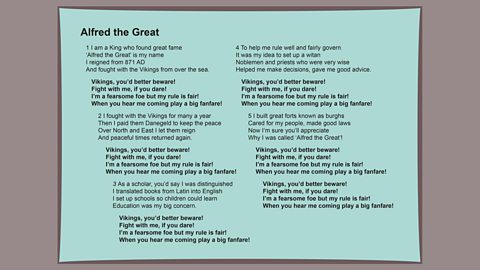
I am a King who found great fame
‘Alfred the Great’ is my name
I reigned from 871 AD
And fought with the Vikings from over the sea.
Vikings, you’d better beware!
Fight with me, if you dare!
I’m a fearsome foe but my rule is fair!
When you hear me coming play a big fanfare!
I fought with the Vikings for many a year
Then I paid them Danegeld to keep the peace
Over North and East I let them reign
And peaceful times returned again.
Vikings, you’d better beware!
Fight with me, if you dare!
I’m a fearsome foe but my rule is fair!
When you hear me coming play a big fanfare!
As a scholar, you’d say I was distinguished
I translated books from Latin into English
I set up schools so children could learn
Education was my big concern.
Vikings, you’d better beware!
Fight with me, if you dare!
I’m a fearsome foe but my rule is fair!
When you hear me coming play a big fanfare!
To help me rule well and fairly govern
It was my idea to set up a Witan
Noblemen and priests who were very wise
Helped me make decisions, gave me good advice.
Vikings, you’d better beware!
Fight with me, if you dare!
I’m a fearsome foe but my rule is fair!
When hear me coming play a big fanfare!
I built great forts known as burghs
Cared for my people, made good laws
Now I’m sure you’ll appreciate
Why I was called ‘Alfred the Great’!
Vikings, you’d better beware!
Fight with me, if you dare!
I’m a fearsome foe but my rule is fair!
When hear me coming play a big fanfare!
Vikings, you’d better beware!
Fight with me, if you dare!
I’m a fearsome foe but my rule is fair!
When hear me coming play a big fanfare!
The song is sung from the point of view of Alfred the Great as he describes his different achievements:
- Fighting against - and then making peace with - the Vikings and establishing the Danelaw.
- Promoting education and learning.
- Ruling wisely with the counsel of the 'witan'.
- Building fortified towns to increase the security of his people.
Click here for the lyric sheet.
Song: 'Alfred the Great' (Children's choir)
I am a King who found great fame
‘Alfred the Great’ is my name
I reigned from 871 AD
And fought with the Vikings from over the sea.
Vikings, you’d better beware!
Fight with me, if you dare!
I’m a fearsome foe but my rule is fair!
When you hear me coming play a big fanfare!
I fought with the Vikings for many a year
Then I paid them Danegeld to keep the peace
Over North and East I let them reign
And peaceful times returned again.
Vikings, you’d better beware!
Fight with me, if you dare!
I’m a fearsome foe but my rule is fair!
When you hear me coming play a big fanfare!
As a scholar, you’d say I was distinguished
I translated books from Latin into English
I set up schools so children could learn
Education was my big concern.
Vikings, you’d better beware!
Fight with me, if you dare!
I’m a fearsome foe but my rule is fair!
When you hear me coming play a big fanfare!
To help me rule well and fairly govern
It was my idea to set up a Witan
Noblemen and priests who were very wise
Helped me make decisions, gave me good advice.
Vikings, you’d better beware!
Fight with me, if you dare!
I’m a fearsome foe but my rule is fair!
When hear me coming play a big fanfare!
I built great forts known as burghs
Cared for my people, made good laws
Now I’m sure you’ll appreciate
Why I was called ‘Alfred the Great’!
Vikings, you’d better beware!
Fight with me, if you dare!
I’m a fearsome foe but my rule is fair!
When hear me coming play a big fanfare!
Vikings, you’d better beware!
Fight with me, if you dare!
I’m a fearsome foe but my rule is fair!
When hear me coming play a big fanfare!
Song: 'Alfred the Great' (Backing track)
I am a King who found great fame
‘Alfred the Great’ is my name
I reigned from 871 AD
And fought with the Vikings from over the sea.
Vikings, you’d better beware!
Fight with me, if you dare!
I’m a fearsome foe but my rule is fair!
When you hear me coming play a big fanfare!
I fought with the Vikings for many a year
Then I paid them Danegeld to keep the peace
Over North and East I let them reign
And peaceful times returned again.
Vikings, you’d better beware!
Fight with me, if you dare!
I’m a fearsome foe but my rule is fair!
When you hear me coming play a big fanfare!
As a scholar, you’d say I was distinguished
I translated books from Latin into English
I set up schools so children could learn
Education was my big concern.
Vikings, you’d better beware!
Fight with me, if you dare!
I’m a fearsome foe but my rule is fair!
When you hear me coming play a big fanfare!
To help me rule well and fairly govern
It was my idea to set up a Witan
Noblemen and priests who were very wise
Helped me make decisions, gave me good advice.
Vikings, you’d better beware!
Fight with me, if you dare!
I’m a fearsome foe but my rule is fair!
When hear me coming play a big fanfare!
I built great forts known as burghs
Cared for my people, made good laws
Now I’m sure you’ll appreciate
Why I was called ‘Alfred the Great’!
Vikings, you’d better beware!
Fight with me, if you dare!
I’m a fearsome foe but my rule is fair!
When hear me coming play a big fanfare!
Vikings, you’d better beware!
Fight with me, if you dare!
I’m a fearsome foe but my rule is fair!
When hear me coming play a big fanfare!
You can also choose to sing with the Children's choir version of the song - good for encouraging your group to join in.
Once you have learnt the song you can polish your performance by singing with just the Backing track version.
Drama: Alfred and the Vikings
Drama: Alfred and the Vikings
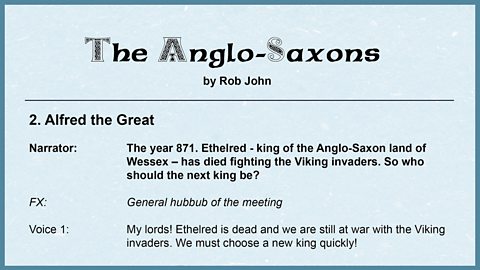
Narrator: The year 871. Ethelred - king of the Anglo-Saxon land of Wessex – has died fighting the Viking invaders. So who should the next king be?
FX: General hubbub of the meeting
Voice 1: My lords! Ethelred is dead and we are still at war with the Viking invaders. We must choose a new king quickly!
Voice 2: I propose Ethelred’s eldest son, Aethelwald! He’s the obvious choice!
Voice 3: But Aethelwald is young, no more than a boy. We are at war. We need a grown man to lead us.
Voice 1: And who, my lord, would you suggest?
Voice 3: Alfred, Ethelred’s brother!
Voice 2: Not Alfred, Alfred is weak! He’s always ill. He won’t survive.
Voice 3: It is true that Alfred is often ill, but he is not weak.
Voice 2: Some days he is so ill he cannot ride his horse.
Voice 1: Alfred has fought bravely in battle.
Voice 2: Alfred is not a true warrior. He would prefer to spend his time reading books than preparing for battle!
Voice 3: We must have kings who can read as well as lead us into battle! Our new king should be Alfred!
Voice 1: I too am for Alfred.
FX: Other voices ‘I am for Alfred’ / ‘Alfred for king!’ etc
Narrator: Alfred was in his early 20s when he became king and although it was true that he was often ill, he certainly wasn’t ‘weak’. The greatest challenge the young king faced came from the Vikings, who had invaded in the north and were moving south…
Thane: King Alfred, the Vikings are advancing again. We cannot beat them.
Alfred: And I say we can.
Thane: But sire - they are stronger than us, they have better weapons. We are outnumbered.
Alfred: Time; if only we had a bit more time to gather our strength. We just need a bit more time…
Thane: Sire - the Vikings march. There is no time.
Alfred: Then we must buy time.
Narrator: And ‘buy time’ is exactly what Alfred did. He made a deal with the Vikings. They agreed not to attack Wessex in return for money. They called that money Danegeld. The Vikings left Wessex in peace but then in 878 the Viking leader - Guthrum - launched a surprise attack on Alfred.
FX: Sounds of battle, horses, cries of men, clash of metal on metal
Thane: Sire, you must escape!
Alfred: No, I will fight and die here alongside my soldiers.
Thane: Then all will be lost. Escape now and you will live!
Alfred: I will not run.
Thane: Sire, please! We need you to live…to lead us to fight another day!
Narrator: Alfred escaped from the Vikings and with a small group of followers, hid in a village surrounded by marshes.
Years later a story was told of the time when Alfred was in hiding. It was said that for many weeks he stayed in the house of an old woman. Alfred was disguised as a poor man so that she had no idea the King was living in her house.
Woman: Hey! Make yourself useful! Keep an eye on the stove. I have bread baking. When the loaves are ready be sure to take them out. Understand?
Alfred: Yes of course - I promise to watch your bread.
Narrator: But Alfred was too busy thinking about the Vikings, too busy trying to work out how he might defeat them…
Alfred: We’ll need more men to fight. We are still too weak.
Thane: And weapons - more swords!
Narrator: Alfred forgot about the loaves of bread and when the old woman returned…
Woman: They’re burnt!
Alfred: I’m sorry. I wasn’t…
Woman: I told you to watch my loaves and now they’re burnt to a cinder!
Thane: Enough! Be silent. Do you know who you’re speaking to?
Woman: Yes! The fool who burnt my loaves!
Thane: No. You are speaking to your…
Alfred: No. It doesn’t matter who I am. She is right to call me a fool. I was given a job to do and I failed. [To the woman] I’m sorry. I will pay you for the burnt loaves. And next time I am given a job I will not fail.
Narrator: When Alfred was ready to leave the marshes he took off his disguise and dressed once more as king…
FX: Drum beat
…and from all over Wessex people came to join him, ready to fight the Vikings.
Alfred: Now we have an army! This time we will take the Vikings by surprise and this time we will win!
FX: Cheering. Music
Narrator: Soon after - at the Battle of Edington - Alfred was as good as his word. The Anglo-Saxon army defeated the Vikings. Guthrum, the Viking leader, promised that he would never attack Wessex again… and in return Alfred gave the Vikings land to the east of Britain, which became known as the Danelaw.
Alfred: We have won a great victory, but we can never be safe until we have trained a proper army. Till we have a fleet of ships, till we have built towns which we can defend. We must look to the future!
Narrator: Alfred put his plans into action: soon that army was trained, those ships were built and new towns, with castles to defend them, sprang up all over Wessex.
Alfred may have been ill for much of his life but he is remembered as one of the strongest kings. He is still the only English king to be given the title ‘Great’.
Synopsis:
Alfred was in his early 20s when he became king in 871 and the defining challenge of his reign was conflict with the Vikings.
Alfred's initial tactic was to make a pact with the Vikings: he agreed to pay them money - the danegeld - in return for peace. The arrangement was eventually broken when the Viking leader - Guthrum - launched a surprise attack against Wessex.
Alfred was forced into hiding in marshland in the West Country and the famous story of Alfred 'burning the cakes' dates from this time. It also marks the low-point in the fortunes of Alfred and the Anglo-Saxons.
Alfred gathers his strength and defeats Guthrum at the Battle of Edington. The Vikings agree to remain in an area to the east of England - which becomes known as the Danelaw. Alfred then sets about increasing the security of Wessex by training an army and building forts.
Click here for the episode transcript (pdf).
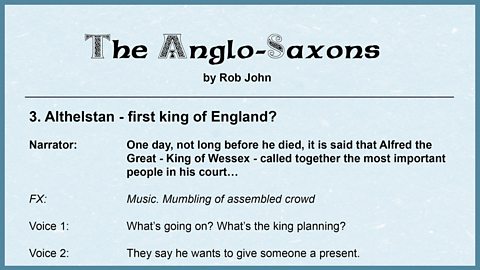
Drama: Athelstan - first king of England?
Drama: Athelstan - first king of England?
Narrator: One day, not long before he died, it is said that Alfred the Great - King of Wessex - called together the most important people in his court…
FX: Music. Mumbling of assembled crowd
Voice 1: What’s going on? What’s the king planning?
Voice 2: They say he wants to give someone a present.
Voice 1: A present? Who’s he giving a present to?
Voice 2: I don’t know but I think we’re about to find out.
Official: Pray silence for the king.
Alfred: Today I wish to give this cloak, belt and sword to my grandson, Athelstan.
Voice 1: Athelstan. Which one is Athelstan?
Voice 2: That boy. The little prince.
Voice 1: Where?
Voice 2: Over there.
Voice 1: But he’s just a child. Why’s the king giving him a sword?
Alfred: Athelstan…
Athlestan: Yes, my lord.
Alfred: Come here. [When the two are close Alfred says quietly:] Today, not even our people here in Wessex know your name, but one day, when you are tall enough to wear this cloak and strong enough to lift this sword, you will be a great king and your name will be known throughout the land.
Athelstan: But grandfather, I don’t want to be famous. I don’t want to be a king.
Alfred: So, what do you want to be?
Athelstan: I just want to be… me.
Alfred: Hmm, that is a good answer. A wise answer. You will be king, but you will always be yourself. Now, turn round and face the people. My lords - look upon this child. This is Athelstan. You will remember that name.
Narrator: While he was still young we believe Athlestan was sent by his father, King Edward – the son of Alfred - to the Kingdom of Mercia. He was to be looked after by his aunt, Athelfleda, Queen of Mercia. She was strong and determined: she built castles and fortresses and led armies against the Vikings. But when Athelstan was sent to live with her in Mercia, he was not happy…
Athelfleda: Let me look at you boy. You are…very small.
Athelstan: I’m not small. I am eight years old and I want to go home. I don’t like it here.
Athelfleda: Why don’t you like it here?
Athelstan: The people of Mercia hate my people - the people of Wessex. I don’t feel safe.
Athelfleda: You have much to learn! We do not hate you. The people here are just afraid - afraid of Wessex because Wessex is strong - just like Wessex fears the Vikings because they are strong. In this land everyone is afraid of everyone else. But what if one day everyone could stop fearing one other and come together as one?
Athelstan: Could that ever happen, Aunt?
Athelfleda: I don’t know. What do you think little Athelstan?
Athlestan: I’m not little!
Narrator: Athelfleda was a powerful queen and also a good teacher. She taught Athelstan to love books and learning and her warriors taught him fighting skills. She taught him how to lead an army into war and she also taught him how to make peace.
Athelstan: Why do people call you a peace-weaver, Aunt?
Athelfleda: Making peace is like making cloth, Athelstan. You have to find all the threads and slowly weave them together until you have something new and strong; something that will last.
Narrator: Athelstan grew up to become a strong and wise young prince. When his father Edward died in 924, Athelstan became king of both Wessex and Mercia and many called him ruler of all England.
Athelstan: My lords, we have a long struggle ahead of us before I or anyone can claim to be King of all England. I have tried hard to make peace across the land, but there are those who still want to fight. An army led by Constantine of Scotland is massing in the north. Scots, Irish, Vikings are joining together to attack us. My lords! We will go to meet them and we will defeat them!
FX: Cheering, drumbeats and marching feet
Athelstan: Athelstan’s army met the forces, led by Constantine, at a place called Brunanburgh in 937…
FX: Battle. Fighting fades to funereal drumbeat
Narrator: The battle lasted for two days and at the end, Athelstan was victorious. But many had died on both sides. Perhaps following the battle Athelstan remembered the words of his aunt, Athelfleda of Mercia…
Athelstan: We have won the battle. It is time to weave the peace.
Narrator: And just as Alfred had predicted, Athelstan became a great king. He helped the poor and passed laws to make the kingdom safer… He built churches and monasteries, promoted learning and had The Bible translated into English…
Most importantly, he started to bring the kingdom together. He invited leaders from all over the land to meet with him…and they came. A kind of peace was woven. And Athelstan had become the first true king of all England.
Synopsis:
Not much is known for certain about the early life of Athelstan. There is a story that his grandfather - Alfred the Great - favoured Athelstan at court and made him a gift of a cloak and sword. It is also believed the Athelstan spent part of his youth in the kingdom of Mercia, which was ruled by Queen Ethelfleda (869? - 918), learning the skills of a young prince.
In 937 Athelstan's kingdom, which combined both Wessex and Mercia, came under attack from a combined force of Scots, Irish and Vikings. Athelstan won a decisive victory at the Battle of Brunanburgh - one of the bloodiest battles in English history. Thereafter Athelstan focused on building the strength of the kingdom.
For many historians Athelstan is the first ruler who can truly be regarded as 'king of all England'.
Click here for the episode transcript (pdf).
Music activity
Focus: Rhythms - fast and slow / Long notes and short notes / Dividing into two parts / Call and response
- Discuss how there are usually many different rhythmic patterns in a piece of music - that’s what helps to make it sound interesting.
- Nigel the presenter claps a variety of fast and slow word rhythms for pupils to copy.
- The presenter claps a variety of long and short note rhythms for pupils to copy.
- Pupils divide into two groups - A and B. They take it in turns to clap long and short note rhythms.
- Discuss if it was easy to stay in time and together? What special skills did pupils need - eg listening carefully to the presenter and watching everyone else.
Full details of the music activity in the Teacher's Notes
Listening music
Listening music: Vivaldi - Concerto for Recorder
Antonio Vivaldi: Concerto for Recorder
- Do pupils know what solo instrument is playing here with the orchestra? It is a recorder.
- The music was written by Italian composer Antonio Vivaldi (born 1678) over 300 years ago.
- What is the style and tempo of the concerto? It is full of energy and very fast!
- Can pupils hear any of the other instruments that are playing? They are string instruments - eg violins, violas and cellos.
- The recorder is a relative of an Anglo-Saxon wind instrument called the bone whistle or bone flute, made from a hollowed out animal bone. Examples are often found on archaeological digs. The instrument has a number of finger holes, ranging from one to six.
You can watch another movement of a Vivaldi recorder concerto at this YouTube link. This is an external link. The BBC is not responsible for the content.
Resources
Teacher's Notes
Download / print (pdf)
Lyrics. document
Download / print lyrics: 'Alfred the Great'
Music. document
Download / print music: 'Alfred the Great' (pdf)
Transcript. document
Download / print the episode transcript (pdf)
Transcript. document
Download / print the episode transcript (pdf)
School Radio > Music > KS2: Anglo-Saxons
Part 1 - Part 2 - Part 3 - Part 4 - Part 5 - Part 6 - Resources - Teacher's Notes

