School Radio > Music > KS2: Anglo-Saxons
Part 1 - Part 2 - Part 3 - Part 4 - Part 5 - Part 6 - Resources - Teacher's Notes
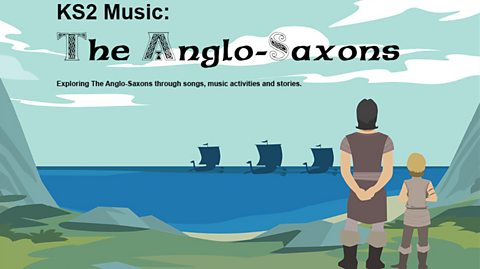
The series begins with an introduction to the Anglo-Saxons - who they were and where they came from - and the first song: 'We are Anglo-Saxons!'
Tutorial: learn the song 'We are Anglo-Saxons'
Tutorial: 'We are Anglo-Saxons!'
Tutorial activities include:
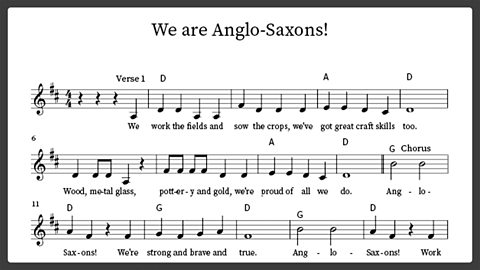
- Identifying and clapping along to the steady, marching beat at the beginning of the song.
- Identifying the steady word rhythms in Verse 1, then the faster word rhythms.
- Understanding how the notes jump from low to high at the end of each verse, running into the chorus.
- Listening for the notes getting higher in pitch at the end of the chorus.
- Dividing into two groups, to sing Verse 3; the tutorial suggests boys and girls due to the traditional roles at the time, but you candivide this however works best for your group.
- Recognising the repeated melodic patterns in Verse 4.

Song: 'We are Anglo-Saxons!'
Song: 'We are Anglo-Saxons!' (Vocal)
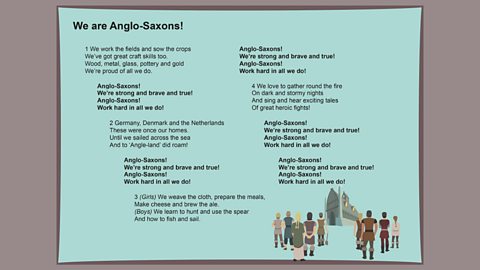
We work the fields
And sow the crops
We’ve got great craft skills too.
Wood, metal, glass, pottery and gold
We’re proud of all we do.
Anglo-Saxons!
We’re strong and brave and true!
Anglo-Saxons!
Work hard in all we do!
Germany, Denmark and the Netherlands
These were once our homes.
Until we sailed across the sea
And to ‘Angle-land’ did roam!
Anglo-Saxons!
We’re strong and brave and true!
Anglo-Saxons!
Work hard in all we do!
(Girls)
We weave the cloth
Prepare the meals
Make cheese and brew the ale.
(Boys)
We learn to hunt
And use the spear
And how to fish and sail.
Anglo-Saxons!
We’re strong and brave and true!
Anglo-Saxons!
Work hard in all we do!
We love to gather round the fire
On dark and stormy nights
And sing and hear exciting tales
Of great heroic fights!
Anglo-Saxons!
We’re strong and brave and true!
Anglo-Saxons!
Work hard in all we do!
Anglo-Saxons!
We’re strong and brave and true!
Anglo-Saxons!
Work hard in all we do!
The first song is an introduction to the Anglo-Saxons and their way of life. Some key elements of the song are:
- Pulse: a steady marching beat.
- Rhythm: alternating between fast and slow rhythms.
- Pitch: musical 'jumps' from high to low.
- Singing in two parts: have the singers split into two groups to sing the lines for 'boys' and 'girls'.
- Melody: repetition of musical patterns.
Click here for the lyric sheet (pdf).
Song: 'We are Anglo-Saxons!' (Children's choir)
We work the fields
And sow the crops
We’ve got great craft skills too.
Wood, metal, glass, pottery and gold
We’re proud of all we do.
Anglo-Saxons!
We’re strong and brave and true!
Anglo-Saxons!
Work hard in all we do!
Germany, Denmark and the Netherlands
These were once our homes.
Until we sailed across the sea
And to ‘Angle-land’ did roam!
Anglo-Saxons!
We’re strong and brave and true!
Anglo-Saxons!
Work hard in all we do!
(Girls)
We weave the cloth
Prepare the meals
Make cheese and brew the ale.
(Boys)
We learn to hunt
And use the spear
And how to fish and sail.
Anglo-Saxons!
We’re strong and brave and true!
Anglo-Saxons!
Work hard in all we do!
We love to gather round the fire
On dark and stormy nights
And sing and hear exciting tales
Of great heroic fights!
Anglo-Saxons!
We’re strong and brave and true!
Anglo-Saxons!
Work hard in all we do!
Anglo-Saxons!
We’re strong and brave and true!
Anglo-Saxons!
Work hard in all we do!
Song: 'We are Anglo-Saxons!' (Backing track)
We work the fields
And sow the crops
We’ve got great craft skills too.
Wood, metal, glass, pottery and gold
We’re proud of all we do.
Anglo-Saxons!
We’re strong and brave and true!
Anglo-Saxons!
Work hard in all we do!
Germany, Denmark and the Netherlands
These were once our homes.
Until we sailed across the sea
And to ‘Angle-land’ did roam!
Anglo-Saxons!
We’re strong and brave and true!
Anglo-Saxons!
Work hard in all we do!
(Girls)
We weave the cloth
Prepare the meals
Make cheese and brew the ale.
(Boys)
We learn to hunt
And use the spear
And how to fish and sail.
Anglo-Saxons!
We’re strong and brave and true!
Anglo-Saxons!
Work hard in all we do!
We love to gather round the fire
On dark and stormy nights
And sing and hear exciting tales
Of great heroic fights!
Anglo-Saxons!
We’re strong and brave and true!
Anglo-Saxons!
Work hard in all we do!
Anglo-Saxons!
We’re strong and brave and true!
Anglo-Saxons!
Work hard in all we do!
You can also choose to sing with the Children's choir version of the song - good for encouraging your group to join in.
Once you have learnt the song you can polish your performance by singing with just the Backing track version.
Drama: The Anglo-Saxons arrive
Drama: The Anglo-Saxons arrive
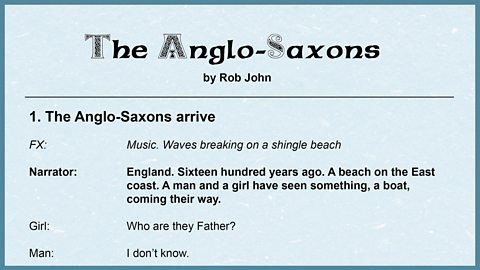
Music. Waves breaking on a shingle beach
Narrator: England. Sixteen hundred years ago. A beach on the East coast. A man and a girl have seen something, a boat, coming their way.
Girl: Who are they Father?
Man: I don’t know.
Girl: Are they Britons like us?
Man: I don’t think so. Their boat looks strange. It’s too long to be one of ours.
Girl: Look Father. There’s another one. Two boats.
Man: No. Not two. Look further out; three…four…five. And see, there. More. Lots more.
Girl: Father - I’m frightened.
Narrator: They don’t know it, but the girl and her father are looking at visitors from across the sea. People who will change Britain forever. People we call The Anglo-Saxons.
Sixteen hundred years ago the Anglo-Saxons started coming across the sea to Britain from countries we now call Denmark, the Netherlands and Germany.
At first they were just raiders; they stole valuable possessions from the Britons and then went home.
But soon the invaders became settlers. They brought their families, they built farms and villages. These Anglo-Saxons had come to stay.
FX: A horse walking, a dog barking, a cockerel crows etc as a thane returns to his village/farm/home at evening.
Narrator: Two hundred years later: The Anglo-Saxons now rule Britain. An Anglo-Saxon lord - a thane - is returning home to his wife and family.
FX: Fire in hearth
Wife: I was worried; you’ve been away for days.
Thane: It was a long way.
Wife: Sit. I’ll bring you food.
Thane: Has all been well?
Wife: The children are fine, the crops are ripening. No wolves have attacked the sheep. All is well. Now… tell me of the meeting.
Thane: The witan was held two nights ago.
Wife: Tell me.
Thane: I’m tired. Tomorrow.
Wife: Were you allowed to enter the Great Hall? Were all the other thanes there?
Thane: I need to sleep.
Wife: Did you see the king?
Thane: Later.
Wife: Tell me now. I want to hear everything.
Thane: Alright…Yes, I entered the Great Hall. Yes, all the thanes of the kingdom were there.
Wife: Is the hall big?
Thane: Huge. Twenty men standing on each other’s shoulders wouldn’t reach the ceiling. The walls are hung with furs and tapestries – the finest. And swords and shields… The tables stretch the entire length of the hall.
Wife: And the king?
Thane: The king sat at the highest table, surrounded by his advisors. The thanes sat down the sides.
Wife: Was there a great feast?
Thane: Meat was roasting on two huge fires. The king’s servants poured horns of mead. Every man ate and drank his fill.
Wife: And…the witan?
Thane: The next day the King held his witan and we found out why he wanted us there; we are to prepare ourselves for battle.
Wife: A battle?
Thane: The kingdom to the north wants to take our land. We’re going to attack them before they attack us. I must leave in three days.
Wife: You? Why do you have to go?
Thane: It’s my duty as a thane. If the king asks me to fight then I must fight.
Wife: No, I don’t want you to go. There is work to be done here. Harvest is coming. Who’ll tell the servants what to do?
Thane: You will. You’ll be in charge.
Wife: They won’t listen to me!
Thane: They will listen. Anyway, I won’t be away for long. This is just a brief quarrel between kings. It’ll be over in no time.
Wife: You don’t know that. Please…
Thane: I have no choice. The King calls me and I must go. If I have to fight then I will fight.
Wife: But you’re not a fighter.
Thane: Really?
Wife: Once perhaps, but not any more. Now we are a farmers…landowners.
Thane: And why are we landowners? Why do we have a farm and fields and animals? Why do we have servants and live in this place? Because the king gave it all to us! So we serve the King. And when he calls us to battle, we do not argue. We pick up our weapons and fight, to the death if we have to.
Narrator: For the next three hundred years the five main Anglo-Saxon kingdoms - East Anglia, Mercia, Kent, Northumbria and Wessex - became stronger and richer. Sometimes they quarrelled and fought battles against each other… but they also built castles and towns and farmed the fertile soil of England.
But then, in 873, new ships appeared sailing towards the English coast - fierce invaders from the north. The Vikings.
Synopsis:
1600 years ago. A beach on the east coast of England. A child and her father watch as ships appear on the horizon. Anglo-Saxons are arriving in England.
The first Anglo-Saxons arrived as raiders, taking away with them whatever precious articles they could plunder. But later they brought their families and settled the fertile land.
Two hundred years later and the Anglo-Saxons now rule the land. A thane returns to his home where his wife quizzes him about the recent 'witan' - a meeting of Anglo-Saxon leaders. The thane reveals that he must shortly leave to fight for the king. Everything they possess is dependent on royal patronage, so he must do as the king commands.
Later, new ships appear on the horizon - new raiders from the north. The Vikings.
Click here to download / print the episode transcript (pdf).
Music activity
Focus: Pulse - fast and slow / Singing in two parts / Singing a round
Pulse: Nigel, the presenter, claps a slow beat, followed by a faster beat and pupils copy. Pupils then move slowly, then quickly, in time to the beat, using rowing movements - reaching forward and pulling back, as though they are rowing an Anglo-Saxon ship.
Singing a round. Pupils divide into two groups. Group A sings Verse 4 first, then Group B joins in.
- Discuss how a steady beat, or pulse usually runs through a piece of music. It is rather like a heartbeat and helps everyone who is singing or playing to stay in time. Encourage pupils to follow the beat carefully and to clap along with it.
- Tell pupils that a round is a piece of music, when everyone sings the same thing - but at a slightly different time to each other. One group goes first, then the next follows, a little later.
- Choose another verse from the song to sing as a round.
Full details of the activity in the Teacher's Notes
Listening music
Listening music: Mozart - Horn Concerto
Mozart: Horn Concerto
- This famous piece of music is a horn concerto. A concerto is a piece of music written for a musician who plays solo accompanied by an orchestra.
- The horn is made out of brass and it belongs to the brass family of the orchestra. It has keys - special metal pads which cover the holes of the instrument. When you press your fingers on the keys you change the notes that the horn plays.
- Musical horns also existed in Anglo-Saxon times. They were made out wood, or out of a real animal’s horn - usually that of an ox or goat.
- What do you think the horn was used for? It could be played loudly for use in battle, or as a signal. It could also be played quietly, with an instrument such as the lyre (or small harp).
You could also share this YouTube link. Watch from the entry of the horn at 00 54 to 02 10. This is an external link. The BBC is not responsible for the content.
Resources
Teacher's Notes
Download / print (pdf)
Lyrics. document
Download / print lyrics: 'We are Anglo-Saxons!' (pdf)
Music. document
Download / print music: 'We are Anglo-Saxons!' (pdf)
School Radio > Music > KS2: Anglo-Saxons
Part 1 - Part 2 - Part 3 - Part 4 - Part 5 - Part 6 - Resources - Teacher's Notes
