We are the Hungry Sandwich Club. We’re a digital design company and we specialise in animation and illustration.
We’re known for our characters, our illustration using bright colours and trying to make every project really fun really. We try and make people laugh. Everything should be taken with a pinch of salt is kind of our attitude.
Andrew:
So this is the home page of our website. And this banner at the top we always have an animated character.
Martin:
And there just a little show reel. A little bit of fun to greet the visitor to our website. And… people will get an essence of what we’re about and hopefully hire us to work with the.
Andrew:
Serious people, banks, insurers or whatever, even they want animation that’s going to explain things to people. They still need to like present themselves as being approachable and friendly. And clients want to be fun and that’s the service you’re selling.
Martin:
So today we’re going to animate another character. Keeping our strong colours that we’ve been using. And I’m thinking about doing an artist or an illustrator. She could have an easel, maybe like one of those … what are those things called?
Andrew:
Artist’s pallet.
Martin:
Artist’s pallet. Yeah, yeah.
Andrew:
Yeah mixing the paints.
Martin:
She can be dipping in, mixing the paints and putting it on the easel.
Andrew:
That sounds cool. I think, yeah, we should go for it. Cool.
Martin:
I’m trying to be really rough with my sketches. I don’t use a fancy notebook. I don’t use a fancy sketch pad. It could be on the back of a napkin. Like these are just really rough. They’re just to get my ideas out - what I think my character could look like.
Both of us are naturally really shy people. We weren’t that person in the class that was shouting. We weren’t that person in the class who was producing work that had to show the work off.
You can actually make your work shine and you don’t have to be the loud one in the class.
So these are templates. So I’m going to use my rough sketches that I’ve done there and start to illustrate on top of these templates that I’ve created.
The most important thing is just two brains are better than one.
Andrew:
If you’re just always working on your own sometimes you just can’t break out of the way you’re thinking or the ideas. But another person’s input, they can see it from a totally different way or coming at it from a different angle. And make you go, oh yeah. I can make something better here.
Martin:
Now I’ve got a load of rough sketches. I’m going to start building my character up.
I use a lot of shapes. Like simple shapes, squares, circles to build up my characters.
So I’ve finished working up my illustration on the computer and I’m basically separated up the layers so each of the body parts can move like a puppet.
Andrew:
So we’re going to take this model now and move it in to our software for animating and make it move.
So I’m just going to dip in to the paint and then spin round when it goes up to meet the canvas.
Martin:
Her elbow should bend in the other direction.
Martin:
I think there is ups and downs. We’ve definitely struggled with finding the way we both work.
Andrew:
So I guess the disadvantage of only having two of us is there’s no one to settle argument. If you disagree it’s just me and him. There’s no third person to say who’s right or wrong. We just have to talk things through until, er… we’ve figured it out.
Martin:
It’s looking good. It’s just about finished.
So when I came to my options I very nearly chose PE but instead I chose art. I just decided to swap. I just told my head of year, I just said I’m going to try art instead… and, it obviously paid off because I’m still here doing a subject that relates to that.
So from the simple sketches this morning, through to the final animation we now have something that we can now show on our website. Hopefully, get some more work and carry on doing what we love.
Video summary
What's it like running your own animation agency?
Leeds based animators Andrew Foster and Martin O’Dea run the digital design company Hungry Sandwich Club.
They create fun animations and characters for companies and brands.
They talk about the positive and negative aspects of working in a partnership, their experiences at school and the importance of ‘getting ideas out’.
They demonstrate the process of creating a new animated character for their own website.
Teacher Notes
The pupils could be set a brief to design a character that would advertise a specific company, with the teacher providing a range of options.
It could be shown to demonstrate how the idea for a character develops.
The pupils could create thumbnail sketches of possible characters, researching the relevant theme to look at source material for inspiration, before creating a final design.
They could use either traditional animation techniques, such as a flickbook or series of drawings to be photographed and animated or use a photo manipulation software programme if the school has such facilities.
This clip will be relevant for teaching Art and Design at KS3 in England and Northern Ireland, KS3 and GCSE in Wales and 2nd, 3rd and 4th Level in Scotland.
A career in ceramics
Anna Barlow tells us about her successful career in ceramics and sculpture design

A career in woodwork
Ruairi McGuigan explains his career in illustration and woodcutting
A career in games design
Sean Barron describes his career in computer games design
A career in street art
Mohammed Ali tells us about his work designing murals and street art
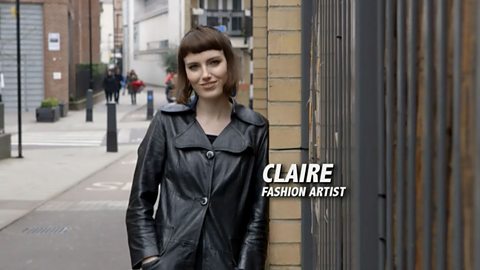
A career as a fashion artist. video
What's it like to work in fashion? Clare Barrow is an artist who now works in the industry.
A career in print design
Artist Charlotte Beevor takes inspiration from nature in her work creating prints