I really enjoy working with wood. I find that it helps give character to my characters. There’s an existing grain. It splinters. It rips. The lines are never clean. Especially in the subject matter I tend to work within which is industrial history. There is a real rawness to that subject. A rawness that’s kind of beautifully represented in the rawness of the wood.
Today we’re gonna work on this large wooden silhouette. Going to fix up the drawing, sort of correct the mistakes and then I’m going to start carving it. And then I will ink up the whole figure. So what we’ll be left with is a black figure with a detailed face.
This piece here is part of a commission I’m working on at the moment for a museum. A commission is where someone wants you to produce artwork or artworks for them in return for money. It’s the commercial side of art.
So the exhibition’s – it’s a history of Irish people living outside of Ireland around the world. I sort of start every project with preliminary sketches. I don’t like to spend too much time on these because no one else is ever going to see these. They’re not the final product, they’re about working through an idea.
So I’ll start with these tiny black smudges almost, just looking at how you can read a stance. Then you’ll sort of build that up a little bit further, looking at may be the overall composition, working up towards sort of maybe going a little bit bigger. A little bit bigger and changing the stance and looking at the faces and the little details that can add another level of information.
And from here I’d almost be ready to go on to the final drawings.
I don’t think I’ve ever been 100% happy with something I’ve drawn. A bad drawing’s there to be learnt from and if you don’t have these reminders, that you weren’t always perfect, and that you couldn’t always draw really well, it’s quite nice to have a reflection point to see your progress.
When Pokémon came out, I used to have books and books of circles with all these different creatures that I’d drawn in them when I must have been like eight years old. And everyone in the class found them really exciting and wanted me to draw them their own figures. And that was sort of like, that kind of, your friends at that age sort of getting really excited about drawing and you being good at something… it hugely encourages you to push it on.
A lot of jobs are about following rules that are already determined. With art you’re encouraged to make up your own rules.
There are elements to making art that I see as a job. The finding commissions. The applications for prizes. The applications for work.But making the art itself doesn’t seem like it’s a job.
It takes a lot of confidence. The idea that you can’t undo. You can’t rub out a chisel mark.
To a viewer they might think that I’ve considered every tiny little scratch on this piece of wood. And that they’re all intentional and really worked. They’re not. Every time is kind of like an experiment. And every time the chisel touches the wood I’m taking a risk. I’m just quite good at pulling them off.
This is the really satisfying bit if you’ve done it right.
It turned out way better than I thought it would…
The feeling at the end isn’t about people saying they like your work. It’s about people understanding and getting the work without being prompted. At no point do I get the sense of satisfaction of someone saying, oh it’s really good I like it. But if someone walks in and they start to read in to it and get involved with the work and look at it long enough to start to pull out these little details that I thought no one would ever notice, that’s when the real satisfaction comes through.
Video summary
Artist Ruairi Fallon McGuigan uses illustration and wood cutting tools to create life-size figures.
He discusses his process and why he loves his career as an artist.
Ruairi has recently received a commission to create the work for a new museum exhibition.
He demonstrates using wood cutting tools and chisels to carve out figures’ faces.
He talks about what inspired him to become an artist and his experiences of art at school.
Teacher Notes
This clip is excellent at explaining the process of developing a realised work, starting with sketches and building to an ambitious large woodcut and printed piece.
The clip could be used to inspire a similar approach from the pupils.
They could work on quick sketches of one another, or as a homework task, and then refine these drawings into a design to be turned into a relief print.
Using polyblock tiles the pupils could transfer their designs onto the tiles to create a printing block and then use printing ink to create stylised portraits.
This clip will be relevant for teaching Art and Design at KS3 in England and Northern Ireland, KS3 and GCSE in Wales and 2nd, 3rd and 4th Level in Scotland.
A career in animation
Andrew and Martin tell us how they built their careers as animators and designers
A career in ceramics
Anna Barlow tells us about her successful career in ceramics and sculpture design

A career in games design
Sean Barron describes his career in computer games design
A career in print design
Artist Charlotte Beevor takes inspiration from nature in her work creating prints
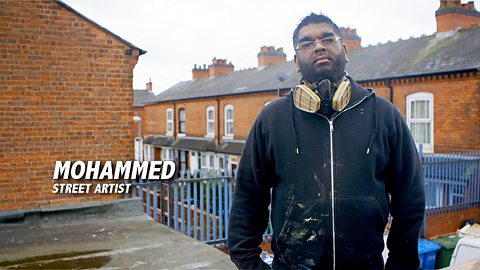
A career in street art
Mohammed Ali tells us about his work designing murals and street art
A career as a fashion artist. video
What's it like to work in fashion? Clare Barrow is an artist who now works in the industry.