My name is Jeanne-Marie Regnier. Jeanne-Marie Regnier. Of course, I have my ID documents to prove it…
This is Paris. 1943. It’s World War Two. The Germans have taken over France. And they’re looking for me.
I’m the only one of my spy group left in the whole country.
My real name… my real name is Noor Inayat Khan. I’ll tell you my story…
I had a wonderful childhood. My father was from an Indian royal family. He was a musician, and he taught people about our religion – Sufi Islam. My mother was American. I was born in 1914. We lived in London, and then in Paris.
I grew up playing Indian music and writing poetry. I never thought I would end up in a war.But when I was 25, the German army invaded France, and I had to make a choice.
Sufism is a religion of non-violence. I didn’t want to hurt anyone, but I felt strongly that what the Germans were doing was wrong…
So I chose to go back to England, and I joined the Women’s Auxiliary Air Force.I trained to become a radio operator, sending and receiving messages over long distances.And then I was asked if I wanted to do a more difficult job – to work as a secret agent.
In occupied France, there were many people secretly working against the Germans.Britain needed to be able to communicate with them – and the only way to do that was to have secret radio operators in France. Of course, they had to be people who spoke perfect French – like me.
I knew that it would be a very dangerous job. But I agreed, and started my training - in how to send messages in code, how to make contact with other secret agents, and most importantly, how to stay hidden.
In June 1943, I was flown into France, in a plane that was small enough to not be detected by the enemy. Using my false identity – Jeanne-Marie Regnier – I travelled to Paris, met up with someone from the secret organisation, and set up a radio link with London.
But my contacts in London weren’t the only ones listening for radio signals coming from Paris.
The German secret police were always listening out too. They were trying to hunt down any enemy spies. They had men driving around the city with radio detector vans, which could zero in on the position of a transmitter. That meant that I could never broadcast for more than 20 minutes.
And I had to keep moving around. A radio transmitter was a heavy piece of equipment – I had to lug it around in a suitcase, or a pram to disguise it.
I think I knew that I’d never make it home again…
The Germans caught somebody in my secret group. They forced her to talk. The other agents who’d been sent out from London were all captured. I was the only radio operator left. And they were hunting for me night and day! I kept moving, and I kept transmitting – for months. But in the end… they got me.
They tried to make me talk. I wouldn’t. I escaped but they caught me again. They transferred me to a prison in Germany. And in September 1944, they had me executed.
But they didn't make me forget who I was, or why I was trying to stop them. Someone else in the prison that day said he heard my final word – ‘Liberté!’ - ‘freedom’.
Video summary
This film follows Noor Inayat Khan, a radio operator and secret agent during WW2, who transmitted messages against the German occupation as part of the French resistance.
Noor Inayat Khan grew up in London and Paris. Her religious background, Sufi Islam, emphasised pacifism and she had a happy childhood, immersing herself in music and poetry.
When war broke out in 1939, she chose a path of nonviolent resistance, joining the Women’s Auxiliary Air Force and later becoming a secret agent in occupied France.
Despite the threat of discovery, she transmitted messages until her eventual capture and execution in 1944.
Teacher Notes
Additional notes
- Names
Noor Inayat Khan had multiple names. As described in this further BBC Teach resource, her code name was Madeleine and her ID documents listed her as Jeanne Marie Regnier.
This film can be used to discuss the role of individuals during wartime and how cultural background can impact a person’s decision-making.
Before the video
- What jobs did people have during WW2 in order to protect their country?
- Sometimes people have multiple names or identities. Why might someone have multiple names?
- What is a secret agent? How would they help during WW2?
- What is a pacifist? Why might someone become a pacifist?
- For upper KS2 students: What was the role of women during WW2? How might this have been different to women’s roles before WW2?
During the video
- How would you describe Noor’s childhood?
- What challenges did Noor face while she was a secret agent in France?
- How did she manage to stay hidden and transmit messages despite the constant danger?
After the video
- Why do you think Noor decided to help during the war even though she was a pacifist?
- How do you think her family and her childhood shaped her beliefs?
- Why was it important for Britain to have secret radio operators in occupied France?
- Who knows what ‘liberté’ means? Why do you think it was her final word?
- What do you think Noor believed in?
- Why do you think it's important to remember stories like Noor Inayat Khan's?
- What can we learn from Noor's story? How can she inspire what we do now?
This film will be suitable for teaching History at KS2 in England and Wales and KS2 in Northern Ireland. Also 2nd Level in Scotland.
More from this series:
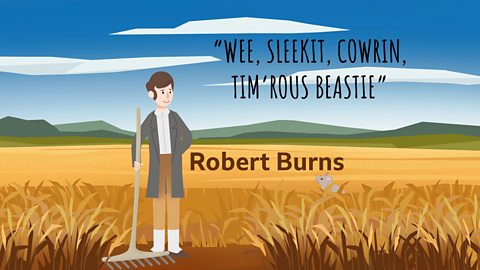
Robert Burns. video
This animated film explores the life of Robert Burns, a poet renowned for his celebration of his Scottish identity.
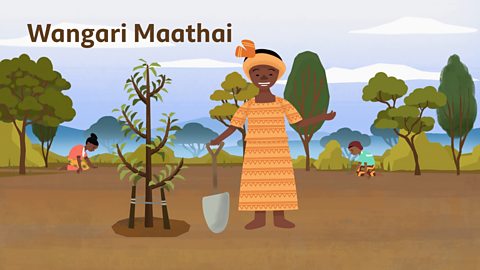
Wangari Maathai. video
This animated film explores the life and achievements of Wangari Maathai, an environmental activist from Kenya who founded the Green Belt movement.
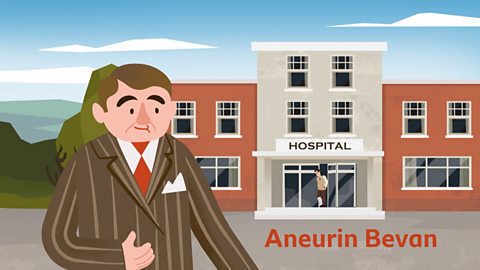
Aneurin Bevan. video
This animated film explores the life of Aneurin Bevan, the Member of Parliament from Wales who successfully established the National Health Service (NHS) in 1948.
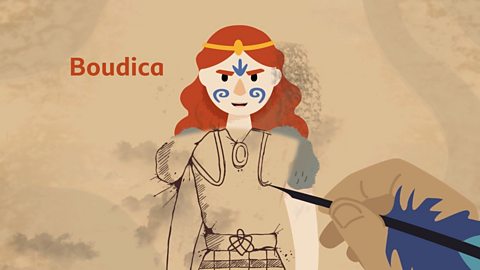
Boudica. video
This film explores the life of Boudica, the Queen of the Iceni tribe whose rebellion against the Romans led to the destruction of Colchester.
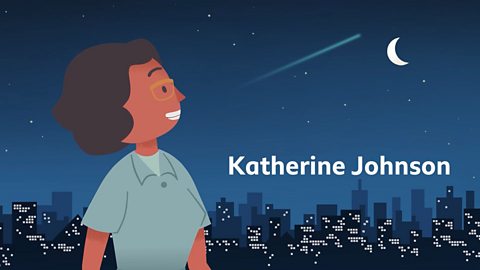
Katherine Johnson. video
This animated film tells the story of Katherine Johnson, a mathematician who joined NASA's space program in the 1950s and played a crucial role in calculating the trajectories for their space missions.