This is the town of Colchester, almost two thousand years ago.We tore the whole place apart!
The Romans… they thought they could do whatever they wanted. But they went too far… they took what was mine!
We are the Iceni tribe, and I am Queen Boudica! And those Romans will never forget my name!
I was just a girl when the Romans came to this land.I didn’t hate them to start with. There are many tribes here. To us younger ones, the Romans were just another tribe… a very powerful one! One you had to treat with respect.
That’s why my husband, Prasutagus, the King of the Iceni, made a deal with them. We agreed to be their allies - their friends. And we agreed that they could rule over half of the Iceni kingdom – but only when my husband died.
Well, he did die. But the Roman governor broke his promise. He told us that our whole kingdom was part of Rome now. And worse than that – they had me beaten, and they took my two daughters away.
What did they think? That an Iceni queen would just bow down and accept such treatment? Never. I swore revenge! I called our tribe to war! The Trinovantes, a nearby tribe, joined us too - they hated the Romans.
The main Roman army had marched off to fight the tribes of the West. So when I marched on Colchester with my warriors, there weren’t many of them trying to stop us. Colchester was a town they had built – like a little piece of Rome. And they hadn’t even put up defences!
We destroyed the whole place! And then we did the same to London, and Saint Albans!
Of course, we knew we’d have to meet their army. As soon as word reached their general, Suetonius, he turned his legion around and headed straight for us.They might have been the best trained soldiers in the world, but we were ready to meet them - and there were more of us!
We fought at what people now call the battle of Watling Street. The Romans positioned themselves in a valley, with thick woods protecting their rear.But we parked our chariots all around them, closing them in. And then we attacked!
And that’s where my story comes to an end.It’s where my warriors came to an end too.There were more of us, but the Romans stayed in formation behind their shields. We were cut down by their javelins and their swords.
And me? I died. There in battle. Or did I drink poison?Well, that depends on whose story you hear! Just like everything about me…
Was my name really “Bou – dica” ? Did I really look like this – fiery red hair, a big, strong warrior? How do you know?
See, my story was written down by ‘historians’ – Roman ones! And they were writing after I was dead and gone! They’d never met me!They didn’t know what I looked like, or even what my real name was!
And us Iceni? What about our history? Well, we spoke our stories. We didn’t write them down. And now… who knows what we actually said?
But one thing’s a sure fact. We did destroy Colchester! And when we did, the Romans learned something important – you don’t mess with the Queen of the Iceni!
Video summary
This film explores the life of Boudica, the Queen of the Iceni tribe whose rebellion against the Romans led to the destruction of Colchester.
In ancient Britain, during the 1st Century AD, Boudica’s husband was the leader of a tribe based in the east: the Iceni. He initially made a deal with the Romans, brokering peace in exchange for half the Iceni kingdom after his death.
However, when he died, the Roman governor reneged on this promise. The Romans tried to take all the Iceni land and mistreated Boudica, as well as her daughters.
Enraged, she led a rebellion in 61 AD, seeking revenge against the Romans. She gained the support of a neighbouring tribe, the Trinovantes, and destroyed Colchester (‘Camulodunum’), London (‘Londinium’) and St Albans (‘Verulamium’).
In the final battle, known as the Battle of Watling Street, despite outnumbering the Romans, Boudica's forces were defeated, and she died. That said, nobody is completely sure how she died.
Every part of Boudica’s story shows us how subjective historical accounts can be. How much can we trust what the Roman historians wrote, when they never met her and were even born years after her death? What can we really claim we know.
Teacher Notes
Additional notes
- Historical subjectivity
It is often disputed how Boudica died and what treatment her and her family received that led to the rebellion.
In this film we have described the Romans as having “taken her daughters away”, a reflection of one account that Boudica’s family members were enslaved and another that her daughters were targeted. It is generally believed that there was cruelty and humiliation, which served as a catalyst for the rebellion.
This film can be used to discuss the subjectivity of historical accounts and Boudica’s role and cultural significance as a leader.
Before the video
- Can you name any female British monarchs?
- Have you heard of Queen Boudica? Who was she?
- Why is it a good idea to look at different sources when learning about historical events?
During the video
- Do you predict that Boudica’s feelings towards the Romans will change? Why?
- How were the Iceni and the Romans different in their traditions and ways of life?
- Why do you think there are different stories about how Boudica died?
After the video
- Do you think Boudica was a strong leader? What did she do that makes you think that?
- Why did Boudica lead a rebellion against the Romans?
- How do you think Boudica felt when the Romans broke their promise and mistreated her?
- Why do you think the Romans and the Iceni made a deal initially?
- What happened to Boudica and her warriors in the end?
Further questions
Explain the difference between primary and secondary sources:
- Primary sources are letters, diaries and speeches by people who were there at the time.
- Secondary sources are written after the event, by people who did not witness it.
- Roman historians wrote about Boudica. Are these primary or secondary sources? (Secondary, as the historians wrote them years later and never met her)
- Do we have any sources, primary or secondary, from Boudica and her tribe? (We don’t have either primary or secondary sources. The Iceni would pass their stories on by talking to each other, not write them down.)
This film will be suitable for teaching History at KS2 in England and Wales and KS2 in Northern Ireland. Also 2nd Level in Scotland.
More from this series:
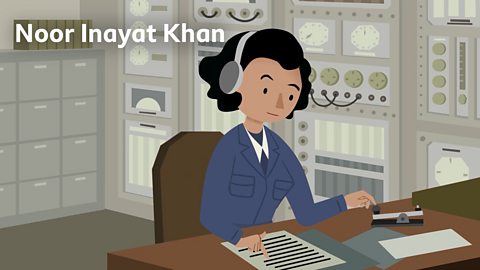
Noor Inayat Khan. video
This film follows Noor Inayat Khan, a radio operator and secret agent during WW2, who transmitted messages against the German occupation as part of the French resistance.
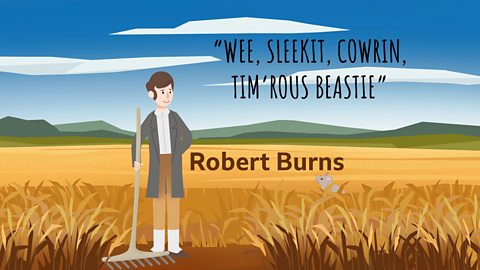
Robert Burns. video
This animated film explores the life of Robert Burns, a poet renowned for his celebration of his Scottish identity.
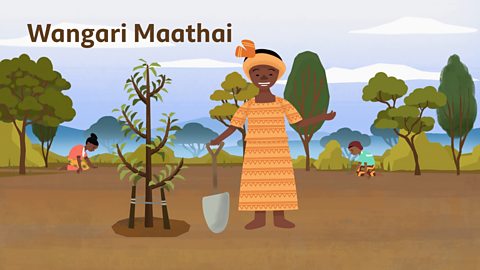
Wangari Maathai. video
This animated film explores the life and achievements of Wangari Maathai, an environmental activist from Kenya who founded the Green Belt movement.
Aneurin Bevan. video
This animated film explores the life of Aneurin Bevan, the Member of Parliament from Wales who successfully established the National Health Service (NHS) in 1948.
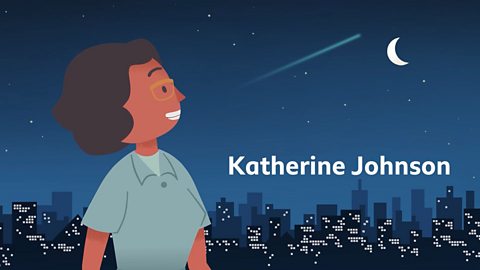
Katherine Johnson. video
This animated film tells the story of Katherine Johnson, a mathematician who joined NASA's space program in the 1950s and played a crucial role in calculating the trajectories for their space missions.