You see that light, moving across the sky? It doesn’t look like much now, does it?
But actually, up there, that’s a spacecraft. And the man inside it – well, he’s a gentleman I work with. He is the first American ever to orbit around the Earth.
At this moment in time, he’s travelling at seventeen thousand five hundred and forty four miles per hour. Exactly… How do I know that? Oh, it’s my job to know!
My name is Katherine Johnson. I am a mathematician for NASA’s space program. And the astronaut who’s risking his life up there - he asked for me personally to check every single calculation we’d made - so he felt safe to blast off.
Because any mistake in our work - even a tiny mistake - could lead to disaster!
I was born in West Virginia in the United States of America, in 1918.
When I was at school, I was so good at math, I got better than the teachers! I had to go to a different school, further away. And I started university when I was just 15 years old!
When I finished school, I knew that I had the talent to work as a mathematician. But not everyone saw that. I knew I’d have to be twice as good as anyone else if I ever hoped to get a job…
But in 1952, I heard something about the government agency in charge of developing advanced aircraft.
They were giving jobs to lots of female mathematicians to do the complicated calculation work for their designs.
I started working in Flight Research. At first, they just wanted me to check their calculations.
But when I showed them that I was an expert in a kind of math called Analytical Geometry, well, then I became a part of the team.
I can tell you, it wasn’t always easy. My boss didn’t want me to put my name on a report that I’d written – because he felt annoyed that the work had been done by a woman.And they tried to stop me going into meetings…
But I wouldn’t accept this; I questioned everything. “Why can’t women attend meetings? Is there a law against it?”
Then in 1958, the agency I worked for changed its name - to ‘NASA’. The USA needed to get men out into space as fast as possible!
That meant that we had our work cut out. Getting a craft safely in and out of orbit around the Earth is incredibly difficult.
How heavy will the rocket be? How fast will it be moving? What angle does it need to travel at? All these things need to be worked out precisely!
I calculated the flight path for the first American to go into space in 1961. And eight years later, in 1969, my work helped a man land safely on the moon for the very first time!
Of course, the astronauts who flew became world famous. But nobody had ever heard of us mathematicians. That didn’t worry me. I was happy to do the work that I loved!
The space program we worked so hard for has helped to change the world.And when I was older, my contribution was recognised. There was even a movie made about me!
Video summary
This animated film tells the story of Katherine Johnson, a mathematician who joined NASA's space program in the 1950s and played a crucial role in calculating the trajectories for their space missions.
Katherine Johnson, born in 1918, loved maths and excelled at a young age. Her town did not have a high school for Black children, but despite racial segregation laws, she persevered and even started university aged just 15 years old.
However she struggled to get a job as a mathematician afterwards, despite her talent and her passion for the subject.
In 1952, Katherine Johnson applied to join the government agency developing advanced aircraft, as it was hiring female mathematicians to perform complex calculations for their aircraft designs. Initially, her role was to check calculations, but after she demonstrated her expertise in analytical geometry, she became an irreplaceable part of the team.
In 1958, the agency she worked for was renamed NASA. Katherine contributed significantly to the space program, helping to calculate the trajectories for historic space missions, including the first American orbit around the Earth and the moon landing in 1969.
Her efforts went unrecognised until later in life when she received acknowledgment, and she was celebrated in popular culture with a major film made about her.
Teacher Notes
Additional notes
- Space Race
Katherine Johnson was working at NASA during the ‘space race’. There was a rivalry between the United States and the Soviet Union during the mid-20th century, where both wanted to achieve the first significant milestones in space exploration, like the launch of the first artificial satellite (Sputnik), the first human in space (Yuri Gagarin), and the first successful manned moon landing (Apollo 11).
The ‘space race’ became symbolic of the ideological and political tensions between the two world powers. That’s why Katherine says: “The USA needed to get men out into space - as fast as possible!”
This film can be used to discuss past discrimination and its impact on individuals, as well as how technological advances like space travel were pioneered by significant individuals.
Before the video
- Can anyone share what they already know about space exploration?
- Can you think of a time when you did something that made you feel proud but nobody else noticed? How did this make you feel?
- What is segregation? Have you heard of discrimination?
During the video
- Why did Katherine’s boss try to stop her from going to meetings?
- Why do you think Katherine's contributions were not initially recognized?
- Do you think she wanted her contributions to be recognised?
After the video
- What challenges did Katherine face due to discrimination?
- How would you describe her attitude to the discrimination she faced?
- How did Katherine work with others in the space program?
- Do you think it is important for people with different skills to work together on projects like space exploration? Why?
- What was happening in the 1950s and 1960s that made space exploration important?
- Why do you think there was a movie made about Katherine's life? Why did it take so long to get made?
This film will be suitable for teaching History at KS2 in England and Wales and KS2 in Northern Ireland. Also 2nd Level in Scotland.
More from this series:
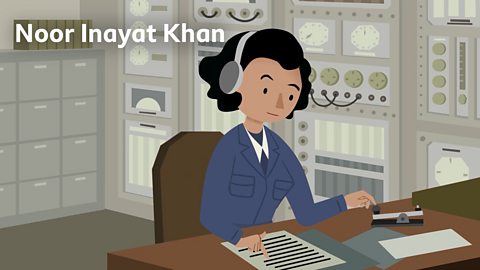
Noor Inayat Khan. video
This film follows Noor Inayat Khan, a radio operator and secret agent during WW2, who transmitted messages against the German occupation as part of the French resistance.
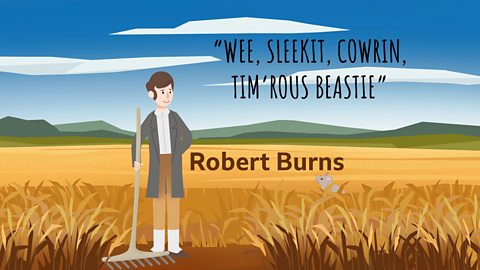
Robert Burns. video
This animated film explores the life of Robert Burns, a poet renowned for his celebration of his Scottish identity.
Wangari Maathai. video
This animated film explores the life and achievements of Wangari Maathai, an environmental activist from Kenya who founded the Green Belt movement.

Aneurin Bevan. video
This animated film explores the life of Aneurin Bevan, the Member of Parliament from Wales who successfully established the National Health Service (NHS) in 1948.

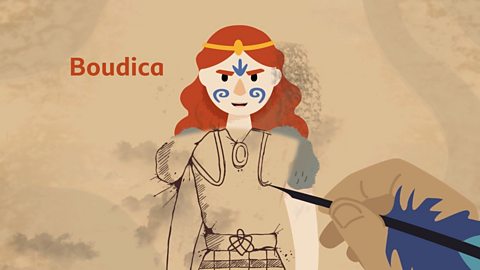
Boudica. video
This film explores the life of Boudica, the Queen of the Iceni tribe whose rebellion against the Romans led to the destruction of Colchester.