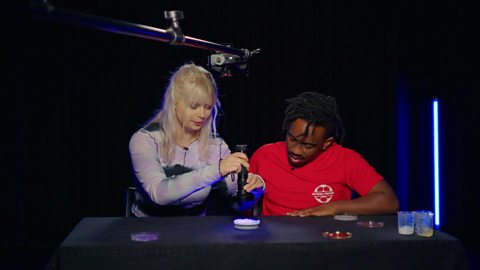
CAYANA:
Aren't magnets great? They can move other magnetic objectswithout even touching them. Take one of these bar magnets, forexample, right. The red end is the north end. The blue end is thesouth end. And with magnets, they attract each other's opposites.So north pole and south pole? Yeah. They attract each other. Butthen if you match the poles, they repel.
LOUISE:
Magnets, all great as well for sorting out all kinds of things. Nowthey can sort through magnetic metals in people's rubbish, whichmakes recycling a whole lot easier.
LOUISE:
Although, I do think the magnets would have to be a lot strongerfor people's rubbish don't you?
CAYANA:
I mean, we do have three types of different magnets, and I wonderwhich one out of these would be the strongest.
LOUISE:
I think it's time for an investigation, don't you?
LOUISE:
How do we do this, then?
CAYANA:
Oh, how about we use these.
LOUISE:
Okay. So how's that going to work? Okay. Yeah, that is pretty cool.
LOUISE:
But how are we going to tell the difference between the magnets?Like, how are we going to make this as accurate as we possiblycan?
LOUISE:
We are trying to find out which of our three magnets is strongestfor this experiment. We're going to use a paperclip, three differentmagnets and a ruler to measure the distance each time. The greaterthe distance that the magnets attract the paperclip, the stronger themagnet. Let's get started.
CAYANA:
Right. We've got the magnets ready. Magnet number one, two andnumber three. So what I want to know now is which one do youthink is the strongest?
LOUISE:
Oh, well, surely it's number three. I mean, look at the size of that. Ithink number three is going to be the big one.
CAYANA:
I'm not too sure, you know, I put my money on number two becauseit was really strong earlier. So I recommend that one.
LOUISE:
Okay. Let's do this, I'm excited to see how we get on.
LOUISE:
Let's get this. Right to the end of that.
CAYANA:
Number one, off you go.
CAYANA:
30 centimetres. moving towards 20.
LOUISE:
oh it's tense.
CAYANA:
Paperclip couldn't be more chill.
LOUISE:
It is chilling, it really is chilling.
CAYANA:
Three centimetres to go. Two. Oh!
LOUISE:
A little pull right at the end there.
CAYANA:
So that was exactly half a centimetre.
CAYANA:
Okay. I am replacing our paper clip at zero. And do you want to dothe second?
LOUISE:
Yes. This is yours.
CAYANA:
This is my one.
LOUISE:
This is what your money's on this one.
CAYANA:
Slowly but steadily. With five, four.
LOUISE:
Oh! That was a big jump. That was a big jump.
CAYANA:
Yes. Okay. So looking at it, we are at 2.4.
LOUISE:
Wow. That's a good one. That is that is a stronger magnet. Muchstronger.
LOUISE:
My final one.
CAYANA:
The big one.
LOUISE:
Okey Dokey Right.
CAYANA:
So it's all fair. Right. Are we ready for this?
LOUISE:
We are. Come on. Number three. You can do this. You can do this.Come on.
CAYANA:
10 centimetres. Moving in.
LOUISE:
Come on, come on.
CAYANA:
That is only 1.4 centimetres.
LOUISE:
You know what? I can't believe that. I mean, look at the size of thatmagnet. I am so shocked. I was certain that was going to be thewinner.
CAYANA:
Shall we have a look at the results?
LOUISE:
Oh, absolutely. Let's do it.
CAYANA:
Right. Magnet number one has attracted the paperclip from adistance of 0.5 centimetres. Magnet number two has measured 2.4centimetres and magnet number three has measured a distance of1.4 centimetres.
LOUISE:
I'm still shocked about that. I really thought number three wasgoing to be the winner. I really did.
LOUISE:
We've been trying to find out which of all three magnets isstrongest. We learnt that magnet two is the strongest by observingthat it attracted the paperclip from a greater distance than theother two magnets that we tested. Investigations like these aregreat for helping us learn about the world around us. Remember,you need to change variable and measure variables and a way ofcontrolling your experiment to make it a fair test. So what are youwaiting for?
Video summary
Magnets are used for many things - from fridge magnets and toys to latches on cupboard doors. They come in all shapes and sizes.
In this film, presenters Cayana and Louise test some magnets to find out which one is strongest.
To do this they set up a comparative test. They test three different magnets and measure the distance that each magnet is able to attract a paper clip.
To make the test fair, they use the same ruler and paper clip throughout.
This short film is from the BBC Teach series experiments in controlled environments.
Teacher Notes
Before Watching
Ask your learners where they have seen magnets in the classroom, at school or at home?
Go on a magnetic safari around the classroom – how many magnetic objects can your learners find? Encourage your learners to then think about what each item is made from. Ask them to create a table showing magnetic and non-magnetic materials.
Look at a range of magnets. Ask your learners which one they think is the strongest? Weakest? What features of the magnets are they basing their prediction on?
After Watching
Look again at the results from the film. Which magnet was the strongest? How did we know? Were you surprised by the results? Why? Encourage your learners to try out the investigation in the film. Do their findings match those in the film? Is there a pattern?
Ask your learners how else they could test the strength of a magnet? They might come up with lots of ingenious methods such as looking to see which magnet can pick up the most paperclips, or how many pieces of paper can be held up by a magnet on a metal table leg or fridge?
Ideas for further learning
Challenge your learners to make a game that uses magnets to make something move.
Key Scientific Ideas
- Poles - The two ends of a magnet are known as the north pole and the south pole.
- Repel - If you try to put two magnets together with the same poles pointing towards one another, the magnets will push away from each other. We say they repel each other.
- Attract - If you put two magnets together with different poles pointing towards one another, the magnets will pull towards each other. We say they attract each other.
- Magnets - There is a range of magnets commonly used in school – bar, ring and horseshoe magnets. These magnets are man-made and can lose their magnetic characteristics over time. Dropping them, heating them, or banging them can lower their magnetism.
- Magnetic - Iron is magnetic, so any metal with iron in it will be attracted to a magnet. Steel contains iron, so a steel paperclip will be attracted to a magnet too.
Developing practical enquiry skills
- Comparative test enquiries - Comparative test are an opportunity for children to make comparisons. In this case we are comparing magnets. To set up a comparative test we change one variable, measure another variable and keep all the other variables the same. It is important that we only change one variable so that we know what caused the effect.
- Prediction - A prediction is saying what might happen during an investigation. When asking learners to make a prediction, it is important to encourage them to draw upon what they already know to support their thinking.
These short film clips support teachers with practical enquiry. They can be both used as a resource for learners to watch at home. Or as a stimulus to support learners to plan and conduct their own science investigations. They link to the UK Science curricula.
Magnets
- Pupils will observe that magnets can act at a distance.
- Pupils will observe that materials containing iron are magnetic.
- Pupils may predict whether two magnets will attract or repel each other, depending on which poles are facing.
Science enquiry / Skills for working scientifically
- Pupils should plan different types of scientific enquiries to answer questions, including recognising and controlling variables where necessary.
- Pupils should take measurements, using a range of scientific equipment, with increasing accuracy and precision, taking repeat readings when appropriate.
- Pupils should record data using tables.
What temperature does yeast grow the most? video
In this short film presenters Harry and Frankie conduct an experiment to find out the best temperature to activate yeast for breadmaking.
Which material is the most effective insulator? video
In this short film presenters Harry and Frankie find out whether wrapping ice stops it from melting and if so, which material works best.
Which soil holds the most water? video
Presenters Harry and Cayana experiment with three samples of soil to find out which holds the most water.
How much gas is there in a bottle of fizzy drink? video
Presenters Harry and Cayana devise an experiment for measuring how much gas is in a bottle of fizzy drink.
Which is the most absorbent paper towel? video
In this short film, presenters Cayana and Louise compare three different paper towels to see which is the most absorbent.
Can people with longer legs jump the furthest? video
In this short film, presenters Frankie and Louise find out whether people with longer legs can jump the furthest.
How effective are different liquids at blocking out UV light? video
In this short film, presenters Frankie and Louise find out how effective different liquids are at blocking out UV light.