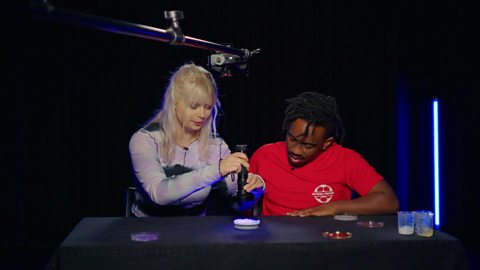
Harry:
(mumbled) What are you doing?
Frankie:
I'm sorry. What?
Harry:What are you doing?
Frankie:
Oh, I'm just here just looking and thinking about yeast.
Harry:
OK, you're going to have to explain that one.
Frankie:
OK, so I've got into baking lately, so it got me thinking what is thebest temperature for yeast to grow at?
Harry:
Why?
Frankie:
Because yeast is what you need when you're making bread for it torise. So if I could figure out what is the right temperature for yeastto grow, I could probably make the best bread ever.
Harry:
I think it's time for an investigation.
Harry:
Right. So what do we need?
Frankie:
Yeast is a living thing when you mix it with sugar it grows.
Harry:
Really?
Frankie:
Yeah. When yeast grows, it releases carbon dioxide. The more yeastthat grows, the more carbon dioxide is released.
Harry:
So if we can find a way to catch and measure the gas produced,then we can find out how much it's grown by.
Frankie:
Basically, yeah.
Harry:
We're trying to find out at which temperature yeast grows the most.For this experiment, we're going to use three equal mixtures ofyeast and sugar. We'll use 30 grams of yeast and 30 grams of sugareach time, three bottles filled with equal amounts of water heatedto different temperatures. We'll use a thermometer to accuratelymeasure the temperature of the water. Then the water will beadded to our mixture of yeast and sugar. Three balloons attachedto the tops of our bottles to catch the carbon dioxide gas that'sproduced as the yeast grows. And a tape measure to measurearound each balloon. The larger the balloon, the more gas is beingproduced and the more the yeast is grown. Let's get started!
Frankie:
So what we have here we've mixed warm and cold water to make amixture of temperatures. We've got 15 degrees here, 30 degreeshere and 45 degrees there.
Harry:
Let's add it in.
Frankie:
Let's do it.
Harry:
Right.
Frankie:
I'm excited for this you know.
Harry:
Nice and gently in, try not to spill it too much.
Frankie:
There you go. We've got the basic parts sorted there.
Harry:
And you can get that last one. Then straight on with the cap.
Frankie:
Okay. How many times do you think we should shake it?
Harry:
Three? Three good shakes.
Frankie:
It's a magic number. I like that one.
Harry:
Do you want to do that one aswell?
Frankie:
Go for it I'm already on a role I'm that excited.
Harry:
You ready? Three, two, one. One, two, three. Lid off.
Frankie:
OK.
Harry:
Then balloon on.
Harry:
Now, this is the tricky bit.
Frankie:
I know right.
Harry:
Alright, they're all on there. Balloons on, mixed up, all good to go.
Frankie:
Cool, that's all done I think we should leave here for about 10minutes.
Harry:
Sounds good to me.
Frankie:
Yeah. Alright cool, I say we'll come back and see which one hasgrown the most then.
Harry:All good. Let's do it.
Frankie:
Well, we can definitely see some differences here hey.
Harry:
I think we can tell which one has produced the most CO2, but shallwe take our measurements to be sure?
Frankie:
Yeah, you know, when we got measuring though, we need toremember to measure around the balloon. That way we canmeasure the circumference of it.
Harry:
Well, let's start with this first one, shall we? 15 degrees. So whatwe've got to do here, be careful, we want to measure around thewidest part of the balloon to make sure it's all even and fair andcan get the most accurate circumference.
Frankie:
That's what's up. You got that yeah?
Harry:
Is that the widest part? Looks like it to me.
Frankie:
7, 7.
Harry:
7 centimetres.
Frankie:
7 centimeters there.
Harry:
Moving on.
Frankie:
30 degrees. Okay.
Harry:
I've got to be careful though actually with this one because it'sobviously blown up a little bit more so we don't want to squeeze itin certain areas to effect the circumference.
Frankie:
That when we've got 15 here now.
Harry:
15 centimetres. Right and our final one on 45 degrees.
Frankie:
I'm excited for this one now.
Harry:
OK.
Frankie:
OK alright we have got the 32 centimetres.
Harry:
32 centimetres.
Harry:
We've been trying to find out at which temperature yeast grows themost. We learnt that yeast grew more at 45 degrees by observingthat it filled the balloon with more carbon dioxide gas over a tenminute period than at 15 degrees or 30 degrees. Investigations likethis are great for helping us learn about the world around us.Remember you need to change variable, a measure variable and away of controlling your experiment to make it a fair test. So whatare you waiting for?
Video summary
Presenters Harry and Frankie want to bake some bread. Before they start, they need to work out how to activate the yeast.
So, they test which temperature yeast grows best at by putting a mixture into a bottle and topping it off with a balloon. As yeast grows, it gives off carbon dioxide, which causes the balloon to inflate.
They set up a fair test, changing the temperature of water in three bottles, keeping the amount of yeast, sugar and water the same.
Then they measure the size of the balloon as it collects the carbon dioxide created by the yeast mixture.
This short film is from the BBC Teach series Experimental.
Teacher Notes
Before Watching
Show your learners a bread roll. Tear it in half – what do they notice? Can they see the bubbles? These are what give bread its soft structure. How do they think they got there? Your learners may mention various raising agents used in cooking – adding air, using steam, adding baking powder or using yeast.
In this investigation we ask the question at which temperature does yeast grow best? Ask your learners what they think yeast might need to activate it? Encourage them to talk about any baking they may have done at home.
After Watching
Revisit the results with your learners. Ask them what does yeast need to grow? Why do bakers need to check their yeast is alive before they use it in baking? Your learners will spot that yeast grows better in warm temperatures. However, make sure they know that if yeast is too warm (60°C) it will die and is no longer active. Ask them to think about why that might be?
Try the investigation for yourselves. You could also try different enquiries such as changing the amount of sugar, water or yeast to see if that affects how much carbon dioxide is produced.
Health & Safety Note - if you try this experiment, please note that children should not work with water over 45°C. To avoid this risk, teachers can prepare flasks of water before the lesson.
Ideas for further learning
Find out more about microorganisms with this Bitesize guide.
Research microorganisms and find out about those which are helpful in food production. And find out about those which are harmful to our health. How can we keep ourselves healthy?
Find out how the invention of the microscope helped scientists to identify a whole new world of tiny microorganisms. Try making your own magnifier with just a drop of water on a piece of plastic.
Key Scientific Ideas
This investigation is especially useful when teaching children about gases.
Yeast - yeast is a microorganism. It is a type of fungus. Most breads are made using Yeast. When bread is made, the yeast becomes spread out in flour. Once activated, yeast begins feeding on the sugars in flour, and releases the carbon dioxide that makes bread rise. NB: Yeast grows better in warm temperatures, up to 60°C when it dies and is no longer active.
Micro-organisms - micro-organisms are living organisms that are too small to be seen with the naked eye. They are found almost everywhere on Earth. There are three types of micro-organisms: viruses, fungi and bacteria.
Gases - gases are a state of matter. Gas particles move about at high speeds, they have no fixed shape or volume. In this investigation we use balloons to capture the gas so they we can measure how much carbon dioxide has been made.
Developing Practical Enquiry Skills
Fair test - fair test enquiries are an opportunity for children to explore cause and effect relationships in science. Children find the answers to their questions in fair test enquiries by changing one variable (independent variable), measuring one variable (dependent variable) and controlling all other variables. Fair tests involve working systematically and analysing data to identify how one variable affects another.
Measuring temperatures - we use a thermometer to measure temperatures in Celsius (°C) When showing your learners how to use a thermometer, ask them to look at the scale. What increments is the scale rising in?
A thermometer is usually made up of a small, hollow glass tube. At the bottom of the tube is a bulb, which holds a liquid. When there is an increase in heat, the liquid inside the bulb expands, pushing up into the tube. A decrease in heat lets the liquid contract, moving down the tube. The place where the liquid stops on the scale is where you can take the reading of the temperature. Ensure you read the thermometer at eye level, keeping it in the water to take the reading._
Note: always use a thermometer suitable for use with primary aged children.
- Constructing a table - tables are an important tool for collecting and organising information. Tables are made of columns and rows. Usually, the change variable (independent variable) is recorded in the left-hand column. The right-hand column records the measurements or observations (dependent variable). Each column should be labelled, including the units of measurement as appropriate.
These short film clips support teachers with practical enquiry. They can be both used as a resource for learners to watch at home. Or as a stimulus to support learners to plan and conduct their own science investigations. They link to the UK Science curricula.
Materials
- Compare and group materials together, according to whether they are solids, liquids or gases.
Living Things
- To develop their understanding of micro-organisms as living things.
Science enquiry / Working scientifically skills
- Pupils should plan different types of scientific enquiries to answer questions, including recognising and controlling variables where necessary.
- Pupils should take measurements, using a range of scientific equipment, with increasing accuracy and precision, taking repeat readings when appropriate.
- Pupils should record data using tables.
Which material is the most effective insulator? video
In this short film presenters Harry and Frankie find out whether wrapping ice stops it from melting and if so, which material works best.
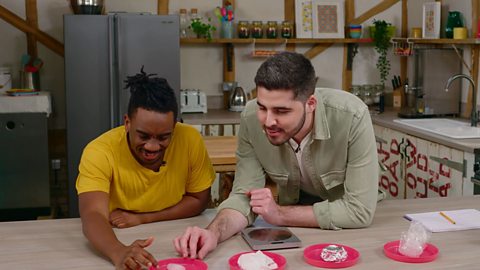
Which soil holds the most water? video
Presenters Harry and Cayana experiment with three samples of soil to find out which holds the most water.
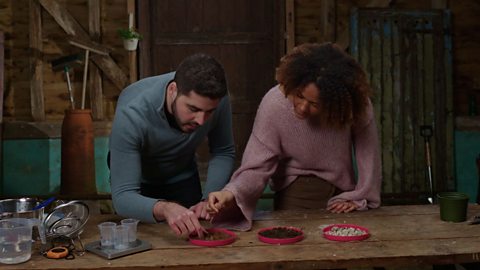
How much gas is there in a bottle of fizzy drink? video
Presenters Harry and Cayana devise an experiment for measuring how much gas is in a bottle of fizzy drink.
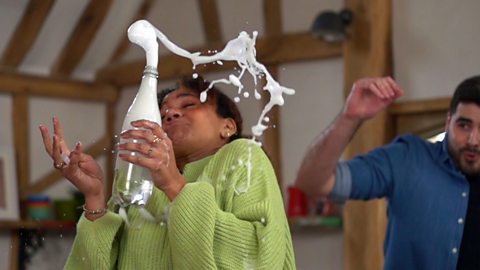
Which is the strongest magnet? video
In this short film, presenters Cayana and Louise test some magnets to find out which one is strongest.
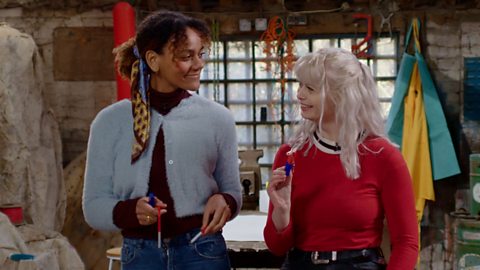
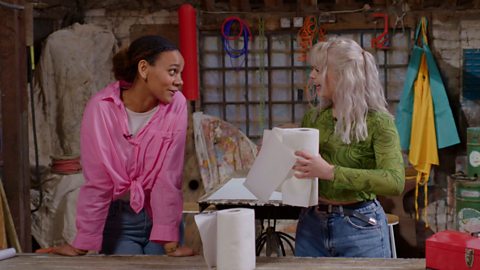
Which is the most absorbent paper towel? video
In this short film, presenters Cayana and Louise compare three different paper towels to see which is the most absorbent.
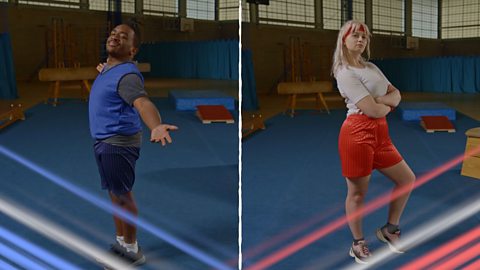
Can people with longer legs jump the furthest? video
In this short film, presenters Frankie and Louise find out whether people with longer legs can jump the furthest.
How effective are different liquids at blocking out UV light? video
In this short film, presenters Frankie and Louise find out how effective different liquids are at blocking out UV light.