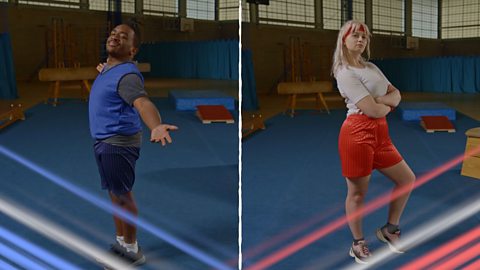
LOUISE:
Do you want some of this?
FRANKIE:
Yeah, sure. Apparently it's going to be warm later, but how muchlight does this actually stop though?
LOUISE:
Ah, well sun cream doesn't actually stop light, it actively stops UVlight.
FRANKIE:
But doesn't UV light help the body get vitamin D?
LOUISE:
Yes, but too much can be harmful so.
FRANKIE:
Well, let's see how effective this actually is then. I mean, we've gottime before this all starts though.
LOUISE:
I think we're a little bit early aren't we?
FRANKIE:
In that case I think it's time for an investigation.
LOUISE:
Let's do it.
FRANKIE:
So I managed to find us a dark room so we can control theinvestigation so what do we need now?
LOUISE:
Right, so we've got the sun cream but I think we need a few morevariables in order to compare.
FRANKIE:
OK we can compare the sun cream with a liquid, like an oil.
LOUISE:
Yes or a water as well.
FRANKIE:
OK.
FRANKIE:
Sun cream, oil and water are the change variables but how do wemeasure the performance?
LOUISE:
We're trying to find out how effective different liquids are blockingUV light. For this experiment, we're going to use three equalamounts of liquid. We're testing sun cream, oil and water. UVbeads, we'll use the same number of beads each time. A UV light, toshine through the liquid and onto the beads. And a camera so wecan compare the results. The less the UV light beads react to theUV light, the better the protection from our liquid. Let's get started!
FRANKIE:
But the question is, what do you believe will make the biggestdifference?
LOUISE:
You know I think the oil should be an interesting one, I'm going tosee how much the UV light gets through there it will be interesting.
FRANKIE:
You know I was going to say water, you know. I don't know whyjust something about water I just feel that would make that suchsignificant difference.
LOUISE:
The natural feeling and I'm surely hoping that the sun cream willblock the most UV light.
FRANKIE:
That's the aim and hope right?
LOUISE:
We hope so, we hope so. I think it's time to get stuck in.
FRANKIE:
Let's do it.
LOUISE:
So we're going to start with the oil, this is going to be number one.
FRANKIE:
I'm excited.
LOUISE:
I am excited to see how this goes as well.
FRANKIE:
I'll pop in and you go and shine that light.
LOUISE:
Fantastic and we will do this for five seconds on each of them. So itis fair.
FRANKIE:
Okay, let's do it.
LOUISE:
So in three, two, one, go.
FRANKIE:
One, two, three, four, five.
LOUISE:
Okay, let's take the oil off.
FRANKIE:
Look at that.
LOUISE:
There we go so you can see it changing kinda, in the middle itseems to be very much changed in there doesn't it?
FRANKIE:
Yeah it has changed. Yeah, yeah, yeah but look at our side some ofthem barely even look touched.
LOUISE:
Here's the sun cream.
FRANKIE:
That's it.
LOUISE:
See how well it does, are you ready to count again?
FRANKIE:
Let's do it.
LOUISE:
OK so in three, two, one, go.
FRANKIE:
One, two, three, four, five.
LOUISE:
Oh OK.
FRANKIE:
Let's see what's happening, look at that.
LOUISE:
Completely clean.
FRANKIE:
No change whatsoever. Well, water is basically a challenge to keepup with that one then.
FRANKIE:
Okay, here we go.
LOUISE:
Ready to count down? Three, two, one, and go.
FRANKIE:
One, two, three, four, five. Wow.
LOUISE:
That was gone straight through. I mean, you see all of the beadsthere, pretty much.
FRANKIE:
Literally even the outside has been touched. OK, completely wrong Iwas there.
LOUISE:
We've been trying to find out how effective different liquids are atblocking UV light. We learnt that sunscreen was the most effectiveby observing that the UV beads didn't react as much when we shota UV light onto them compared with the other liquids that wetested. Investigations like this are great for helping us learn aboutthe world around us. Remember, you need a change variable, ameasure variable, and a way of controlling your experiment tomake it a fair test. So what you waiting for?
Video summary
Presenters Frankie and Louise are enjoying the sunshine and put some sun cream on to protect their skin from the sun’s harmful UV rays.
But they can’t help wondering does sun cream really work? So, they put it to the test, asking how effective different liquids are at blocking out UV light?
Using UV beads, which contain pigments which react with ultraviolet light from the sun, they carry out a simple comparative test.
They cover three sets of UV beads with sun cream, oil and water, shine a UV torch on the beads to discover which liquid blocks out UV light.
This short film is from the BBC Teach series Experiments in controlled environments.
Teacher Notes
Before Watching
Show your learners a bottle of sun cream. Ask your children why it is important to wear sun cream? Ask them to think about ways that we protect ourselves from the sun? Show them some UV beads – ask them to predict what happens when you expose them to natural light? Explain that they are responding to a special type of light called UV light.
After Watching
Reflect on the results of the investigation. Which liquid prevented UV from reaching the beads? What does this tell us about how sun cream protects our skin? What do they think the SPF number on sunscreen means? SPF stands for sun protection factor. It’s the measure of how much UV gets through the screen. The higher the number, the less UV passes through.
Try the investigation out. You could also try investigating different fabrics – which ones are better at stopping UV light from reaching your skin? You could then use your results to make a sun hat! Or you could test your sun glasses. If you place them over UV beads, do they prevent UV from getting through? Discuss why it is important that sunglasses filter out UV light. It’s important that all sunglasses carry a UV400 mark. This means that the lens is blocking all the harmful UV.
Ideas for further learning
Design an information campaign to share with other people. How can you teach them about keeping their bodies safe in the sun?
Research how flowers use colours and markings in the ultra violet spectrum to attract pollinators.
Key Knowledge
- UV Light – ultra-violet light cannot be seen by the human eye. Some animals, including birds, reptiles, and insects such as bees, can see in the ultraviolet spectrum. Many birds have patterns in their plumage, that are invisible to us humans at usual wavelengths, but can be seen in ultraviolet spectrum by other birds.
For us humans, too much UV light can cause sunburn or cause damage to our eyes. So, it is important to wear a hat and sun screen when outdoors especially in the summer time.
- UV Beads - contain pigments that turn colours when exposed to UV light. UV Beads are the perfect tool for understanding how solar radiation can be harmful and to recognise measures that can be taken to reduce the risks associated with exposure to sunlight.
Developing practical enquiry skills
Comparative test enquiries - comparative test are an opportunity for children to make comparisons. In this case we are comparing liquids. To set up a comparative test we change one variable, measure another variable and keep all the other variables the same. It is important that we only change one variable so that we know what caused the effect.
Prediction - a prediction is saying what might happen based during an investigation. When asking learners to make a prediction, it is important to encourage them to draw upon what they already know to support their thinking.
These short film clips support teachers with practical enquiry. They can be both used as a resource for learners to watch at home, or as a stimulus to support learners to plan and conduct their own science investigations. They link to the UK Science curricula.
Light
- Pupils Recognise that light from the sun can be dangerous and that there are ways to protect their eyes.
Science enquiry / Working scientifically
- Pupils should plan different types of scientific enquiries to answer questions, including recognising and controlling variables where necessary.
- Pupils should take measurements, using a range of scientific equipment, with increasing accuracy and precision, taking repeat readings when appropriate.
- Pupils should record data using tables.
What temperature does yeast grow the most? video
In this short film presenters Harry and Frankie conduct an experiment to find out the best temperature to activate yeast for breadmaking.
Which material is the most effective insulator? video
In this short film presenters Harry and Frankie find out whether wrapping ice stops it from melting and if so, which material works best.
Which soil holds the most water? video
Presenters Harry and Cayana experiment with three samples of soil to find out which holds the most water.
How much gas is there in a bottle of fizzy drink? video
Presenters Harry and Cayana devise an experiment for measuring how much gas is in a bottle of fizzy drink.
Which is the strongest magnet? video
In this short film, presenters Cayana and Louise test some magnets to find out which one is strongest.
Which is the most absorbent paper towel? video
In this short film, presenters Cayana and Louise compare three different paper towels to see which is the most absorbent.
Can people with longer legs jump the furthest? video
In this short film, presenters Frankie and Louise find out whether people with longer legs can jump the furthest.