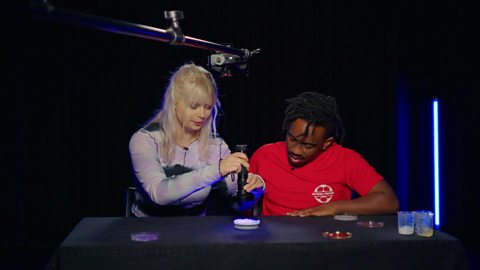
HARRY:
Hi.
CAYANA:
Hey. What are you doing?
HARRY:
I've just dropped my bottle of fizzy drink on the floor, and now I'ma bit worried to open it.
CAYANA:
I think you'll be fine.
HARRY:
I don't know.
CAYANA:
Give it here.
HARRY:
Careful.
CAYANA:
Come on.
HARRY:
No, see.
HARRY:
What did I say? Absolutely covered.
CAYANA:
Well, it's open now.
HARRY:
It's interesting, though, isn't it? To see and figure out how much gasis in a bottle like this to produce a reaction like that, it has goneeverywhere.
CAYANA:
I know. How much gas do you think is actually in that bottle?
HARRY:
Well, there's only one way to find out. I think it's time for aninvestigation.
HARRY:
All dried off?
CAYANA:
Not quite.
HARRY:
Yeah, no you still got, yeah anyway. So what exactly do we needthough to figure out how much fizz is in this bottle?
CAYANA:
Well, the fizz in the bottle is created by adding carbon dioxide gasinto the bottle, but how do we measure that?
HARRY:
We're trying to find out how much gas is in a bottle of fizzy drink.For this experiment, we're going to use: an unopened bottle of fizzydrink. A tube attached to a bung that fits the neck of the bottle.Measuring cylinders. And a tank of water, we'll submerge thecylinders in water and measure the gas as it pushes the water out.Let's get started!
HARRY:
So go on then. Prediction time. How much gas do you think thatbottle is going to produce?
CAYANA:
I think quite a lot you know. I would say maybe around 150millilitres.
HARRY:
Really?
CAYANA:
Yeah.
HARRY:
I'll go for 50 millilitres from that. I guess we'll just have to find outwon't we? Let's do it.
CAYANA:
Okay. Right. I'm going to pop the cylinders into the water, fill themright up just like this, let all the water come in.
HARRY:
And I'm going to open the bottle now, stick the bung in.
CAYANA:
I'm going to take the other end.
HARRY:
In it goes.
CAYANA:
Into the water and just into the cylinder.
HARRY:
Are we in?
CAYANA:
Yes
HARRY:
We're in and already there's bubbles through, I'm going to give it abit of shake. The gas is coming out of the bottle,
CAYANA:
I wasn't expecting that.
HARRY:
no, through the tube and then straight pushing the water out fromthe cylinder, that's one done.
CAYANA:
All the way through. OK can you just?
HARRY:
I'll pinch it.
CAYANA:
Yes pinch it.
HARRY:
To stop the gas coming out.
CAYANA:
And I'll note it down, actually. OK second cylinder.
HARRY:
Into the next one. Bit of a shake with two full 250 millilitrescylinder down, onto the next one I think now. Yeah.
CAYANA:
Yes, you pinch that.
HARRY:
Pinching.
CAYANA:
Noting.
HARRY:
Bit of a shake again, straight away,
CAYANA:
More bubbles coming.
CAYANA:
Keep going.
HARRY:
Still shaking.
CAYANA:
Yeah.
HARRY:
But not too aggressively.
CAYANA:
Yeah, that's the third one down.
HARRY:
Tally it up, I'll pinch.
CAYANA:
And we're switching over again.
HARRY:
Next cylinder.
CAYANA:
I think we're close to an end.
HARRY:
Well you say that but we've be proved wrong before we might beproved wrong again.
CAYANA:
We are half way through the fourth.
HARRY:
I think we might have to call it there that's not dropping any lower,is it?
CAYANA:
No not really.
HARRY:
We filled up three plus a half, so that's three and a half, 3250 timesthree and a half gives us?
CAYANA:
That would be 875 if I'm correct?
HARRY:
And that is how much gas is being produced from this bottle.
CAYANA:
That is interesting and we were very wrong.
HARRY:
Very wrong.
HARRY:
We've been trying to find out how much gas is in a bottle of fizzydrink. We learnt that our bottle held 875 millilitres of carbondioxide gas by observing the measuring cylinders as the gas pushedthe water out. Investigations like this are great for helping us learnabout the world around us. Remember, you need a change variable,a measure variable, and a way of controlling your experiment tomake it a fair test.
CAYANA:
So what are you waiting for?
Video summary
In this short film presenters Harry and Cayana devise an investigation for measuring how much gas is in a bottle of fizzy drink.
They attach a rubber bung with a rubber hose onto the bottle.
Then bubble off the fizz through cylinders of water.
They realise there is far more gas in there than they predicted!
This short film is from the BBC Teach series experiments in controlled environments.
Teacher Notes
Before Watching
Show your learners a 500ml bottle of fizzy drink. Ask them which states of matter they can identify in the materials that make up the bottle of fizzy drink? They may notice the solid bottle, the liquid drink and the gas both within the drink and at the top of the bottle.
Now ask them to predict how much gas they think is in the bottle in millilitres. Encourage them to explain reasons for their prediction.
After Watching
Try the investigation out for yourself. Do your learners gather similar results? They could develop this enquiry into a comparative test by comparing different bottles of fizz. Are some types of fizzy drink more fizzy than others?
You could try weighing a can of fizzy drink, then leaving it open so that the drink goes flat. Does its weight change? What causes it to get lighter? What does this tell you about the gas inside? Through these investigations your learners will see that gases have mass.
Ideas for further learning
Research the affect that carbonated drinks have on your teeth. Why aren’t fizzy drinks good for you? Find out more about carbon dioxide. Why is it used to help put out fires?
Key Scientific Ideas
Carbon Dioxide - fizzy drinks contain a gas called carbon dioxide, a colourless odourless gas that dissolves in water under pressure. Carbon dioxide is necessary for life on Earth. When animals breathe out, they release carbon dioxide into the air. Plants use this carbon dioxide to make their own food through photosynthesis. Plants then release oxygen into the air for animals to breathe in. Carbon dioxide makes up about 0.03% of Earth’s atmosphere.
Gas – gas particles move about at high speeds; they have no fixed shape or volume. Gas will spread to fill any space that is available. This means that in contrast to liquids and solids, the volume of a gas is not fixed. If gas is pressurised, its volume contracts. If you decrease its pressure, its volume increases. The gas in the bottle of fizz was under a lot of pressure, its volume was small. However, when the bottle was opened the gas pushes the water out of the cylinder, we can see that under less pressure, the volume of the gas is much larger.
Developing practical enquiry skills
Observation Over Time – in this type of enquiry we simply make observations or measurements over a period of time. These observations can take place over seconds, minutes, hours, or days, or over longer periods of time, such as weeks or months. In this case our presenters made their observations over a period of about 10 minutes. When learners make observations over time, they should make notes about what they see happening, looking for changes.
Measuring volume of gas - fill the measuring cylinder with water. Stand it upside down in the water. Connect the bung into the bottle, with a piece of rubber tubing. Record how many cylinders of water are displaced and multiply that by the volume of each cylinder in millilitres. Continue timing until no more carbon dioxide appears to be given off. Each time the presenters change the cylinder, they lose gas. So, they don’t obtain an accurate measurement. However, they are able to ascertain that the amount of gas in the bottle is far more than they predicted.
These short film clips support teachers with practical enquiry. They can be both used as a resource for learners to watch at home. Or as a stimulus to support learners to plan and conduct their own science investigations. They link to the UK Science curricula.
Materials
- Compare and group materials together, according to whether they are solids, liquids or gases.
Science enquiry / Working scientifically skills
- Pupils should plan different types of scientific enquiries to answer questions, including recognising and controlling variables where necessary.
- Pupils should take measurements, using a range of scientific equipment, with increasing accuracy and precision, taking repeat readings when appropriate.
- Pupils should record data using tables.
What temperature does yeast grow the most? video
In this short film presenters Harry and Frankie conduct an experiment to find out the best temperature to activate yeast for breadmaking.
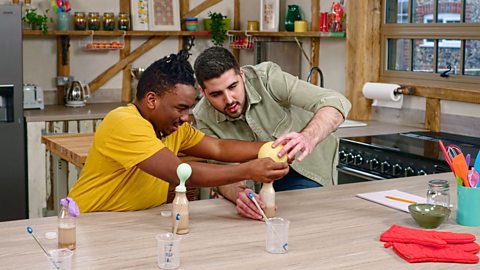
Which material is the most effective insulator? video
In this short film presenters Harry and Frankie find out whether wrapping ice stops it from melting and if so, which material works best.
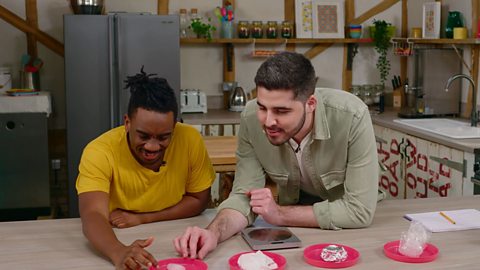
Which soil holds the most water? video
Presenters Harry and Cayana experiment with three samples of soil to find out which holds the most water.
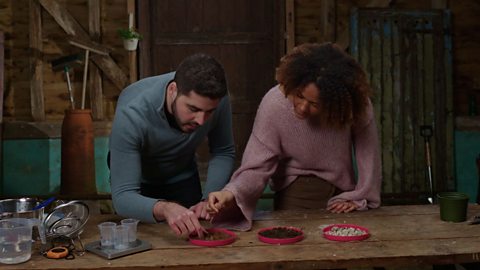
Which is the strongest magnet? video
In this short film, presenters Cayana and Louise test some magnets to find out which one is strongest.
Which is the most absorbent paper towel? video
In this short film, presenters Cayana and Louise compare three different paper towels to see which is the most absorbent.
Can people with longer legs jump the furthest? video
In this short film, presenters Frankie and Louise find out whether people with longer legs can jump the furthest.
How effective are different liquids at blocking out UV light? video
In this short film, presenters Frankie and Louise find out how effective different liquids are at blocking out UV light.