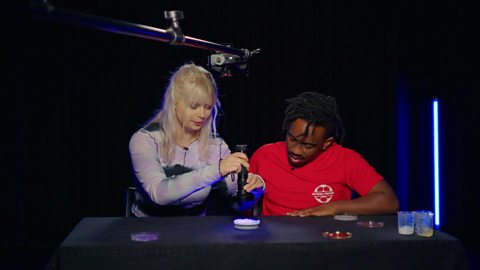
LOUISE:
Are you tired of using so much kitchen roll? Do you wish you hadsomething a little bit more absorbent? Well, look no more, because our brand new super absorbent kitchen towel will blow you away.
CAYANA:
What are you doing?
LOUISE:
Oh my gosh, you made me jump, where did you come from?
CAYANA:
What was that all about?
LOUISE:
I was just, you know, messing about a bit.
LOUISE:
You know the very funny adverts you get on the telly.
CAYANA:
Yeah.
LOUISE:
You must know them.
CAYANA:
But how true is that, really? I mean, how much different can theybe?
LOUISE:
Well, that's what I was actually wondering, which is why I've gotthese.
CAYANA:
Now that you've got them, we might as well find out.
LOUISE:
I think it's time for an investigation.
CAYANA:
So tell me, how are we going to go about this?
LOUISE:
Okay. So obviously we've got three different paper towels here. Soif we number them one, two and three, then these are going to beour change variable.
LOUISE:
We're trying to find out which paper towel absorbs the most water.For this experiment, we're going to use: three trays. One sheet ofpaper per tray, cut to equal sizes. A beaker, we'll add 30 millilitresof water to each tray on top of each paper towel. A stopwatch,we'll allow 10 seconds for the water to absorb each time. Andanother beaker for measuring the excess water. The less water left,the more absorbent the paper towel. We'll repeat the experimentthree times and take an average of the results. Let's get started!
LOUISE:
Let's get into it. Here we go.
CAYANA:
I'll stop, you pour.
LOUISE:
Paper towel number one.
LOUISE:
30 millilitres of water going in in three, two, one and go. Ohspreading pretty quick.
CAYANA:
Okay. Three, two, one. That's it.
CAYANA:
Time's up.
LOUISE:
Okey doke, let's get it out.
CAYANA:
There's quite a lot left I think.
CAYANA:
It's quite the stream of water coming out.
LOUISE:
There is, so we have twelve on that one.
CAYANA:
OK I’ll note that down.
LOUISE:
Paper towel number two? Let's go, OK and go.
CAYANA:
All right, this is spreading a bit quicker.
LOUISE:
A lot quicker, isn't it? There we go, OK let's have a little look seehow much we've got in here, we have ten millilitres exactly in thisone.
CAYANA:
Ten millilitres.
LOUISE:
Yes.
CAYANA:
Great.
LOUISE:
Going in in three, two, one and go.
CAYANA:
Two, one.
LOUISE:
There we go, let's get this out and see what's in here.
LOUISE:
I don't know if this one is as absorbent as the others.
LOUISE:
Quite a bit of the beaker is full, though, let's have a little look howmuch we've got.
CAYANA:
Tell me, tell me, tell me.
LOUISE:
We have, that is 15 millilitres.
CAYANA:
Wow.
LOUISE:
There we go let's put it back.
CAYANA:
We do want to be super accurate though, so let's do it a few moretimes and then we can work out our average.
LOUISE:
Perfect.
LOUISE:
That is the investigation done, we've done three different papertowels so now all we'd find out is the average.
CAYANA:
I love this part. OK, so how do we get the average? We've got threedifferent results per towel. Look at the first number, the secondnumber and the third number, add them all together and thendivide them by the numbers of rounds we did. So for the first one,that would be 12 millilitres plus 10 millilitres plus 12 millilitres,which equals 34 millimetres and then we're going to divide that by3, which gives us 11.3 millilitres of an average.
LOUISE:
We're going to find out the other two.
CAYANA:
Okay.
LOUISE:
Are you ready? Okay, here we go I’ll click my fingers in three, two,one.
CAYANA:
Whoa!
LOUISE:
Whey! There we go.
CAYANA:
Okay, so the average of paper number two is 9.7 millilitres and theaverage of paper towel number three is 15.7 millilitres.
LOUISE:
We've been trying to find out which paper towel absorbs the mostwater. We learned that paper towel was the most absorbent byobserving that there was less water left in the tray after 10 secondsthan with the other two paper towels that we tested. Investigationslike this are great for helping us learn about the world around us.Remember, you need a change variable, a measure variable, and away of controlling your experiment to make it a fair test.
CAYANA:
So what are you waiting for?
Video summary
Many brands of kitchen paper make extraordinary claims about their absorbency.
In this film presenters Cayana and Louise put those claims to the test, by investigating which paper towel is the most absorbent.
To do this they set up a comparative test.
They change the type of paper towel, they measure the amount of water it absorbs and they keep other variables (the amount of water, the size of the paper towel and the time to absorb) the same.
This short film is from the BBC Teach series Experiments in controlled environments.
Teacher Notes
Before Watching
Ask your learners to think about the last time they spilt a drink. What did they use to wipe it up? Why did they choose kitchen towel rather than photocopier paper, greaseproof paper or tissue paper? Ask them how science can help us to check claims made in adverts?
Show your learners some samples of kitchen roll. Ask your learners which paper towel they think is most absorbent and why? Ask them how they think they could measure which is the most absorbent?
Ask the learners how they would set the investigation up? Which variable would they change? Which variable would they measure? Which variables would they keep the same? Why is it important to control those variables?
After Watching
Discuss the film, why did the presenters repeat the test three times?
Try the investigation out for yourselves. Which is your most absorbent kitchen paper? Write a list of the properties of this kitchen paper? What makes it so good at absorbing? Compare the different samples of kitchen paper by looking at them closely with a magnifying glass or a digital microscope.
Paper towels are made from plant fibres which are mixed with a special type of resin to make them strong when they are wet. Layering the paper towel creates more spaces for water to fill, so if your paper towel has layers, that could explain why it may be more absorbent. Some kitchen rolls are embossed or have shapes pressed into them to make them look quilted. These shapes form air pockets to attract water. That is why paper towels are so absorbent.
Your learners could test other materials for absorbency. What do they notice about the property of absorbent materials? Ask them to rank the materials they test from most to least absorbent.
You could also test the paper towels for their strength. Ask your learners to think about how they would test this? What would they measure?
Ideas for further learning
Your learners could test other claims made in adverts. For example, which tea bag makes the strongest brew? Or which washing powder removes the most stains?
Key Scientific Ideas
- Absorbency - some materials are absorbent. They soak up water and can hold it in their fibres. The most absorbent material is the one that holds the most water. Natural fibres, such as plant fibre, wool and cotton, are examples of absorbent materials.
Developing practical enquiry skills
Comparative test enquiries - Comparative test are an opportunity for children to make comparisons. In this case we are comparing kitchen towels. To set up a comparative test we change one variable, measure another variable and keep all the other variables the same. It is important that we only change one variable so that we know what caused the effect.
Repeat measures – We repeat our readings to enable us to gather more data. Each measurement is often a little bit different and so repeat readings allow the gathering of reliable results. Repeat readings allow us to take an average.
These short film clips support teachers with practical enquiry. They can be both used as a resource for learners to watch at home. Or as a stimulus to support learners to plan and conduct their own science investigations. They link to the UK Science curricula.
Materials
- Pupils should Identify and compare the suitability of a variety of everyday materials for particular uses.
- Pupils should give reasons, based on evidence from comparative and fair tests, for the particular uses of everyday materials.
Science enquiry / Skills for working scientifically
- Pupils should plan different types of scientific enquiries to answer questions, including recognising and controlling variables where necessary.
- Pupils should take measurements, using a range of scientific equipment, with increasing accuracy and precision, taking repeat readings when appropriate.
- Pupils should record data using tables.
What temperature does yeast grow the most? video
In this short film presenters Harry and Frankie conduct an experiment to find out the best temperature to activate yeast for breadmaking.
Which material is the most effective insulator? video
In this short film presenters Harry and Frankie find out whether wrapping ice stops it from melting and if so, which material works best.
Which soil holds the most water? video
Presenters Harry and Cayana experiment with three samples of soil to find out which holds the most water.
How much gas is there in a bottle of fizzy drink? video
Presenters Harry and Cayana devise an experiment for measuring how much gas is in a bottle of fizzy drink.
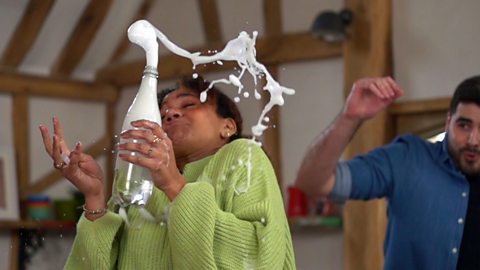
Which is the strongest magnet? video
In this short film, presenters Cayana and Louise test some magnets to find out which one is strongest.
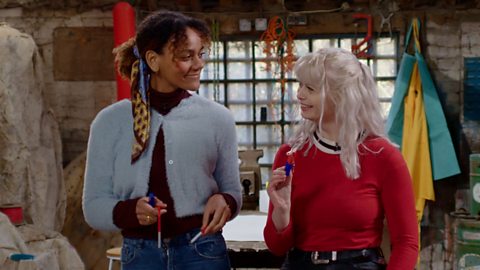
Can people with longer legs jump the furthest? video
In this short film, presenters Frankie and Louise find out whether people with longer legs can jump the furthest.
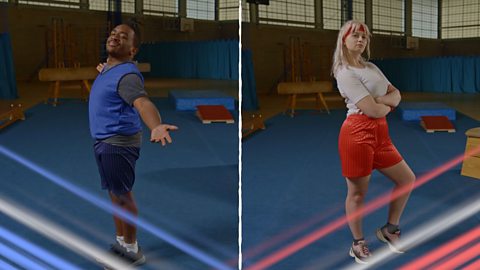
How effective are different liquids at blocking out UV light? video
In this short film, presenters Frankie and Louise find out how effective different liquids are at blocking out UV light.