ADAM:'This is planet ant. A giant, man-made ant home, built especially above ground, to allow us to investigate the incredible lives of these tiny creatures.
ADAM:'These glass boxes and tubes have been built to replicate the underground tunnels and chambers of an ant colony in the wild and they're full of busy leaf cutter ants.
ADAM:'This is the first time that a man-made ant colony has been built on this scale. I've brought some young scientists along to planet ant to see what we can discover about one of the world's most fascinating insects and like all good scientists, they have lots of questions.'
CHILD #1:Why do they cut the leaves?
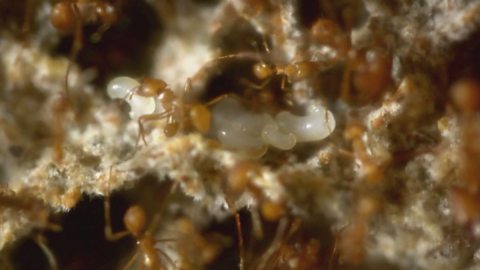
ADAM:Yeah they're leaf cutting ants, they're not leaf eating ants. What they're actually doing is taking these leaves back into the nest and once they're there, they use the leaves to grow a fungus.
ADAM:'Leaf cutter ants, despite their name, don't eat leaves. They bring them into the nest as a food supply for the fungus they're growing inside and it's the fungus that they eat.
ADAM:'Our ants are farmers and the fungus is their crop.
ADAM:'The fungus contains just the right balance of nutrients to feed the colony and its developing young.'
ADAM:'This crop alone, grown in just a few weeks since the ants arrived from Trinidad, will feed thousands of new ants.'
GEORGE:Ah look at that. Ooh! Ow! They're not happy about this but I can really see the structure of the fungus garden. I mean this is their very reason for being isn't it?That is the major resource in there.
ADAM:It's not like a mushroom or a toadstool, it's very fragile. It's more like a sponge. There's a huge surface area in here, so there's lots of little chambers and cavities and places for them to feed.
GEORGE:That is unbelievable.
ADAM:It's a really beautiful structure.
GEORGE:It's really soft.
ADAM:Yeah.
CHILD #1:Why do they have spots on them?
ADAM:Well those spots you can see aren't actually spots, what they are is spikes that come out of the middle of them so they're really spiny and that stops things from eating them.
ADAM:'Our ants eat fungus but some animals eat ants.
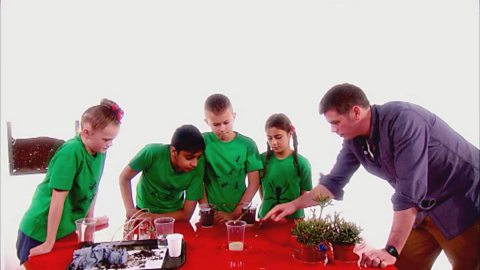
ADAM:'I set our young scientists a challenge: to find out which animals ants eat and which animals eat ants.'
CHILD #3:That will definitely eat the spider.
CHILD #4:The ant can eat them and they can be eaten by an ant.
CHILD #1:And these three can eat the fly I think–
ADAM:Down to there.
ADAM:OK so what we've got here is a big tangle of interactions haven't we? We've got lots of animals eating lots of other animals and being eaten by them. What do we call that?
CHILD #3:A food chain.
ADAM:Well a food chain's one animal eating another, eating another but we've got something much more complicated. We call this a food web because everything's interconnected and the ant might have been eaten by some things and eat some other things but we've got all these complicated relationships around the outside so everything's linked up.
ADAM:'Studies have shown that ant colonies can increase the variety or diversity of animal life around them.'
ADAM:'Nutrients released from their underground nests fertilize the surrounding soil which in turn helps the growth of plant life on the surface.
ADAM:'And more plants mean more animals.6ADAM:'For this reason, ants have been called ecosystem engineers.'
ADAM:'On planet ant, the colony is thriving. They've devastated plant after plant. Cutting leaves to use to feed the fungus and it's this fungus that's used to feed the colony. They are fungus farmers.
ADAM:'Ants, like other animals, have their own part to play in the ecosystem. They depend on the leaves and in turn nutrients from the ants' nest are released back into the surrounding soil, which encourages plant life to grow, which helps other animals to thrive.'
Young scientists are given photographs of different animals and asked to draw lines connecting them, according to whether they eat or are eaten by another animal.
This creates a food web.
We learn how ant colonies can affect their surroundings. For example, nutrients released from their nests can fertilise the soil which helps plants to grow, which means more animals can live in the area.
This increase in diversity close to the colony has led to ants being called ‘eco engineers’.
This clip is from the series Life on Planet Ant.
Teacher Notes
Students could grow their own ant colony and observe the behaviour of the ants, tracking it in a class journal over a number of weeks.
What interactions do the ants have with plants and their surrounding environment? What about with each other?
Students could also draw diagrams of the ants or create a larger than life poster, signposting the physical and behavioural characteristics and how this ensures the survival of the species.
Curriculum Notes
This clip will be relevant for teaching Science/Biology at KS2 in England, Wales and Northern Ireland and 2nd Level in Scotland.
More from Life on Planet Ant
Inside an ant colony. video
The most important ant is the queen whose job it is to lay the eggs and there are also many different types of worker ants.
How ants communicate. video
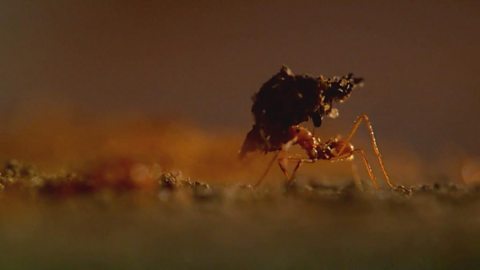
The young scientists learn how ants communicate using chirping sounds called stridulation.
Why are ants different sizes? video
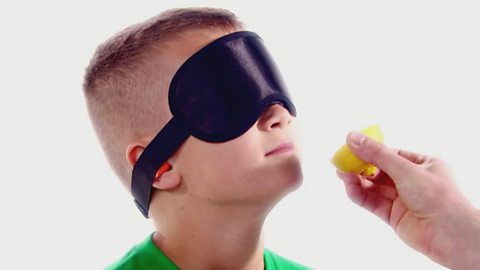
Dr George McGavin explains to the young scientists how the ant colony is organised into different types of ants, known as castes.
How to build a mini ant nest. video
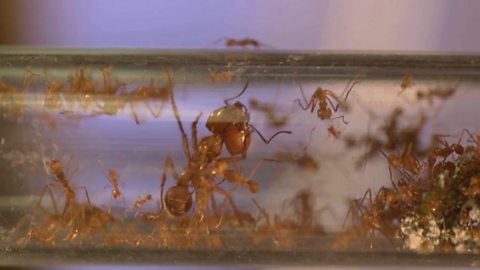
The young scientists create their own small ant colony using plastic cups and make a pooter to collect the ants.
Life cycle of an ant. video
The young scientists learn about the life cycle of an ant, including how the eggs hatch into larvae.