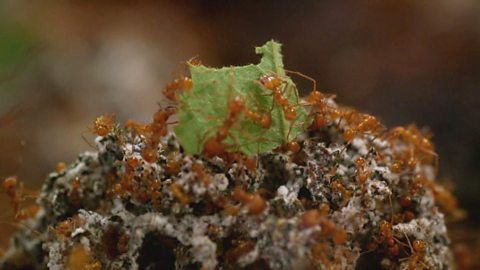
ADAM:'This is Planet Ant. A giant, man-made ant home, built especially above ground, to allow us to investigate the incredible lives of these tiny creatures.
ADAM:'These glass boxes and tubes have been built to replicate the underground tunnels and chambers of an ant colony in the wild and they're full of busy leafcutter ants.
ADAM:'This is the first time that a man-made ant colony has been built on this scale.
ADAM:'I've brought some young scientists along to Planet Ant to see what we can discover about one of the world's most fascinating insects. And like all good scientists, they have lots of questions.'
CHILD #1:How would an ant be born?
ADAM:How would an ant be born? Well inside a colony there's a queen, she's a really big ant and she lays all the eggs that produce all of the ants in the colony.
CHILD #2:Where is the queen?
ADAM:Where is the queen?
ADAM:Well we don't know exactly where the queen is because she might move around a little bit but she's definitely in one of those boxes over there.
ADAM:'We can't see the queen on Planet Ant as she's hidden deep inside the nest but I can show the young scientists a leafcutter queen, just like her from another colony.'
ADAM:What can you see?
ALL: Ants.
CHILD #3:Fungus.
ADAM:You can see the fungus, you can smell the fungus a little bit.
CHILD #4:Beetles.
ADAM:Ah, what are you pointing at that's a beetle?
CHILD #4:Beetles.
ADAM:No that's not a beetle What do you think–
CHILD #1:Mushrooms.
ADAM:she might be.
CHILD #2:Queen ant.
ADAM:That's the queen, yeah, that's the queen ant. So leaf cutting ants have this really big queen.
ADAM:'Our ant colony will only ever have one queen living in it. She is HUGE compared to the other ants and is cared for, round the clock, by smaller ants.
ADAM:'They tend to her every need, because she's the most important ant in the colony. She is the mother of all the ants. That means she lays the eggs, that hatch into the larvae which in turn, become the adult ants.
ADAM:'The ants in a colony are not all the same. There are different types of ant, and each have a different job to do from the queen that lays the eggs, to the soldiers that defend the nest.
ADAM:'All the eggs the queen lays are almost identical so how can they become all the different kinds of ant, that make up the colony?'
ADAM:'The workers are in control of this. What they feed the larvae, and how much they feed them, determines the kind of ant that they will become.
ADAM:'They tend to respond to the world around them. If the colony comes under attack, they will need more soldiers so the workers will ensure the larvae become soldiers. If they need to gather more leaves, then they'll feed more larvae to grow into foragers.
ADAM:'It's amazing to think that the queen is the mother to every one of the hundreds and thousands of ants in planet ant.'
CHILD #2:Wow.
ADAM:So there's the queen.
CHILD #4:Gross.Look at her giant abdomen.
ADAM:Yeah, why do you think her abdomen is so big?
CHILD #1:Because she's laying eggs.
ADAM:Yeah she's laying lots of eggs so there's lots of ovaries in here that are making all those eggs.
CHILD #4:What would happen if she dies?
ADAM:If you killed the queen in this colony, they're not gonna get any more eggs. So what's gonna happen is that the workers that are there are gonna live their lives but there's gonna be no one to replace them so the colony will come to an end.
ADAM:'There are lots of different types of ants in our colony but the most important one of all, is the queen. This is because she is the ant that reproduces. She lays the eggs that hatch into the larvae that become the adult ants. Without her, the colony would die.'
A leafcutter ant colony from Trinidad has been rescued and re-housed in a giant man-made nest in the UK, allowing an in-depth study into their normally hidden world. It’s the first time a man-made colony has been built on this scale and Professor Adam Hart gives four primary school scientists a tour.
The young scientists are not able to see the queen as she is hidden deep within the nest. But, in the lab, Adam is able to show them a similar queen from another leafcutter colony.
They learn that the queen is much larger than all the other ants, with the smaller ants that surround her tending to her every need.
The life cycle of ants is described; the queen lays the eggs which hatch into larvae and then change to become the ants in the colony.
When the eggs are laid they are all the same, but what and how much they are fed results in different kinds of ants, such as soldier ants and minima.
The ant colony is very clever; if it comes under attack it produces more soldier ants, and if they need more leaves they will grow more ants to become foragers.
This clip is from the series Life on Planet Ant.
Teacher Notes
Students could role-play how an ant colony adapts to outside forces. One student could be selected as the ‘queen’ and two others as worker ants. Everyone else could stand in a ‘holding zone’.
The ‘queen’ could tap students in the holding zone on the shoulder and they would then become ‘eggs’. Once the eggs are created, the worker ants should hand out different coloured bands, depending on whether the ant in the egg will become a soldier or a worker ant.
Once a few ants have been ‘born’, a caller could describe an outside force which is affecting the colony. For example, ‘another colony is attacking’. The workers should then hand out more ‘soldier’ bands. Outside forces should lead to killing a number of ants at once so that students can return to the holding zone, begin their life again as ‘eggs’ and continue the flow of the game. Examples include humans stepping on the colony, or doing battle with other ants.
Students could draw the different stages of the ant life cycle in the correct order.
Curriculum Notes
This clip will be relevant for teaching Science/Biology at KS2 in England, Wales and Northern Ireland and 2nd Level in Scotland.
More from Life on Planet Ant
Inside an ant colony. video
The most important ant is the queen whose job it is to lay the eggs and there are also many different types of worker ants.
How ants communicate. video
The young scientists learn how ants communicate using chirping sounds called stridulation.
Why are ants different sizes? video
Dr George McGavin explains to the young scientists how the ant colony is organised into different types of ants, known as castes.
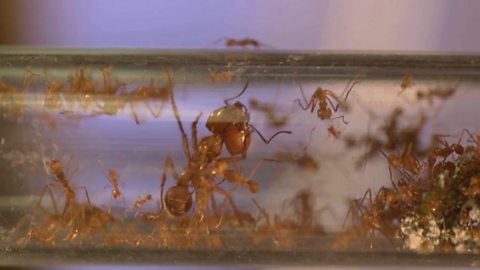
How to build a mini ant nest. video
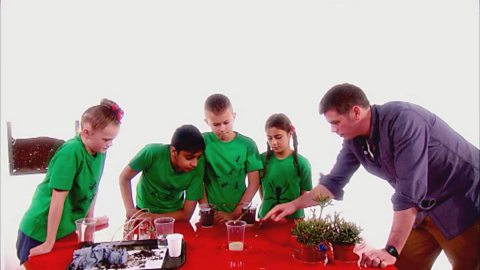
The young scientists create their own small ant colony using plastic cups and make a pooter to collect the ants.
What ants eat and what eats ants. video
Young scientists draw lines connecting photos of different animals, according to whether they eat or are eaten by another animal.