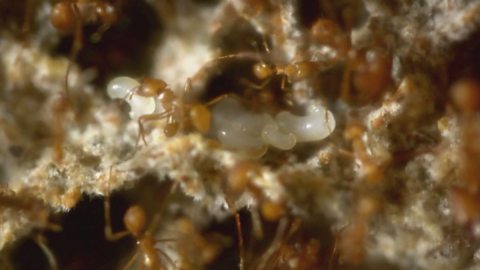
ADAM:'This is Planet Ant. A giant, man-made ant home, built especially above ground, to allow us to investigate the incredible lives of these tiny creatures.
ADAM:'These glass boxes and tubes have been built to replicate the underground tunnels and chambers of an ant colony in the wild and they're full of busy leafcutter ants.
ADAM:'This is the first time that a man-made ant colony has been built on this scale. I've brought some young scientistsalong to Planet Ant to see what we can discover about one of the world's most fascinating insects. And like all good scientists, they have lots of questions.'
CHILD #1:How come some ants are big and some ants are small?
ADAM:It's really, really useful for this ant colony to have ants of these different sizes ecause it's like having a really complicated tool kit. It means that you can do lots of different things.
ADAM:So the ants that are very small are very good at doing gentle little delicate jobs whereas the bigger ants are really good at doing things like defending the nest and carrying big objects.2:21ADAM:So it's about having lots of different ants of different sizes, to do lots of different jobs.
GEORGE:Now the first thing that's really obvious when you look at an ant colony the adult ants seem to be of different sizes.
GEORGE:Now, it's not because they're not fully grown, it's because they are different casts of ants and under here I've got three different casts of worker ants.
ADAM:'In the insect world, a cast system means that there are lots of body types of different shapes and sizes, within a single species or group of animal.'
GEORGE:And they're different sizes for a good reason. Each of these casts of ants have a different job to do.
ADAM:'Soldier ants are bigger than the other casts. That head, isn't filled with a large brain but a massive set of muscles to power a fearsome pair of jaws or mandibles, strong enough to cut through leather.
ADAM:'Going down the size scale, this smaller ant is called a media worker. These are the ants that collect and bring leaves back to the nest. It's serrated jaws are just the right shape for cutting into tough plant material.'
ADAM:'At the very bottom of the scale are the minima the most numerous ants of all. They use the leave to grow fungus that feed the colony and they look after the young.
ADAM:'The work is divided between all the ants. Each cast of ant has a role to play.'
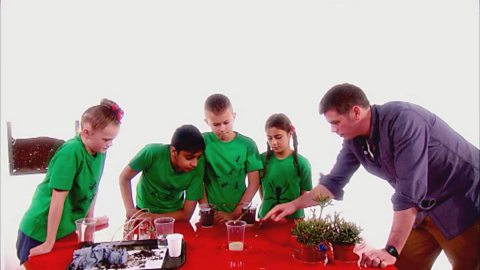
ADAM:'Our young scientists are examining some ants more closely.'
ADAM:Alright, we've had a nice chance to look at these ants, I reckon we should try and draw them.
ADAM:'Drawing the ants is a really good way of focusing on the detail of them.'
ADAM:Try and make a nice, big, clear sketch so that we can see all the structures and all the way that these animals are put together.
ADAM:These ants are insects and you can tell they're insects because they've got these three body sections.
ADAM:So at the front you've got the head just like we do. We've got that middle section, what do we call that?
CHILD #3:The thorax?
ADAM:Yeah, the thorax and the thorax has got three pairs of legs so six legs coming out of it.
ADAM:So that's all about moving around and then we've got this big chunky bit at the back. Do you know what we call that?
CHILD #4:The abdomen?
ADAM:Yeah the abdomen. Now this is our abdomen, what do we do in here, what's this?
CHILD #4:We put our food in it?
ADAM:Yeah, this is our tummy. So you've got the head, you've got the thorax and then you've got that big third body segment at the back.
ADAM:'The hundreds and thousands of ants on Planet Ant, are organised in a very special way.
ADAM:'Inside are different casts or kinds of ant from the minima to the soldiers and they each have a job to do for the colony but although there are different casts, there is something that's the same they are all insects.
ADAM:'That means they have six legs and three body parts a head, a thorax and an abdomen.
ADAM:'Just like in our world, on Planet Ant, there are jobs that need to be done and having all the different casts, means that each job can be done effectively.'
The young scientists are keen to find out why ants are different sizes. Dr George McGavin explains how the ant colony is organised into different types of ants, known as castes.
Each castes is a different shape and size and has a special job to do.
The soldier ants are big with huge mandibles that are used for defending the nest and carrying large objects. The smaller media ants collect leaves and take them back to the colony. The smallest ants, called minima, use the leaves brought back to the colony to farm fungus.
Minima ants are the most numerous, so they are also tasked with looking after the young in the colony.
The colony is very organised and each caste of ant has its own special job so that the ant community can survive.
This clip is from the series Life on Planet Ant.
Teacher Notes
Students could research ant behaviour using various ICT sources and have fun creating job advertisements for the different kinds of ants. Key specifications may include ‘jaws strong enough to cut through leather’ or ‘able to lift 100 times own body weight’.
Students could also be encouraged to sketch ants in their local environments to accompany their job adverts, identifying and labelling key features.
Curriculum Notes
This clip will be relevant for teaching Science/Biology at KS2 in England, Wales and Northern Ireland and 2nd Level in Scotland.
More from Life on Planet Ant
Inside an ant colony. video
The most important ant is the queen whose job it is to lay the eggs and there are also many different types of worker ants.
How ants communicate. video
The young scientists learn how ants communicate using chirping sounds called stridulation.
What ants eat and what eats ants. video
Young scientists draw lines connecting photos of different animals, according to whether they eat or are eaten by another animal.
How to build a mini ant nest. video
The young scientists create their own small ant colony using plastic cups and make a pooter to collect the ants.
Life cycle of an ant. video
The young scientists learn about the life cycle of an ant, including how the eggs hatch into larvae.