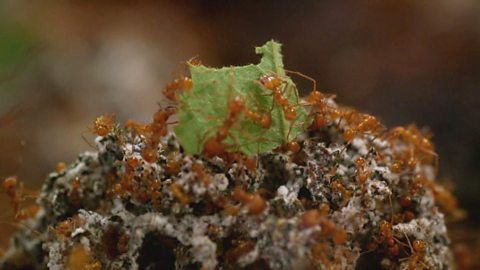
ADAM:'This is Planet Ant. A giant, man-made ant home built especially above ground to allow us to investigate the incredible lives
ADAM:'of these tiny creatures. These glass boxes and tubes have been built to replicate the underground tunnels and chambers of an ant colony in the wild, and they're full of busy leafcutter ants.
ADAM:'This is the first time that a man-made ant colony has been built on this scale. I've brought some young scientists along to Planet Ant to see what we can discover about one of the world's most fascinating insects.And like all good scientists, they have lots of questions.'
CHILD #1:Are they friendly?
ADAM:They're friendly to each other. It's like a big city.
CHILD #1:Yeah?
ADAM:And they want to defend themselves so they're really friendly in the city,
ADAM:but they're really aggressive to anything that's not part of their city
ADAM:'Our young scientists are investigating how ants communicate with one another.'
ADAM:Can you hear anything?
CHILD #2:No.
CHILD #1:No.
ADAM:Actually some ants can use very, very small sounds, our ants in Planet Ant are producing very tiny sounds.
ADAM:'Using a special piece of equipment called a microphone we discover that the ants are communicating with each other using sound. Not only can we hear the sounds of footsteps and leaves being cut, we can also hear a special chirping sound.'
CHIRPING
ADAM:'This is called stridulation, a sound the ants make by rubbing two sections of their abdomen together. They make this noise to call other ants to the best leaves on a plant.
ADAM:'Ants also use stridulation if they're in trouble to call to other ants for help.'
ADAM:What would happen, if we plug up Jack's ears?
ADAM:What's gonna happen now?
ALL:He can't hear us.
ADAM:Yeah, he can't hear us. So it's more difficult to communicate with him but how could we communicate with him?
CHILD #3:Sign language?
ADAM:Yeah we could use our hands couldn't we? So how about… If we blindfold Jack as well?
ADAM:How could we communicate with Jack now?
CHILD #2:With sense of smell?
ADAM:Let's say we wanted Jack to move around just using these lemons. How could we do that?
CHILD #2:Put them up to his nose and then tell him where to walk and then he could follow the smell of the lemon.
ADAM:So let's see what we can do. Yeah, he's picked it up, look. First that way, can we move him back the other way?
ADAM:'An ant's sense of smell is vital to them, but they don’t use noses like us. They use their antennae to detect special chemicals that they lay on the groundcalled pheromones.
ADAM:'To find out more about how this works, I'm setting our ants on Planet Ant a challenge.
ADAM:'I've given them a Y-shaped trail. At one end of that 'Y' is food and at the other is nothing. They have to decide whether to go left or right.
ADAM:'After just 20 minutes, virtually all of them are heading down the path that leads to the food. Leafcutter ants don't have very good eyesight so how do they know where to go?'
ADAM:'When an ant goes out looking for food, she leaves a pheromone trail on the ground behind her that her sisters are able to follow. If she finds food, she will then lay down even more pheromone on her way back to the nest, making the original trail even stronger. If she doesn't find food, she won't lay any more pheromone and the trail simply evaporates away.
ADAM:'The stronger the pheromone trail, the more likely an ant is to follow it and in turn, add her own pheromone to the route.
ADAM:'When hundreds and thousands of ants are doing this, very strong trails are produced that link the nest directly to food.
ADAM:'The way that ants communicate with one another allows them to be a highly organised group of insects. They use chemicals called pheromones to lay trails to food that other ants can detect using their antennae. This is why we often see lines of ants marching backwards and forward to food.
ADAM:'They also use stridulation, a noise made by rubbing two parts of their abdomen together, to call other ants to the tastiest leaves or to help them if they're in trouble.
ADAM:'So to us, Planet Ant might seem to be a quiet and peaceful world but in reality, it is full of the sounds of ants constantly communicating with one another.'
The young scientists learn how ants work as a community and are friendly to each other, communicating using chirping sounds called stridulation.
This is a sound made by rubbing two parts of their abdomen together.
They use this to communicate to others where the best leaves are on the plant and if they are in trouble.
Ants also communicate using signals with their legs and use their antennae to sense different chemicals that other ants lay on the ground called pheromones.
Back in the lab, Adam focuses the young scientists on different types of communication and tests one of them by blindfolding him and asking him to follow the smell of a lemon.
In the man-made ant colony, Adam gives the ants a test to demonstrate the use of pheromone trails to find food.
He creates two different bridges, only one of which leads to food, to find out if and how ants leave and follow pheromone trails.
This clip is from the series Life on Planet Ant.
Teacher Notes
The children could be asked to communicate by creating their own signals, perhaps learning some sign language or using Makaton, also blindfolding each other and testing different smells to find out which is the easiest to follow and which smells last longest.
Test the idea that ‘the stronger the pheromone trail, the more ants will follow it'.
Curriculum Notes
This clip will be relevant for teaching Science/Biology at KS2 in England, Wales and Northern Ireland and 2nd Level in Scotland.
More from Life on Planet Ant
Inside an ant colony. video
The most important ant is the queen whose job it is to lay the eggs and there are also many different types of worker ants.
Why are ants different sizes? video
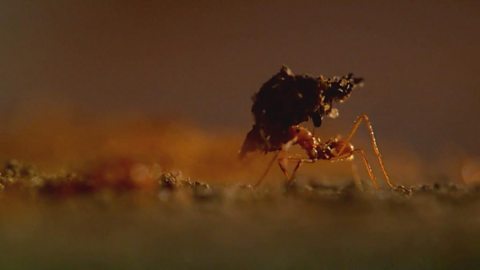
Dr George McGavin explains to the young scientists how the ant colony is organised into different types of ants, known as castes.
How to build a mini ant nest. video
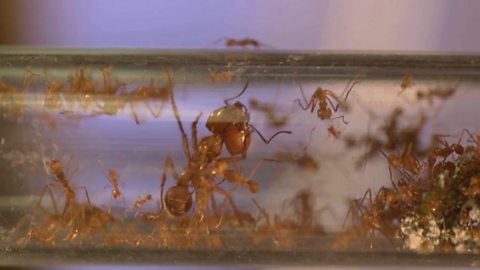
The young scientists create their own small ant colony using plastic cups and make a pooter to collect the ants.
Life cycle of an ant. video
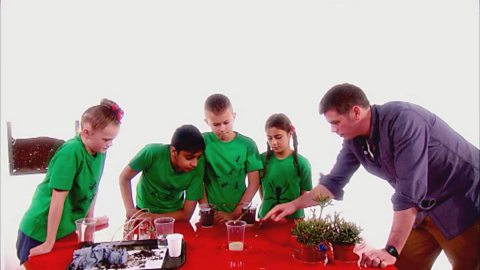
The young scientists learn about the life cycle of an ant, including how the eggs hatch into larvae.
What ants eat and what eats ants. video
Young scientists draw lines connecting photos of different animals, according to whether they eat or are eaten by another animal.