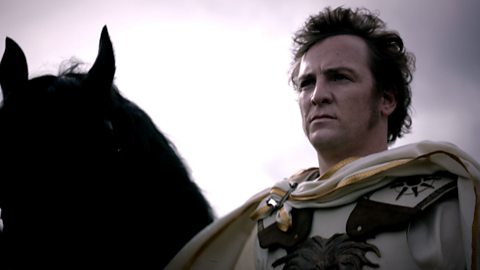
In the mid-nineteenth century, in the United States of America, a conflict was brewing between the modern industrial north and the more rural south.
The nation that had been the first to enshrine the ideals of liberty and equality into its constitution was polluted by a system of slavery.
In the mid-1800s, there were around four million slaves in the United States, almost all of them in the south working on plantations like this growing cotton, tobacco and much else. Economically, slavery was a dynamic and efficient system, and as America started to spread towards the west, the southern states wanted to see slavery spreading too.
But in the north, where many states had banned slavery, they thought very differently. They were determined that slavery would not grow. America was split down the middle.
Things came to a head in 1860 when the northerner, Abraham Lincoln, became president.
ABRAHAM LINCOLN:
But can we, while our votes will prevent it, allow slavery to spread into the northern territories?
Andrew:
Lincoln believed that slavery was wrong but he also said that he had no intention of abolishing it, hoping instead it would die out over time. But southern politicians realised that Lincoln’s arrival in the White House meant slavery would not now spread further, as they’d hoped.
Eleven southern states decided to break away from the Union, and established an independent and separate government, the Confederacy. Lincoln had no choice but to declare war on the south, to defend the Union.
This was a struggle between two different ways of life. In the south, it was an agricultural society, traditional, conservative, many people living on plantations which were virtually self-sufficient, cut off from the rest of the world. Yes, said the north, but all your wealth depends on slavery.
In the north, urban industrial America based on steel and railroads, and a rising middle class. Ah yes, said the south, whose prosperity is based on wage slaves. So two Americas, now no longer able to properly speak to each other.
On April 12th 1861, these two Americas duly went to war. Lincoln mobilised the north’s industrial might, using railways to transport men and weapons. But to start with, it went badly for him. The south had better generals and a bolder fighting spirit.
After eighteen months, Lincoln was desperate. He decided to destroy the foundation on which the south was built. He’d free the slaves.
We must free the slaves, he said, or be ourselves subdued. He hoped this would destroy the southern economy and demoralise the people. And so on New Year’s Day 1863, Lincoln announced his emancipation proclamation, that all the slaves in the rebel states would immediately be free.
Liberated slaves flocked to fight with the northern forces, while the south struggled with shortages and inflation.
The tide of war turned in the north’s favour. On April 9th 1865, after a devastating invasion, the south surrendered.
Six hundred and twenty thousand soldiers had been killed, nearly as many as in every other war the United States has fought, put together.
In the final days of the war, Lincoln did something extraordinary. He simply turned up at the Confederate rebel capital of Richmond Virginia, not very far from Washington. His troops had just taken it.
It was still burning.
No one had any idea what to expect when he arrived here by boat at Rocketts Landing.
There was a huge crowd, entirely black. Lincoln had the most recognisable face in America and he was spotted immediately and there were cries of “our messiah” and “Jesus Christ”. One man knelt to him and Lincoln said no no, you only kneel to your god.
And then the group started to walk the two miles into the centre of Richmond and gradually there were more and more white faces in the crowd, sullen, silent, staring back from windows and the tops of buildings, the people that he had just defeated.
And Lincoln’s group were expecting shouts of abuse, possibly even shots.
Nothing.
And at that moment it seemed as if Abraham Lincoln had won all of America back.
Ten days after Richmond, Lincoln went to the theatre in Washington. He hadn’t been keen but his wife had begged him to come, a night off for the hero.
ACTRESS:
Did you see him?
ACTOR:
No but I see him.
Andrew:
But the defeated south would inflict one last act of bloodshed.
A second rate actor and southern Confederate supporter called John Wilkes Booth saw Lincoln as a tyrant.
The actor, Booth was about to make his final appearance, and he knew the reviews would be mixed.
ACTOR:
Well I know enough to turn you inside out.
You sockdologizing old man trap!
Andrew:
Booth cried out the Latin motto of the State of Virginia.
BOOTH:
Sic semper tyrannis!
Andrew:
Thus always to tyrants!
MARY LINCOLN:
Help me, help!
Andrew:
The north mourned an immortal political hero. In the south they celebrated. One Texan newspaper professed itself “thrilled by the death of our oppressor."
The American Civil War left a bitter legacy. In the south, burned and devastated, the whites remained very angry about what had happened and black Americans faced many many decades of grinding rural poverty, segregation laws and lynchings for those who stepped out of line.
But the Union was preserved, and in the north this extraordinarily industrious vigorous economy, now linked together by railroads, stormed ahead, the American colossus striding towards the twentieth century.
Video summary
Andrew Marr describes how the American Civil War and Abraham Lincoln, changed American history forever.
The focus is on Abraham Lincoln’s role in the conflict and his assassination.
Scenes shown include violence towards slaves, Lincoln’s assassination and battle scenes.
The long term consequences of national division, segregation and lynching are also outlined.
This is from the series Andrew Marr's History of the World.
Teacher Notes
In pairs, ask pupils to create two contrasting newspaper headlines together with supporting outline points to illustrate the conflicting points of view of the North and the South.
The pair can then write a balanced obituary for their newspaper examining the extent of Abraham Lincoln's legacy to the USA.
The clip could provide an overview of the key issues surrounding both the Civil War and the eventual abolition of slavery.
It could be used to help explain the contrasting views of the Union and the Confederacy on economic and moral issues.
Pupils could draft an obituary for Abraham Lincoln.
Paired work could involve two contrasting reports of his assassination; one from a northern Union newspaper and one from the South.
Warning: There are some violent scenes in this clip.
This clip will be relevant for teaching History and Politics at KS3 and KS4/GCSE in England and Northern Ireland and National 5 and Higher in Scotland.
This topic appears in OCR, AQA in England, CCEA GCSE in Northern Ireland and SQA Scotland.
Development of the contraceptive pill video
Andrew Marr explores the birth control movement in the USA in the early 20th century.

Gandhi video
Andrew Marr explores Gandhi’s campaign of civil disobedience against the British.
Hitler's rise to power. video
Andrew Marr tells the story of Hitler’s rise to power in Weimar Germany.
American Civil War. video
Andrew Marr analyses 1860s America and the American Civil War, explaining how the conflict, and Abraham Lincoln, changed American history forever.
Russian Serfs video
Andrew Marr outlines the abolition of serfdom in Russia in the 19th century.
China's Cultural Revolution. video
Andrew Marr explores the Chinese Cultural Revolution.
The French Revolution. video
Andrew Marr tells the story of the French Revolution.
The Industrial Revolution. video
Andrew Marr tells the story of Britain’s Industrial Revolution.
Alexander the Great. video
Andrew Marr explores the life of Alexander the Great.