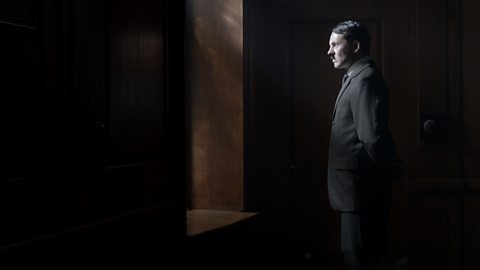
It’s been said that in 1930, three people had achieved instant global recognition:
Charlie Chaplin,
Adolf Hitler,
and a skinny fellow who dressed to impress, Mohandas Gandhi.
Gandhi was a child of the British Empire.
Born in India in 1869 he trained as a barrister in London before moving to South Africa where he successfully fought against the appalling treatment of Indian immigrants. Twenty years later, he returned to India which was then the jewel in the crown of the British Empire and here he began to challenge the injustices that many Indians suffered under British rule.
The British liked to think that in India, they were the good imperialists, parents really. But after famines and repression, many Indians didn’t see it that way.
In March 1930, Gandhi, leader of the Indian Independence Movement, sent a letter to the headquarters of the British Raj in New Delhi. It was a direct challenge posted through the front door.
VICEROY:
Come in!
Andrew:
The letter was addressed to Edward Frederick Lindley Wood, the Lord Irwin, Viceroy and Governor General of India.
Gandhi explained politely but firmly that he was intending to start a campaign of civil disobedience through which he would win India’s independence.
GANDHI:
I do not seek to harm your people. My ambition is no less than to convert the British through non-violence and thus make them see the wrong they have done to India.
Andrew:
Gandhi finished his letter by promising to call off his planned campaign if the British would agree to talks about freedom for India.
In the 1920s, on the surface the British Empire seemed as self-confident as ever. Some sense of its swagger is given by the Viceroy’s new house in Delhi. A British architect working on a Moghul scale, it makes Buckingham Palace seem poky.
But this was confronted by the determination of the wiry little man from Gujarat who understood that the British weakness was a determination to be thought decent rulers, so his campaign of non-violent disobedience was a kind of political torture. Gandhi said there are many causes I’m prepared to die for but none that I am prepared to kill for. Answer that.
Hm!
The Viceroy chose not to answer Gandhi’s letter so the trouble-maker embarked on his campaign of polite smiling civil disobedience.
Gandhi set out to walk the 240 miles from his home to the coast in a protest about salt. Along the way the crowds welcoming him grew day by day. When he arrived at the seashore, fifty thousand supporters, newsmen among them, were waiting to greet him.
Gandhi walked down to the water’s edge and he scooped up some salty mud.
GANDHI:
With this handful of salt, I am shaking the foundations of the British Empire.
Andrew:
Focusing on salt was a stroke of genius any spin doctor would envy. Indian salt production was a British monopoly and it was taxed, a huge source of income controlled solely by Britain. Gandhi encouraged all Indians to break the law by panning their own salt and refusing to pay the salt tax. It was an echo of the Boston Tea Party, the trigger for the Americans to gain their independence from Britain.
Gandhi was engaged in a propaganda campaign, and refusing to pay tax on salt would remind the Americans of their refusal to pay tax on tea when they broke away from the British Empire. So by collecting the salt and refusing to pay tax on it, Gandhi was challenging the British to make themselves look both brutal and ridiculous.
As mass protests rippled across India, the British authorities decided to arrest Gandhi and throw him into jail.
Perfect! Just what he wanted.
His arrest spurred even more people to come onto the streets. Demonstrations were ruthlessly put down. Britain was humiliated and condemned around the world.
By the end of 1930, sixty thousand peaceful protesters had been imprisoned. The agonised Viceroy gave in. He had Gandhi released from prison and invited him in for talks.
VICEROY:
Mr Gandhi.
GANDHI:
Lord Irwin.
VICEROY:
Would you care for some tea?
GANDHI:
Tea would be perfect.
Andrew:
This meeting was the turning point. They agreed a pact which would lead, in stages, to India’s independence.
VICEROY:
Sugar, Mr Gandhi?
GANDHI:
No, thank you.
Andrew:
As the two men celebrated with a cup of tea, Gandhi had one final surprise.
GANDHI:
I am putting some salt into my tea, to remind us of the historic Boston Tea Party.
VICEROY:
Very good, Mr Gandhi.
Andrew:
But in Britain, not everybody was impressed.
Back in London, Winston Churchill was appalled to see Gandhi posing as a fakir, striding half-naked up the steps of the Vice-regal Palace, to parlay on equal terms with the representative of the King Emperor.
This is just the beginning. It took sixteen years and a world war, but already the greatest empire the world had ever seen was lying rather grandly on its death bed.
Gandhi’s legacy has reached much further than independence for India.
His philosophy of non-violent resistance has been an inspiration all around the world from the American civil rights movement to the unarmed students facing down tanks in China’s Tiananmen Square.
GANDHI:
Non-violence is the greatest force at the disposal of mankind. It is mightier than the mightiest weapon of destruction devised by the ingenuity of man. Non-violence is a weapon for the brave.
Video summary
Andrew Marr describes how Mahatma Gandhi led India to independence during British led rule through a campaign of civil disobedience.
He explores the background to the campaign, the key events and negations, and Gandhi’s legacy through the 20th century.
Warning: There are some scenes of violence.
This is from the series: Andrew Marr's History of the World.
Teacher Notes
Gandhi's concept of non-violent resistance and the role of civil disobedience were the corner-stones of his motive and methods to achieve Indian independence.
Ask students to make a list of the actions taken by Gandhi and place them in an order of significance and impact.
It might be used as the stimulus for a debate on the value and impact of peaceful protest in contemporary society.
Pupils could also discuss how 'The Empire' affected India and it's people.
How few benefits such as the railway system impacted on hundreds of thousands of people, including enslavement.
A study of India's independence movement might be followed up by this to provide an overview of issues, context and key characters.
As an extension, pupils might use this as part of a comparative investigation into key 20th century figures and political leaders.
This clip will be relevant for teaching History at KS3 and KS4/GCSE in England, Wales, Northern Ireland and National 5 and Higher in Scotland.
This topic appears in OCR, AQA, WJEC in England and Wales, CCEA GCSE in Northern Ireland and SQA Scotland.
Russian Serfs video
Andrew Marr outlines the abolition of serfdom in Russia in the 19th century.
The Atomic bomb video
Andrew Marr explores the development and deployment of the first atomic bomb.
China's Cultural Revolution. video
Andrew Marr explores the Chinese Cultural Revolution.
Development of the contraceptive pill video
Andrew Marr explores the birth control movement in the USA in the early 20th century.

American Civil War. video
Andrew Marr analyses 1860s America and the American Civil War, explaining how the conflict, and Abraham Lincoln, changed American history forever.
The French Revolution. video
Andrew Marr tells the story of the French Revolution.
The Industrial Revolution. video
Andrew Marr tells the story of Britain’s Industrial Revolution.
Alexander the Great. video
Andrew Marr explores the life of Alexander the Great.
Hitler's rise to power. video
Andrew Marr tells the story of Hitler’s rise to power in Weimar Germany.