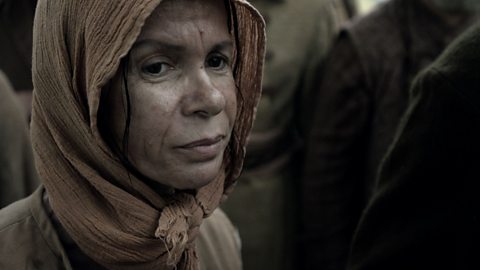
The nuclear arms race of the 1950s and 60s between communist and capitalist camps terrified the world.
It brought the threat of mutually-assured destruction. Using nuclear weapons would guarantee the annihilation of both sides and with them human life on earth.
But this deadly threat did preserve a fragile peace between the superpowers.
It allowed the rival systems to test their own economic power and in the west the sheer energy of capitalism was unleashed as never before, producing a gushing abundance of goods, a colourful gloss of material plenty.
NEIL ARMSTRONG:
This is Apollo launch control. Five, four, three, two…
Andrew:
It was a time when everything seemed possible.
NEIL ARMSTRONG:
It’s different… but it’s very pretty out here.
Andrew:
But as the west went moony, on the other side of the world, daily life was descending into a political nightmare…
The People’s Republic of China. July 1967.
Fanatical gangs, known as the Red Guards, were hunting down anyone suspected of betraying the ideas of the Chinese communist leader, Chairman Mao Tse Dong. The name of this victim: Deng Xiaoping.
One day he’d become the most powerful man in China, the leader who would turn the country into the economic power house that it is today.
Deng was one of the original Chinese communists. He’d been a guerrilla fighter, he’d led armies for Mao from the early days right through to the final victory and Mao liked him a lot. He called him “the little man”, and he’d drawn Deng into the tight group of people who really ran China, but now Deng was on his knees being screamed at by the Red Guards, the fanatical foot soldiers of the wildest social experiment ever to hit modern China: the Cultural Revolution.
The Cultural Revolution meant a vast purge of anyone thought to stand in the way of Chairman Mao’s long march towards a communist utopia.
Mao called for a war against the four olds:
old thinking, old culture, old customs, old habits.
It’s estimated that millions of people died in the Cultural Revolution. The Chinese government itself says that a hundred million people suffered. Mao had quite deliberately unleashed social anarchy, a war against the past, a war against moderation, a war against common sense.
Mao’s warped economic reforms had led to famines in which up to forty-five million people died.
Deng Xiaoping fell foul of Mao’s Red Guards for daring to suggest there might be a better way of running the economy.
At the 1961 party conference, Deng argued that economic growth mattered more than communist theory and he quoted an old peasant saying: it doesn’t matter if the cat is black or white, if it catches mice, it’s a good cat. Now this was dangerous stuff. It suggested that he thought there was an alternative way for China to modernise, not necessarily Chairman Mao’s way.
After his public denunciation, Deng Xiaoping was exiled to work in a tractor factory.
In time, Mao relented and Deng was welcomed back to Beijing as if nothing had happened. When Mao died in 1976, the great survivor seized the chance of a political comeback. Within two years, Deng was the most powerful man in China.
Deng’s moment had come and what a moment! He took China right round towards roaring full throttle capitalism.
Under Deng, China’s repressive state continued but he began welding together the two big ideas that had divided the world in the twentieth century. For him, capitalism in a communist country wasn’t a contradiction.
It was a pragmatic solution.
Since Deng’s reforms were introduced, China’s economy has been growing at an average of nearly 10% a year, every year.
It’s on track to become the world’s biggest economy by 2016.
Video summary
Andrew Marr explores the Chinese Cultural Revolution and the fall and rise of Deng Xiaoping.
He looks at the changing fortunes of Deng within China’s ruling Communist Party, his relationship with Chairman Mao Zedong, and the role his economic reforms played in the emergence of China as a superpower.
This is from the series: Andrew Marr's History of the World.
Teacher Notes
Create a timeline which charts the rise, fall and rise again of Deng Xiaoping.
Label significant events in his life and rate them on a score of 1-10.
Show events from Deng Xiaoping's life, from his early days as a militant member of the Communist party, through the Cultural Revolution and his political comeback after the death of Chairman Mao.
As a plenary, students could be asked to consider whose legacy is greater, Mao or Deng Xiaoping?
This clip will be relevant for teaching History at KS3 and KS4/GCSE in England, Northern Ireland and National 4, National 5 and Higher in Scotland.
This topic appears in OCR, AQA in England and CCEA GCSE in Northern Ireland and SQA Scotland.
The Industrial Revolution. video
Andrew Marr tells the story of Britain’s Industrial Revolution.
The French Revolution. video
Andrew Marr tells the story of the French Revolution.
Alexander the Great. video
Andrew Marr explores the life of Alexander the Great.
Gandhi video
Andrew Marr explores Gandhi’s campaign of civil disobedience against the British.
Development of the contraceptive pill video
Andrew Marr explores the birth control movement in the USA in the early 20th century.

American Civil War. video
Andrew Marr analyses 1860s America and the American Civil War, explaining how the conflict, and Abraham Lincoln, changed American history forever.
The Atomic bomb video
Andrew Marr explores the development and deployment of the first atomic bomb.
Hitler's rise to power. video
Andrew Marr tells the story of Hitler’s rise to power in Weimar Germany.
Russian Serfs video
Andrew Marr outlines the abolition of serfdom in Russia in the 19th century.