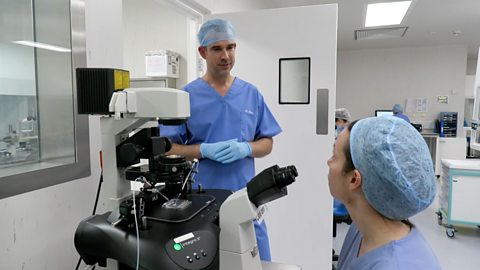
When a man and woman decide to have sex in order to make a baby, the man releases sperm to meet an egg inside the woman’s body. It’s the most common way that these cells meet.
The sperm leaves through the penis and in order for this to happen, the penis has to become hard and stiff. The medical term for it is an erection and it happens when someone is aroused.
An erection happens when the nerves surrounding the penis become active, causing the muscles to relax and more blood to flow into the penis. This makes it stiff and hard.
Now erections can sometimes happen at unexpected times. Don’t worry, it’s perfectly natural and it will go back down.
When a woman is aroused, there is an increase in blood flow to the vagina and vulva, and the clitoris which is part of the vulva, swells. Fluids are also released into the vagina to make it slippery.
To make a baby through sex, when both grown-ups are ready and give consent, the man’s penis goes into the woman’s vagina, and together they move back and forth.
This can create a pleasurable feeling for both the man and the woman, which can increase into something called an orgasm.
During a male orgasm sperm in the testes are squeezed through tubes called sperm ducts towards the base of the penis where it gets mixed with fluid to make semen.
Muscles at the base of the penis then contract, forcing the semen out into the vagina. This reflect action is called ejaculation.
Those sperm are on a mission, just like mini superheroes racing against time to get to the egg with just 12-24 hours to get there.
An egg is released by one of the ovaries each month and it travels into the fallopian tubes. The sperm need to travel here to find it.
Up to 200 million sperm are released when a man ejaculates, but it only takes one to fertilise the egg and start making a baby, and that can only mean one thing – it’s a race!
We are building up to the start of the race and what a line-up we have.
There can be only one winner. Who will it be?
Sperm, on your marks, get set, go.
And they’re off.
Whoo hoo! Come on number 1,009,324! You’ve got this
They’ve got a long way to go and some of the sperm are already beginning to get tired and stop swimming.
What’s that one doing? It’s going the wrong way
Only the strongest and fastest sperm will ready the egg
And it looks as though number 1,192 is breaking through.!
It’s leaving the other sperm for dust. There’s no reaching it now, and it’s done! It’s the first to reach the egg.
Winner
Now fertilisation has taken place.
The egg and sperm can become an embryo that will hopefully develop into a baby.
Video summary
This short film discusses what happens when a man and woman decide to have sex to make a baby.
Using animation, it describes how sexual intercourse takes place, giving the correct terminology for genitals and other relevant vocabulary.
The film refers to being grown up and ready, and the need for mutual consent in choosing to have a physical relationship.
This film can be used as part of a school’s planned programme for relationships and sex education (RSE), and schools might also choose to use it to support science curriculum requirements for teaching about reproduction. Schools must determine and detail the content for their sex education curriculum where taught, and parents have the right to withdraw their children from that content only.
Please ensure you watch the film prior to using it in class, to ensure it is suitable for your pupils and in line with your school's policy for RSHE. Further guidance is given below.
Before watching the clip
Use baseline assessment/discussion to establish pupils’ existing knowledge. Link this to other curriculum or year group content (e.g. in Science) where relevant.
Your teaching must be age-appropriate, show sensitivity and meet the needs of all pupils – some may have already learnt about sexual reproduction whereas others may have no knowledge of it.
You should establish whether and what learning has happened in previous lessons about the use of correct terminology, and recap on any previous discussions of why correct medical terminology is useful.
Safeguarding
Teaching about sexual intercourse and fertilisation requires sensitive and well-judged teaching based on knowledge of pupils and their circumstances.
Creating a safe space for RSHE lessons is important, including encouraging pupils to respect others through listening and being mindful of other’s feelings.
- Give some thought to what is happening before and after the lesson for those pupils and how to provide opportunities for them to ask questions, anonymously or face-to-face.
- Remind pupils where to go for good answers to their questions.
- The whole school community needs to be aware of when these lessons are taking place, to enable all staff to respond to questions in a supportive and informative way.
- With your RSHE lead, discuss ways of responding to common questions that reflect your school’s ethos and RSHE policy.
- Be aware of your school safeguarding policy and procedures for safeguarding disclosures and concerns.
You should pay particular attention to pupils who may need clarification around the legal age of consent and the law around consent.
This tool from Brook Learning may be helpful.
It is important to emphasise that sex is an adult behaviour. If children are worried about something after this lesson, they may need support.
SEND
Ensure the subject is accessible for pupils with SEND and prepares pupils for adulthood, as set out in the SEND code of practice: 0 to 25 years.
Topics that are addressed in other clips
- If you have sexual intercourse does that always make a baby?
- Can you stop your body making a baby?
- Does everyone have a baby?
- What if no sperm win the race?
- Can you have sex and NOT make a baby?
Further information for teachers
You may find the following resources helpful in your preparation to teach this topic:
Childline: Sex and relationships
NSPCC: Talk Relationships: delivering sex and relationships education training courses
Links to guidance
- Para 68 – Sex Education
Where a maintained primary school chooses to teach aspects of sex education (which go beyond the national curriculum for science), the school must set this out in their policy and all schools should consult with parents on what is to be covered.
DfE National Curriculum science
- main external body parts, puberty, and reproduction in plants, how a baby is conceived and born.
Keywords
Sperm, penis, erection, nerves, vagina, vulva, clitoris, consent, orgasm, sperm duct, semen, ejaculation, egg, ovaries, fallopian tubes, fertilisation, testes, embryo
Discussion
- Have pupils already covered reproduction and life cycles in science?
- Genital diversity: genitals come in different shapes and sizes – not all look like the illustration in this film
- The size, shape and appearance of real sperm and eggs: in the animation they have faces and are shown to be larger than in real life
Relationships and families. video
This short film is about combinations of humans that can make up a family: mothers and fathers, sisters, brothers, dogs, two fathers, two mothers, foster families. It introduces the concept of biological parents, adoptive parents, foster parents, and divorced parents.
Sperm, egg and reproductive organs. video
This short film introduces the topic of reproduction and that babies start from an egg and sperm. Correct terminology is given for genitals and reproductive body parts in male and female bodies.

Puberty. video
This short film looks at puberty and why it happens, defining it as changing from a child to a reproductive adult. There is a description of the changes that happen in most bodies, what that may mean for female bodies and male bodies, when it might happen and that it is normal.
What is attraction? video
This short film is about feelings of attraction that can begin to happen during puberty. They can feel warm, exciting, and sometimes confusing.

In vitro fertilisation (IVF) video
This short film explains IVF - a procedure used to help people who cannot conceive via sexual intercourse. It is used to help people to get their eggs and sperm to meet, fertilise and hopefully make a baby.