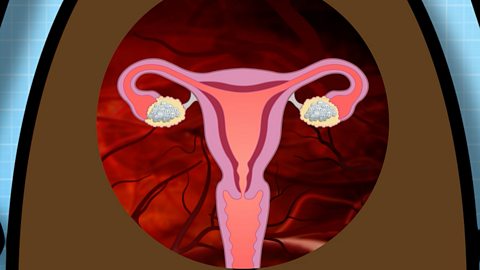
I’ve come to the Fertility Partnership Clinic in Oxford where they do an amazing medical producer called in vitro fertilisation, IVF, and that helps people to get their eggs and their sperm to meet, fertilise and hopefully make a baby.
So doctors take eggs from one patient and sperm from the other patient, and in this lab the embryologists introduce the sperms to the eggs
This is where the IVF journey begin
Meet Medical Director Tim Child.
We prepare the patient who’s going to have IVF to take some drugs, and that stimulates the ovaries to produce lots of extra eggs within.
How are the eggs collected?
We use a small needle and drain the fluid out of the ovaries. We do it under ultrasound scan guidance so we know exactly where the needle is at all times. We collect the fluid into test tubes just like this.
The test tube is then sent to the embryologists.
Thanks very much Chris.
He looked a bit familiar.
Right.
On the hunt for eggs is embryologist Anna.
So I’m looking for little bundles of cells called cumulus cells and they look like a little fluffy cloud.
And the egg is inside among those cumulus cells?
Yes. And when I find that egg, I’ll move it into a dish.
Okay.
And put it in this incubator where it still stay nice and warm. It’s 37°C just like the human body
And the perfect mixture of nutrients and chemicals.
Exactly.
And then they’re ready for the sperm.
Yes.
Amazing.
Sperm that has been collected from a patient is washed and is put in a centrifuge, a machine that makes the test tubes spin around at a higher speed to separate out the heathiest and most active sperm.
This is an egg under the microscope, and these are sperm.
A single sperm at around 0.005 CM. You could fit about 200 of them end to end on your fingernail.
So what you’re looking for is a good shaped head, swimming properly with reasonable speed.
Okay, so we’re looking for shape and movement. Look at that one go!
Yeah, that one’s speedy.
Some of them are really motoring.
With eggs and sperm all good to go, they’re ready to be introduced to each other.
You can either put the eggs and the sperm together on their own…
And the sperm swim toward the egg?
Yes.
Sort of like what happens in the human body?
Yes.
Okay.
And then the other method is called ICSI which is intracytoplasmic sperm injection.
Intracytoplasmic sperm injection, have you go that?
And that’s where you take one single sperm and inject it into an egg.
Because the cells are so small, Anna uses a micromanipulator which has two needs: one to hold the egg in place; and a very sharp needle to inject the sperm. But first she needs to pick one.
This one here is swimming really nicely, so I can take my needle…and select him.
And he’s off! Let’s see that again.
The sperm is held in this needle, ready for the next stage.
So I can show you a video of what would happen next. That’s an egg, and then you would take your one individual sperm…
And there’s the sperm.
You’d push it through into the egg. You’d apply suction to break the membrane…
I saw it sort of pop there.
Yep, and then you’d release the sperm into the egg.
It’s in. It’s done.
That’s it.
Wow. This is the incredible first stages of creating a baby, and it’s very similar to how you started to develop.
The egg and sperm now go into an incubator and hopefully the sperm will fertilise the egg so that an embryo starts to develop to create a baby.
So this is like a sort of robo-uterus that mimics the conditions inside the human body?
Yes. From fertilisation they begin to divide over the next five days.
Just like in the human body, it doesn’t always work, but when it does like in this sped up video, cells divide to create more cells, eventually forming a blastocyst which is made up of around 150 cells.
And that’s ready for transfer to the patient’s body.
Yes, which will hopefully implant and hopefully form a baby in nine months.
IVF accounts for 2-3% of all live births in the UK.
The incredible thing about witnessing IVF is that you’re seeing something that’s normally invisible because it happens inside the female body, but no matter whether the egg and the sperm that made you met because of IVF or because of sexual intercourse, this incredible moment is how we all start life.
Video summary
This film shows a doctor visiting a fertility clinic. It explains that IVF is a procedure used to help people who cannot conceive via sexual intercourse. It describes how IVF is used to help eggs and sperm to meet, fertilise and hopefully make a baby.
Note that the film does refer briefly to the fact that IVF ‘doesn’t always work’. This may lead to questions and discussion around miscarriage or still birth which could be triggering for pupils or teachers with lived experience.
There is also a discussion of ‘drugs’ (meaning medicines/hormones). This may be confusing for pupils if they associate the word ‘drugs’ with something negative or illegal.
This film is relevant to sex education, as well as health education. IVF is not specifically mentioned in the primary science curriculum, but if a school was choosing to teach about human sexual reproduction then explaining IVF would be relevant in that context. Similarly, depending on what the school is teaching in sex education, it may be relevant to cover IVF in that context.
The film may also be useful in secondary schools as part of science or sex education.
Remember that primary schools need to be able to draw a line between their curricula for relationships education and sex education in order to implement the parental right to request their child is excused from sex education.
Please ensure you watch the film prior to using it in class, to ensure it is suitable for your pupils and in line with your school's policy for RSHE. Further guidance is given below.
Before watching the clip
Use baseline assessment to establish current knowledge. Discuss with other teachers and link to their curriculum.
Note that the topic of fertility is not specified in the RSHE guidance for primary pupils, although there are links to this topic from learning about how a baby is conceived and born. Before deciding whether to cover this topic with pupils you must refer to your school’s policy.
Any teaching of this topic must meet the needs of all pupils. Some may be confused by the film if they lack understanding of how babies are made, that sometimes people have sex, and it doesn’t make a baby, or are unaware that some couples may be unable to conceive through sexual intercourse.
Check whether this content has been covered in pupils’ prior learning in science?
It may also be helpful to refer back to any previous discussions about why using correct medical terminology is useful.
Safeguarding
Teaching about sexual intercourse and fertilisation requires sensitive and well-judged teaching based on knowledge of pupils and their circumstances.
Creating a safe space for RSHE lessons is important, including encouraging pupils to respect others through listening and being mindful of other’s feelings.
- Give some thought to what is happening before and after the lesson for those pupils and how to provide opportunities for them to ask questions, anonymously or face-to-face.
- Remind pupils where to go for good answers to their questions.
- The whole school community needs to be aware of when these lessons are taking place, to enable all staff to respond to questions in a supportive and informative way.
- With your RSHE lead, discuss ways of responding to common questions that reflect your school’s ethos and RSHE policy.
- Be aware of your school safeguarding policy and procedures for safeguarding disclosures and concerns.
Please pay particular attention to students who may be IVF babies, also be aware of adoption/fostering or families currently having a complicated time of fertility.
SEND
Refer to the ‘preparing for adulthood’ outcomes as set out in the SEND code of practice – schools should support children in developing friendships.
Topics that are addressed in other clips
- How do people usually make a baby?
- Do you have to go through puberty to be able to make sperm and eggs?
- Is it important to be attracted to someone to make a baby with them?
- How does sex happen?
- How does the sperm get to the eggs if it isn’t done like this?
Further information for teachers
University College London Hospital: Reproductive Medicine Unit
Signposting for pupils
Childline: Friends, relationships and sex
Links to guidance
DfE RSHE statutory guidance
Para 65 – Sex Education
Sex education is not compulsory in primary schools, but schools should determine their content based on the needs of their pupils and this may include additional sex education content.
Keywords
Sperm, egg, fertility, baby, embryologist, cells, incubator, fertilisation, cumulus, centrifuge, intracytoplasmic sperm injection, embryo, uterus, baby, blastocyst, implant, sexual intercourse.
Discussion
Why do people need to have IVF?
Make it clear to pupils that not everyone has IVF. Most use their bodies and sex to make a baby.
- If a man and a woman can’t get pregnant, what are the reasons why?
- Why may some humans use medical intervention? (Sometimes bodies need professional medical interventions to help them make a baby; maybe because the production of sperm or egg is not working. Or a couple may ask a fertility clinic for help because they are a same sex couple.)
- Ensure pupils understand that there are different ways of making a baby, but they all include sperm, an egg and a womb.
- How do doctors get the egg/sperm out?
- Where does the baby grow?
It is important to be aware that pupils may ask, what if IVF doesn’t work? Then what? Adoption and fostering may be part of this conversation.
- See paragraph 59 of the DfE RSHE Guidance:
‘59. Teaching about families requires sensitive and well-judged teaching based on knowledge of pupils and their circumstances. Families of many forms provide a nurturing environment for children. (Families can include for example, single parent families, LGBT parents, families headed by grandparents, adoptive parents, foster parents/carers amongst other structures.) Care needs to be taken to ensure that there is no stigmatisation of children based on their home circumstances and needs, to reflect sensitively that some children may have a different structure of support around them, e.g. looked after children or young carers.
Relationships and families. video
This short film is about combinations of humans that can make up a family: mothers and fathers, sisters, brothers, dogs, two fathers, two mothers, foster families. It introduces the concept of biological parents, adoptive parents, foster parents, and divorced parents.
Sperm, egg and reproductive organs. video
This short film introduces the topic of reproduction and that babies start from an egg and sperm. Correct terminology is given for genitals and reproductive body parts in male and female bodies.

Puberty. video
This short film looks at puberty and why it happens, defining it as changing from a child to a reproductive adult. There is a description of the changes that happen in most bodies, what that may mean for female bodies and male bodies, when it might happen and that it is normal.
What is attraction? video
This short film is about feelings of attraction that can begin to happen during puberty. They can feel warm, exciting, and sometimes confusing.

Sex and sexual intercourse. video
This short film talks about genitals, arousal, sexual intercourse, and fertilisation. It sets out that this is something that can happen when a man and woman decide to have sex to make a baby, and that this is the most common way of fertilisation.