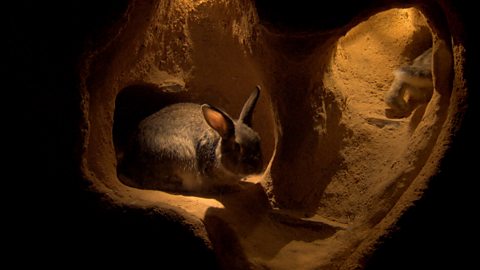
Chris Packham visits a man-made rabbit warren to see baby rabbits being born.
A scientist shows him how a thermal imaging camera detects heat instead of light and can be used to see which animals are the warmest.
He discovers that the kits (baby rabbits) have no fur when they are born, so they must huddle together to keep warm.
The mother rabbit feeds the kits with milk, just like all mammals.
Because it is warmest in the middle of the huddle, the kits change places to stay warm.
When the kits are older, they start to eat solid food; initially, their mother’s faeces, as this contains important bacteria that will help the kits to digest the tough plant material.
This clip is from the series The Burrowers.
Teacher Notes
This clip could be used as a stimulus when studying life cycles and the ways in which animals reproduce.
Remind pupils that all mammals, including humans, are initially fed on milk from their mothers.
As the baby mammals get older, they move towards a diet that makes use of the natural resources around them, such as grass for rabbits. But digesting grass is very hard, and special bacteria are needed by baby rabbits to help them.
What do humans need in their diet to stay healthy?
Curriculum Notes
This clip is relevant for teaching Science at KS1 and KS2 in England, Northern Ireland and Wales and at Early and 1st Level in Scotland.
More from The Burrowers:
How do badgers keep clean? video
Chris Packham uses footage from a man-made badger sett to explore how badgers overcome various challenges to clean themselves underground.
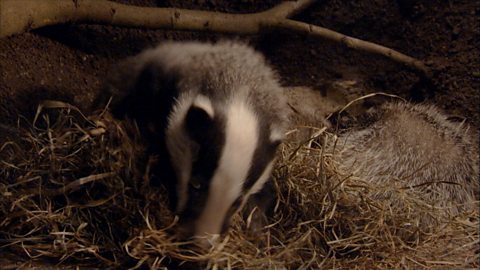
How do badgers live underground? video
Chris Packham investigates how badgers live in family setts underground that are distributed across their territory.
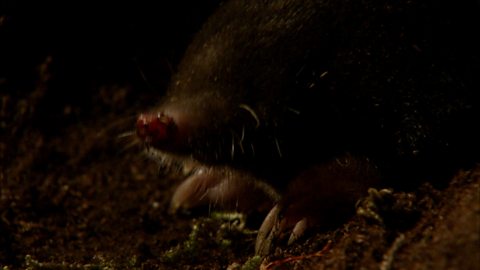
How have moles adapted to live underground? video
Chris Packham observes moles in a man-made burrow and explores the ways that they are adapted for life underground.
What is a rabbit warren like? video
Chris Packham investigates a deserted rabbit warren that has been filled with concrete to show its shape and structure.
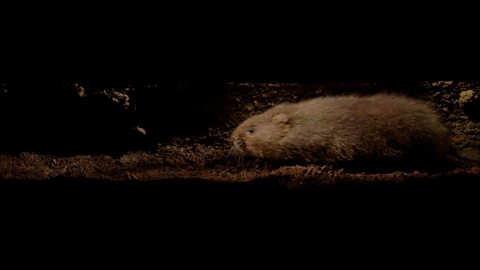
How have water voles adapted to live near the water? video
Chris Packham investigates how water voles have adapted to live in and near to the water.