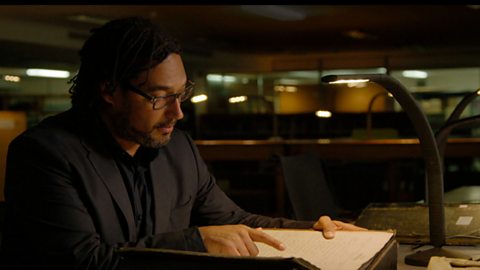
DAVID OLUSOGA:'These are Britain's forgotten slave owners.'
DAVID OLUSOGA:'By the mid-18th Century, as slave owners in the Caribbean became increasingly wealthy from their sugar plantations, they started to return home, bringing with them their fortunes. This is Harewood House, in Yorkshire. A magnificent country estate, built upon the proceeds of slavery.'
DAVID OLUSOGA:This landscape, this very artificial landscape, with the pastures, and the lake and the very neat, ornate gardens, was carefully designed to create one impression, the impression of permanence.
DAVID OLUSOGA:'But it's an impression that's false. This place is really a monument to social change. Change brought about by money flooding in from the Caribbean. Harewood House is home to David Lascelles. Eighth Earl of Harewood, first cousin, once removed, to the Queen. Great grandson of King George V, 53rd in line to the throne.'
DAVID LASCELLES:…all the Earls of Harewood, and many of the Countesses of Harewood, up on the walls.
DAVID OLUSOGA:Oh, yes.
DAVID LASCELLES:A mixed bunch. Here we are in the most magnificent room in the house, the gallery.
DAVID OLUSOGA:Wow, nice.
DAVID LASCELLES:Interior by Robert Adam, beautiful ceiling. Furniture by Thomas Chippendale, one of the most gracious craftsmen, the mirrors and the side-tables and so on. So yeah, many of the great craftsmen of the 18th Century.
DAVID OLUSOGA:'Henry, the founder of the Lascelles dynasty, set out for Barbados in 1711, age 21. He acquired plantations and slaves, by lending money to sugar planters and taking possession of their property if they defaulted on their payments. Within 20 years, Henry had become one of the richest men in England.'
DAVID LASCELLES:And whatever else he may, or may not, have been. However abhorrent we find the trade he was in now, he was clearly a very, very smart businessman. A very clever entrepreneur.
DAVID OLUSOGA:They always say in the Caribbean that it was a place where you could make a lot of money, but it was also a place where you could lose a fortune, because there were men like Henry Lascelles, who were there ready to seize on people who couldn't keep up with their rents, couldn't keep up with their mortgages.
DAVID LASCELLES:A lot of people made great fortunes at that time didn't they, across the country.
DAVID OLUSOGA:'Henry was in search of social status as well as riches. Not only for himself, but for the generations that followed. Starting with Edwin, his first-born son.'
DAVID LASCELLES:Well there's Edwin, over the mantlepiece. A red velvet outfit. Studied Classics at Christ Church in Cambridge. Went on the Grand Tour, travelled round Europe, looking at the great antiquities of Rome, and Greece, and so on. The portrait of him by Joshua Reynolds, the greatest portrait painter of that era.
DAVID OLUSOGA:The man you go to to say that you've arrived.
DAVID LASCELLES:Exactly. Edwin could afford the best, so he got the best and had that portrait painted.
DAVID OLUSOGA:'When Edwin inherited his father's slave plantations, the income he received allowed him to build this, the house of his dreams, Harewood House. Through Henry's success in Barbados, Edwin was given the opportunities and the money, that elevated him into the higher ranks of British society.'
DAVID OLUSOGA:What would Henry Lascelles, the ruthless trader from the Caribbean, the slave owner, what would he have made of his family's elevation to the aristocracy?Would he have been proud?
DAVID LASCELLES:I'm sure that's he would have wanted. He must have had a master plan of some sort, because otherwise he wouldn't have made sure that his son was educated in the same way that he was.
DAVID OLUSOGA:And there were many families, not always on the scale of the Lascelles, who are making this journey, this multi-generational journey, from being plantation owners on the ground, who are looking slaves in the eye, to being seamlessly part of the British elite and aristocracy.
DAVID LASCELLES:Yes, I think that their story was typical. Might have been quite fast, unusually fast, because Henry made a lot of money in a relatively short period of time, over about 20 years.
DAVID OLUSOGA:And it's not unique by any means.
DAVID LASCELLES:Not unique.
DAVID OLUSOGA:'Edward Jervis Jervis, 2nd Viscount St. Vincent. Charles Rose Ellis, Lord Seaford. The slave compensation records show other families, like the Lascelles, who returned to Britain with vast fortunes, that would, in time, change Britain. Not only were they able to invest in building properties, like Harewood House, but their money allowed them to penetrate the social and political elite too. Simon Fraser of Ness Castle. John Hurt, fifth Earl of Hopetoun. Their incorporation into the establishment ensured that the slave owners interests and the national interest were aligned.'
Video summary
Historian David Olusoga investigates the impact of slave ownership on British society, including its social and economic consequences.
He traces how the wealth of returning slave owners in the mid-18th Century paid for monumental country estates and sometimes elevation to the British aristocracy.
To demonstrate his point, Olusoga tours Harewood House in Yorkshire and interviews the present Earl of Harewood about his 18th Century slave-owning ancestors.
Olusoga uses records of compensation to slave owners to claim that British national interests and those of slave owners were often aligned.
This is from the series: Britain's Forgotten Slave Owners.
Contains scenes which some viewers may find upsetting. Discussion of slavery could raise emotive issues around racism and identity. Teacher review is recommended prior to use in class.
Teacher Notes
This could supplement study of the abolition of the British slave trade and the abolition of slavery within the British Empire itself.
The tour of Harewood House and the interview with the present Lord Harewood could be linked to the issue of whether Britain should pay reparations for its past involvement in slavery.
This could be used to support the teaching of migration in to and out of Britain.
This clip will be relevant for teaching History at KS3, KS4/GCSE, in England and Wales and Northern Ireland.
Also at National 4 and National 5 in Scotland.
This topic appears in OCR, Edexcel, AQA, WJEC, CCEA GCSE and SQA.
How British slave owners fought for compensation. video
Historian David Olusoga investigates how British slave owners fought for compensation.
The Barbados Slave Code. video
David Olusoga and the Barbados Slave Code.
Why British slave owners opposed Abolition. video
Historian David Olusoga investigates the resistance to the abolition of slavery.
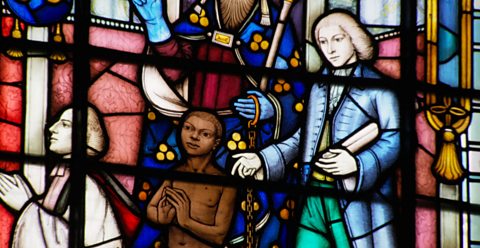
British slave owners in the 1830s. video
Historian David Olusoga investigates evidence of British slave ownership in the 1830s.