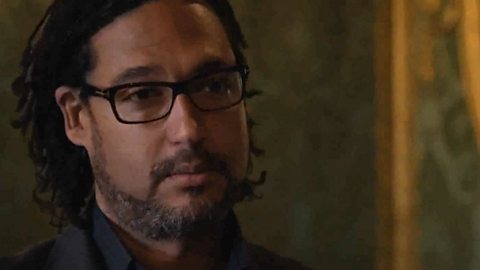
DAVID OLUSOGA:'These are Britain's forgotten slave owners.'
DAVID OLUSOGA:'In 1807, one of the most momentous events in modern British history took place. The slave trade, the trafficking of human beings from Africa across the Atlantic, was finally abolished. The man who led this campaign was William Wilberforce.'
DAVID OLUSOGA:These are the stained glass windows in Wilberforce's church in Clapham. And what they depict are the lives of the saints. Not the Biblical saints, but the saints of abolition. And Wilberforce is standing there with what you presume is the 1807 act, the act he spent most of his life fighting to push through parliament. This church is rightly proud of the fact that William Wilberforce and the other abolitionists prayed and worshipped in these pews. But what's been forgotten is that sitting just a few metres away listening to the same hymns, the same sermons, was another influential and prominent member of the congregation. George Hibbert.
DAVID OLUSOGA:'George Hibbert was a slave owner. He had fought against Wilberforce and defended the slave trade. He may have lost that battle, but the fight was far from over. There were still hundreds of thousands of enslaved people, across the British Empire. The bigger battle over the future of slavery was looming.'
DAVID OLUSOGA:The coming battle was to be fought in parliament but also in the churches. It was a battle of ideas, but it was also a struggle for British public opinion. For the slaves 5,000 miles away in the Caribbean it all too often became a violent struggle of uprisings followed by brutal repressions. But to make sense of why it was that the slave owners were so determined to fight on, you have to understand just what it was that they were trying to defend.
DAVID OLUSOGA:'This is a sugar plantation in Guyana. In the 18th and 19th Centuries, like today, the rich fertile soil found here enabled vast quantities of very high quality sugar to be cultivated. This made Guyana the most profitable of Britain's Caribbean posessions, and made thousands of British men and women very rich.'
DAVID OLUSOGA:Among the investors who were pouring their money into Guyana in the early 19th Century were a family of Scottish traders. They bought plantations, including this place, which they would really struggle to recognise today. This is the modern incarnation of the Wales plantation which was the property of John Gladstone. Now he was the father of William Ewart Gladstone, who went on to become prime minister. This place made Gladstone a fortune. But what he worried about was what all the plantation owners here in Guyana worried about, labour. And they were convinced that the only way to maintain their secure supply of man-power was by defending slavery, no matter where opposition to it came from.
DAVID OLUSOGA:'By the 1820s, John Gladstone and other slave owners were facing strong opposition from abolitionists back home in Britain. At the heart of the battle was the new science of statistics. These are slave registers, enormous ledgers which contain the names of all the slaves working in the Caribbean. They were first compiled in 1817, and recalculated every three years.'
DAVID OLUSOGA:This is the slave register for Demerara in Guyana, for all the plantations that run alongside the Demerara river. And here is the entry for the Wales plantation. And this register gives the whole number of slaves attached to the plantation Wales on the 31st of May, 1820. And it gives that number as 364. Now three years earlier, the previous registration, the census of slaves, had taken place at the Wales plantation, and at that time there had been 396 slaves living on the plantation. And as the register says, that means that 53 have died, because only 16 have been bought. So in three years on the Wales plantation there's been a mortality rate of thirteen percent. And mortality rates like that aren't unique to this plantation. Many of the plantations in this book have similar, or higher, mortality rates. And what that tells you, what that proves, is that even in the 1820s, even after the end of the slave trade, slavery was still a system that consumed the lives of human beings at an appalling rate.
DAVID OLUSOGA:'For those opposed to slavery, this was the evidence they needed to fuel their campaign against the brutal inhumanity of the slave system itself. In January 1823 a group of abolitionists, including William Wilberforce, set up the world's first anti-slavery society. Their goal, the end of slavery itself.'
Video summary
Historian David Olusoga investigates the resistance to abolition of slavery among British slave owners including the threat they perceived to the profitable sugar cane industry.
He deliberately contrasts William Wilberforce, leader of the abolitionists with George Hibbert, a slave owner who worshipped in the same church in Clapham.
Olusoga also refers to the family of the Victorian Prime Minister William Gladstone whose fortunes were based on sugar plantations in Guyana.
Like other slave owners he points out that they were determined to protect their sole supply of labour- slaves.
Olusoga also uses slave ledgers updated every three years from 1817 to 1834 to point out high mortality rates among slaves.
This is from the series: Britain's Forgotten Slave Owners
Contains scenes which some viewers may find upsetting. Discussion of slavery could raise emotive issues around racism and identity. Teacher review is recommended prior to use in class.
Teacher Notes
This could be used to supplement the study of the abolition of the British slave trade and the abolition of slavery within the British Empire itself.
It could be used to debate the causes of abolition including the disputes around the supposed decline of the sugar cane industry in the early nineteenth century as a factor used to help prove an economic motive for the abolition of the slave trade and slavery itself.
It could also be used as an example of how a historian makes use of archival evidence to support their case.
This could be used to support the teaching of migration in to and out of Britain.
This clip will be relevant for teaching History at KS3, KS4/GCSE, in England and Wales and Northern Ireland.
Also at National 4 and National 5 in Scotland.
This topic appears in OCR, Edexcel, AQA, WJEC, CCEA GCSE and SQA.
How British slave owners fought for compensation. video
Historian David Olusoga investigates how British slave owners fought for compensation.
The Barbados Slave Code. video
David Olusoga and the Barbados Slave Code.
British slave owners in the 1830s. video
Historian David Olusoga investigates evidence of British slave ownership in the 1830s.
The social and economic impact of slave ownership on British society. video
David Olusoga explores slave ownership at Harewood House.