DAVID OLUSOGA:'These are Britain's forgotten slave owners.'
DAVID OLUSOGA:'This is the Atlantic coast of Barbados. In 1627, a group of 50 or so British settlers arrived on the island. Within a few decades, these settlers had turned a small uninhabited island into one of the most profitable places on Earth.'
DAVID OLUSOGA:'The most dynamic, and ruthless of them had managed to get their hands on the best land and had started experimenting with a new crop. It was a giant form of grass, known as sugar cane. Just 20 years later, 40% of the agricultural land was covered in sugar cane. It was a back-breaking, labour-intensive job to produce the sugar and the people who had to do it were Africans, brought over in ships as slaves. And as the demand for sugar grew, so too did the demand for slaves from Africa.'
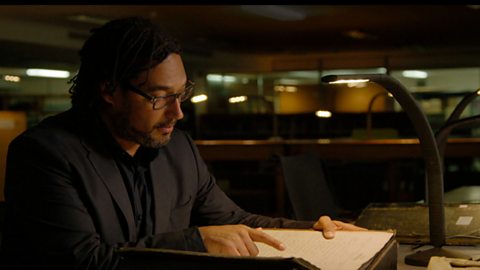
DAVID OLUSOGA:'The Barbados National Archive, keeps a record of how Britain's first slave owners built a new kind of society.'
HILARY BECKLES:Barbados–
HILARY BECKLES:–became the world's first slave society. This is a unique historical development. A slave society is quite different from a society with slaves. All the societies in the hemisphere had enslaved peoples, but Barbados was the first to be built and sustained completely upon the enslavement of Africans
DAVID OLUSOGA:'The slave system was ruthlessly enforced right from the start. One document found here dates from 1661. It's known as the Barbados Slave Code. Authored by the island's most powerful slave owners, it gives a rare insight into their way of thinking.'
DAVID OLUSOGA:Part of that process of transforming people from human beings and into things is to justify it, and on the very first page of the Barbados Slave Code, it describes Africans as people who are 'heathenish' and 'brutish' an 'uncertain and dangerous kind of people'. This is early racism.
HILARY BECKLES:The English arrive in the Caribbean already with a fully-formed racist and racial view about other people especially African peoples.
DAVID OLUSOGA:Looking at the slave code, the issue of violence comes up very quickly, it says here that "if any negro shall offer any violence to any Christian" any white, "as by striking or such like, that negro shall, on his first offence be whipped, on his second offence be severely whipped and have his nose slit and be burned with a hot iron on some part of his face."
HILARY BECKLES:The English realise that the only way this system can be maintained is through extreme violence. It is not a system that can survive in any other way. So this island is unique, not only for its tourism beauty and all the contemporary, positive features' but this is where the greatest experiment in human terror, in the modern era, was first put in place, in Barbados.
DAVID OLUSOGA:'The British planters spread the slave code to other colonised islands in the Caribbean and, like Barbados, more slave-driven societies based on violence and terror would emerge.'
Video summary
Historian David Olusoga investigates the spread of the Barbados Slave Code across British colonies during the eighteenth century and its social and economic impact.
He begins his narrative with the English settlement of Barbados in 1627 which resulted decades later in a lucrative sugar cane industry covering 40% of the island and cultivated by enslaved Africans.
The clip emphasises the harsh and racist provisions of the code and its role in creating a slave society and economy controlled by the use of severe violence.
British records quote Africans as being referred to as 'heathenish' and 'brutal'.
This is from the series: Britain's Forgotten Slave Owners
Contains scenes which some viewers may find upsetting. Discussion of slavery could raise emotive issues around racism and identity. Teacher review is recommended prior to use in class.
Teacher Notes
This could supplement study of the abolition of the British slave trade and the abolition of slavery within the British Empire itself.
It could also be used as an example of how an historian makes use of archival evidence to support their case.
This could be cross-referred with maps showing the trade voyages in the Transatlantic Slave Trade.
This could be used to support the teaching of migration in to and out of Britain.
This clip will be relevant for teaching History at KS3, KS4/GCSE, in England and Wales and Northern Ireland.
Also at National 4 and National 5 in Scotland.
This topic appears in OCR, Edexcel, AQA, WJEC, CCEA GCSE and SQA.
Why British slave owners opposed Abolition. video
Historian David Olusoga investigates the resistance to the abolition of slavery.
The social and economic impact of slave ownership on British society. video
David Olusoga explores slave ownership at Harewood House.
How British slave owners fought for compensation. video
Historian David Olusoga investigates how British slave owners fought for compensation.
British slave owners in the 1830s. video
Historian David Olusoga investigates evidence of British slave ownership in the 1830s.