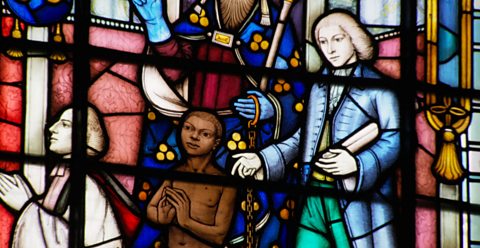
DAVID OLUSOGA:'These are Britain's forgotten slave owners.'
DAVID OLUSOGA:'These Georgian terraces in the heart of London conceal a forgotten chapter in Britain's history. A new study of a forgotten archive from the 1830s reveals that many of these houses were once the homes of British slave owners. Researchers at University College London have used these documents to create a database of each and every one of the slave owners who lived in Britain. They reveal that thousands of them lived all over the country.'
DAVID OLUSOGA:This is Bryanston Square in central London. This is number eight. This was the home of Tully Higgins. He has 328 enslaved people on plantations in Demerara which is in the British colony of Guyana. At number 12 we have Nathaniel Snell Chauncy. Now he owned slaves in Guyana, in Grenada, in Antigua, and on the islands of St. Vincent and Tobago. In all, he owned 3,000 slaves.
DAVID OLUSOGA:'When the 1833 abolition of slavery act was passed these slave owners slipped quietly into obscurity.
DAVID OLUSOGA:'For almost two centuries, these documents, these ledgers and letters, have been here in the archives. And for the most part, they've just been forgotten about. Even by historians.'
DAVID OLUSOGA:These files tell us the name of every British slave owner. They tell us who they were, where they lived, and how many slaves, how many men, women and children they owned.
DAVID OLUSOGA:And most chillingly, they give us the value of those slaves. In pounds, shillings and pence.
DAVID OLUSOGA:'At the point of abolition, there were over 40,000 slave owners, who laid claim to 800,000 individual slaves across the Caribbean, South Africa, and the island of Mauritius.'
DAVID OLUSOGA:Here is a record for George Hibbert and his brother, William Hibbert, of Portland Place, in London. For the 360 enslaved peoples on one of their plantations, in the parish of St. James in the county of Cornwall, on the island of Jamaica. And for those 360 people, they're paid the sum of 6,244 pounds, four shillings and five pence. And that's not their only plantation. The Hibberts own 16 plantations, just on Jamaica.
DAVID OLUSOGA:At the other end of the spectrum, in this ledger there's an entry here for Agnes and Martha Montgomery of Perthshire. Now we think that they're probably sisters and between them, they own one slave. That one individual is valued at 63 pounds, 19 shillings, and three pence. From the Reverend James Hamilton, for 216 slaves on his plantation. Here is a record for Steven Isaacson, who was living in Dorset…
DAVID OLUSOGA:'These records reveal just how widespread slave ownership was in Britain. How so many thousands grew rich on the proceeds of slave labour, and how this money laid the foundations for the British Empire and Britain's modern economy.'
DAVID OLUSOGA:Just beneath is another of their plantations, on which there are another three hundred… Steven Isaacson.
Video summary
Historian David Olusoga investigates evidence of British slave ownership in the 1830s, referring to 40,000 owners with over 800,000 slaves in the Caribbean and elsewhere.
The figures are from detailed records of compensation to slave owners paid when slavery was abolished in 1834 across the British Empire.
Olusoga uses the records to demonstrate how widespread and profitable the ownership of slaves was in Britain at the time, linking his analysis by visits to Georgian terraces in parts of London.
This is from the series: Britain's Forgotten Slave Owners
Contains scenes which some viewers may find upsetting. Discussion of slavery could raise emotive issues around racism and identity. Teacher review is recommended prior to use in class.
Teacher Notes
This could supplement study of the abolition of the British slave trade and the abolition of slavery within the British Empire itself.
It could also be used as an example of how a historian makes use of archival evidence to support their case.
It could be used to support the teaching of migration in to and out of Britain.
This clip will be relevant for teaching History at KS3, KS4/GCSE, in England and Wales and Northern Ireland.
Also at National 4 and National 5 in Scotland.
This topic appears in OCR, Edexcel, AQA, WJEC, CCEA GCSE and SQA.
How British slave owners fought for compensation. video
Historian David Olusoga investigates how British slave owners fought for compensation.
The social and economic impact of slave ownership on British society. video
David Olusoga explores slave ownership at Harewood House.
The Barbados Slave Code. video
David Olusoga and the Barbados Slave Code.
Why British slave owners opposed Abolition. video
Historian David Olusoga investigates the resistance to the abolition of slavery.