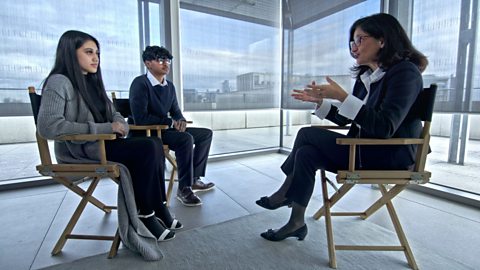
Fion:
I'm Fion.
Jaden:
I'm Jaden.
Fion:
And we're from Sheffield.
Rich Roberts:
Hi, I'm Rich Roberts. When I was 17, I thought I was going to be thrown out of school. The thing I did best was play billiards and so I thought I might become a professional billiards player. I went on to study science and eventually, after many decades won a Nobel Prize. You might already think you know what it takes to succeed in life. Good grades, getting work experience, going to college and university and so on. But I'm going to talk about something different, about something that it's very important to learn, when you fail in life and also when you have luck. Indeed, it's only by failing that I ever succeeded. You know, there's a nice snooker table behind you. Have you guys played snooker?
Fion:
We had a good go early and I’d say after a while, we got better at it. At the start, we were a bit dodgy. I mean, we weren't perfect. We definitely had a few failures. So we'd like to know how can failure lead to success?
Rich Roberts:
You need to go back and essentially do a post-mortem to find out why you failed. This is really important because if you just say, oh I failed, I'm going to go on and do something else, you never really learn from the failure.
Fion:
I’m getting better, each time.
Rich Roberts:
This concept of learning from your failure is really important, and for me, it was essential because this was how I won the Nobel Prize. I came up with this brilliant experiment, but it didn't produce the answer that we'd expected. And so we spent a lot of time trying to find out why we weren't getting the answer that we expected and ended up discovering something called splicing. That was what led to the Nobel Prize. It turned out to be a huge discovery, and it all came because this cute experiment I'd come up with failed.
Jaden:
After university, did you have to search for your job or did you get scouted for it?
Rich Roberts:
In my subject, you had to go abroad and get some experience in a lab abroad. So I applied to six different places. Only one place accepted me and this was a professor who was in Wisconsin. Say, a month, two months before I was scheduled to go and join him, he wrote and said can you delay for a couple of months because I'm just moving to Harvard? And so I ended up doing my postdoc at Harvard quite by chance.
Jaden:
What could you say that you've kind of transferred from when you used to play snooker to being a scientist now?
Rich Roberts:
Whenever you're playing a game like snooker, every so often something lucky happens. When you have a lucky break, you have to focus twice as hard on the next shot to make sure that you take advantage of the luck.Sometimes you can be trying to make a shot, and it doesn't quite work out the way you wanted it to work out, but nevertheless score. This is certainly something that's been very true for me in my scientific career. And so never feel guilty when you have luck but take advantage of it. Failure, figure out why you failed. Luck, take advantage of it. But also, the fact that you have to really focus on what you're doing. When you're doing science, you really have to focus on the experiments in hand on the questions that you're asking. You can't allow yourself to be too distracted. When you're playing snooker or billiards, this is when you missed the shot. In science, this is very important to really keep your eye on the ball.
Fion:
Thank you for speaking to us. It was nice to meet you.
Rich Roberts:
Well, thank you, and I wish you two the very best of success.
Fion:
Today we had a go at snooker ourselves. There was definitely a few shots missed, but there was definitely also a lesson learned. We noticed as we kept going, we did learning. If I see a snooker table, I'll have another go.
Nobel Prize winning scientist Rich Roberts talks about learning from failure and luck.
When he was 17, Rich thought he would become a professional billiards player, but instead went on to become a scientist and won a Nobel prize.
Rich talks about the importance of failure and luck on his journey to success. In learning from a failed experiment he ended up discovering something called splicing, which turned out to be a huge discovery and led to the Nobel prize.
He also emphasises the importance of taking advantage of luck and not becoming distracted.
This short film is from the BBC Teach series Lessons with Leaders.
Teacher Notes
Things to check your students know:
- What ‘billiards’ is.
- The meaning of the words ‘failure’ and ‘resilience’.
Possible talking points:
Science:
- _Rich says ‘It is only by failing that I ever succeeded’. What does he mean by this? How does failure in science help us succeed? _
- After a failure, Rich suggests doing a ‘post mortem’ of the experience. What does this mean? Why might this be helpful?
- Rich conducted an experiment that failed, but it led him to discover something new. Have you experienced a failed experiment in your science lessons that has led you to understand something new? What about in another subject? What does this teach us about how we should approach getting things ‘wrong’?
- What steps did Rich take to get into a career in science?
Physical Education:
- Rich talks about ‘luck’ in sport. How would you define the word ‘luck’? To what extent do you think sport is influenced by luck? Why?
- How can we learn from failure in sport?
- Rich says ‘when you have a luck break you have to focus twice as hard on the next shot to make sure that you take advantage of the luck’. Can you apply this theory to your favourite sport?
- ‘Losing focus is when you miss the shot’. How do you maintain focus in sport to ensure you don’t miss? If you do miss what should you do next?
Careers:
- Rich says ‘You might already think you know what it takes to succeed in life. Good grades, work experience, going to college and university’. Do you think these are the steps you need to take in order to succeed in life? Why? Why not? What steps do you need to take to be successful in your chosen career? What does ‘succeeding in life’ look like to you?
- After university Rich had to study abroad to get experience in a lab in another country. In what ways might studying in another country be helpful?
- Rich applied to six different schools in other countries but only got accepted to one. Was this a failure? Why might some people perceive it to be?
- Rich talks a lot about the different challenges and ‘failures’ he has experienced in his career – what can we learn from this? How can we change our attitude to failure? Why would this be helpful?
Follow on tasks - you could ask students to:
- Science: look back at a previous experiment they have completed or watch an online ‘failed’ experiment and conduct a ‘post mortem’ and pull out the positives from this ‘failure’.
- PE: analyse examples of ‘lucky’ shots in different sports and discuss the extent to which luck versus skill played a role in the success.
Ask students to analyse each other’s performance in a chosen activity and ‘post mortem’ the ‘failure’ in their performance. Explore how this feels and why it can be hard to look at where we go wrong. - Careers: map out their own journey to what success looks like to them in their chosen career. What qualifications/experience and further education they need but also what they hope to achieve in this career and the ‘soft skills’ they hope to develop.
Curriculum Notes
- This short film is to help stimulate discussion on the following topics: resilience and careers in science.
- It is relevant to subjects such as careers, physical education and science.
- This video is most suited to 11-16-year-old pupils across the UK.
- In England it is relevant to careers, careers in science and physical education at GCSE Level.
- In Scotland it is relevant to 4th Level ‘Health and Well-Being’ and 5th Level physical education.
- In Northern Ireland and Wales it’s relevant to ‘Learning for Life and Work’ CCEA (in lessons on ‘Life Experiences’) and physical education at GCSE Level.

More from the series Lessons with Leaders:
Cressida Cowell - The importance of play. video
Author and illustrator Cressida Cowell talks to two students about the importance of play in unlocking your creativity.
Kumi Naidoo - How to be a good activist. video
Kumi Naidoo talks about how he got involved in activism and how to be a good activist.
Jocelyn Bell Burnell - Why unconscious bias matters. video
Professor Jocelyn Bell Burnell talks to two students about why unconscious bias matters.
Venki Ramakrishnan - The race in science. video
Scientist Venki Ramakrishnan explains the vital role played by competition and cooperation in science.
Benjamin Zephaniah - Finding your voice. video
Poet and novelist Benjamin Zephaniah talks about the importance of finding your voice.
Paul Nurse: What is life? video
Biologist and Nobel Prize winner Paul Nurse talks about what biology tells us about life.
Minouche Shafik - How to be a good citizen. video
Former Deputy Governor of the Bank of England Minouche Shafik talks about why we take part in society.