Hasib:
My name is Hasib.
Kamile:
My name is Kamile. We're both from East London.
Hasib:
We both love movies and books.
Kamile:
And today we're meeting one of the country's leading authors.
Cressida Cowell:
I’m Cressida Cowell and I am the author and illustrator of the How to Train Your Dragon books. You might already know all about writing grammatical sentences and structuring your writing. These are all really important building blocks, but I'm going to talk about what it is to be creative. I'm going to talk about how we need to play and have fun to unlock our creativity. Indeed, play is something I take really seriously.I want your imagination to be your playground.
Kamile:
How do you come up with your characters?
Cressida Cowell:
The space I come to is this writing shed at the bottom of my garden. It's a space for play, a space to be creative, a space where the real world sort of is pushed back and you're turned in on yourself.
This is where I wrote and came up with the ideas for all of my books, and the shed is covered in in photographs, maps of the world. I've got the books, so I've got Treasure Island, I'll have Peter Pan there. So, all of the things that inspire me.
Kamile:
So, when you talk about playing, what do you mean exactly?
Cressida Cowell:
The start of a story is really beginning by playing around with ideas, by mucking around, by making a mess, being not afraid to make mistakes. There's a reason why my heroes name is Hiccup, which is another word of a mistake because a lot of my books are about using the accident, about not being afraid to make a mistake.
Kamile:
Are there any locations that have inspired your characters or your work?
Cressida Cowell:
I mean, How to Train Your Dragon is based on on somewhere true. Every year from when I was a baby we would be taken to this uninhabited island off the west coast of Scotland, and that is the Isle of Berk.
That's the inspiration for the Isle of Berk. That was the first place that part of Scotland was the first place that the Vikings came to.
Hasib:
I don't have a shed and I don't live in Scotland, so how can students implement that into their way of thinking?
Cressida Cowell:
You don't need a shed and you don't need to go to Scotland. You can just have a sketchbook. We can all have that. A book where you can play. The sketchbooks are really the play spaces. Every creative person will have books like this full of ideas.
You can see how messy it is. This is where ideas begin. I'm a writer, and so I break rules in a playful sort of way to come up with something original. This is the very first sketch. This little sketch of Hiccup and Stoic is the very, very first sketch that turned into this twelve book franchise and then this film franchise. Think of all of the jobs that that represented the work in the publishing industry, in the film industry. It all began here with this tiny, little playful drawing of a little Viking character.
Hasib:
Can I have a career in the creative industry?
Cressida Cowell:
Of course you can. Of course you can. The creative, we’re in fact, incredibly good at the creative industries in this country. The creative industries make over £100 billion a year for this country. We export more books than any other country in the world. We’re fantastically good at film, music, all of all of these things.
So my goodness. Very, very important that you feel that you can enter the creative industry.
Kamile:
But is there a place for creativity in other, more traditional industries aside from the creative industry?
Cressida Cowell:
My goodness there is. I mean, this is so important.
We need people who can think outside the box. We need creative entrepreneurs. We need creative doctors. We need creative politicians. A lot of the problems that are facing the world are big problems, and we need creative politicians, creative scientists, creatives in all areas to solve these problems.
Hasib:
Thank you
Kamile:
Thank you so, so much.
Cressida Cowell:
Thank you. I really hope you do come and join the creative industries.
Kamile:
I loved Cressida’s idea of being playful, and whilst I originally found it a bit strange, I now truly understand what she meant because letting yourself go and exploring your own creative world is truly how you create something inspirational.
Hasib:
I feel like anyone can be creative and nothing stopping them. All you need is a pen and paper and write down whatever you want, draw anything you want and have freedom in your writing.
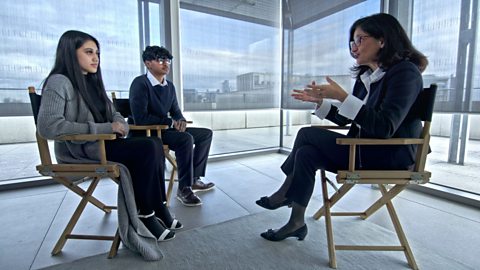
Author and illustrator Cressida Cowell talks to two students about the importance of play in unlocking your creativity.
Cressida talks about being inspired to write the 'How to Train Your Dragon' books by her childhood trips to an uninhabited island of the west coast of Scotland.
She emphasises how mucking about and not being afraid to make mistakes helped shape the beginning of the story, and the name of the main character 'Hiccup'.
Finally, Cressida talks creativity in more traditional industries, and the need for creative entrepreneurs, doctors and politicians to deal with the big problems the world is facing.
This short film is from the BBC Teach series Lessons with Leaders.
Teacher Notes
Things to check your students know:
- What is meant by the terms creativity and imagination.
Possible talking points:
Creativity and careers in creative industries:
- Cressida talks about her own childhood holidays as inspiration for the settings for some of her work - what does this tell you about how you can utilise your own experiences when being creative?
- Cressida talks about ‘playing’ and ‘mess’ as part of being creative - what do these words mean to you?
- ‘Creative industries make over £100 billion a year for this country’. Can you think of any jobs that would be included in ‘creative industries’? What skills and experiences would help you get into this industry? What qualifications might you need?
- ‘Is there a place for creativity in other industries?’ Cressida thinks we need more creativity to help us solve problems in society - how do you think creativity could help?
Creative writing:
- Cressida says she works in her shed when she wants to be creative: it is a place where ‘the real world is pushed back and you’re turned in on yourself’. What does she mean by this? We can’t all go to a shed to write, but how could this way of working help you with your writing?
- What does Cressida have in her shed? What does that tell you about where you could draw inspiration from for your own writing? What inspires you?
- ‘The start of a story is really beginning by playing around with ideas, by mucking around, by making a mess, being not afraid to make mistakes!’ Do you feel afraid of making a mess when you start your creative writing? How can you overcome this? How does the redrafting and proofreading process help with this?
- ‘Sketchbooks are the play spaces’ have you ever tried sketching or drawing an idea before you start writing? How might this help?
Follow on tasks - You could ask students to:
- English: create a ‘sketch’ with the title ‘The mistake’. Give them 10 or 15 minutes to ‘play’ with ideas through drawing, discussing and sharing their thoughts. Then ask them to spend 20 minutes ‘writing from the wrist’ or ‘free writing’: writing without stopping or over thinking about what they’re doing, but writing continuously. They mustn’t lift their pen from the page! After doing this ‘free writing’ students could spend time sharing and discussing their work, or picking out the bits they think work really well to use next time they write. They may also wish to reflect upon if they found it easier or harder to write after their ‘play’.
- Creative careers: research the different jobs they could choose to do if they wanted to work within the creative industries and the different qualifications or experiences they might need to reach one of these career options. This Bitesize Careers article explores the variety of jobs in media and the creative sector.
Curriculum Notes
- This short film is to help stimulate discussion on the following topics: creative writing, creativity and careers in the creative industry.
- It is relevant to subjects such as careers, english and art.
- Most suited to 11-16-year-old pupils across the UK in developing their creativity, specifically in creative writing for english.
- Most suited to 14-16-year-old pupils across the UK in developing their creative writing skills and study of the arts/understanding creativity.
- In England, Northern Ireland and Wales it is relevant to creative writing skills as part of english language GCSE.
- In Scotland it is relevant to descriptive and creative writing as part of english National 5.

More from the series Lessons with Leaders:
Kumi Naidoo - How to be a good activist. video
Kumi Naidoo talks about how he got involved in activism and how to be a good activist.
Rich Roberts - Learning from failure and luck. video
Nobel Prize winning scientist Rich Roberts talks about learning from failure and luck.
Jocelyn Bell Burnell - Why unconscious bias matters. video
Professor Jocelyn Bell Burnell talks to two students about why unconscious bias matters.
Venki Ramakrishnan - The race in science. video
Scientist Venki Ramakrishnan explains the vital role played by competition and cooperation in science.
Benjamin Zephaniah - Finding your voice. video
Poet and novelist Benjamin Zephaniah talks about the importance of finding your voice.
Paul Nurse: What is life? video
Biologist and Nobel Prize winner Paul Nurse talks about what biology tells us about life.
Minouche Shafik - How to be a good citizen. video
Former Deputy Governor of the Bank of England Minouche Shafik talks about why we take part in society.