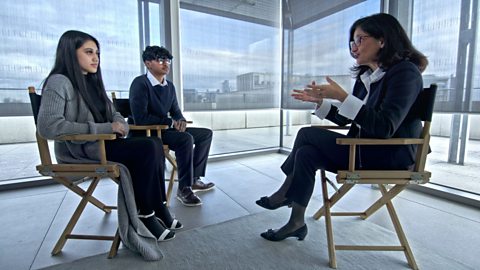
Merin:
I'm Merin and I'm 15.
Sabera:
Hi, I'm Sabera, and I'm 15 years old.
Merin:
We've come to a theatre near our school in East London.
Sabera:
We’re here to meet someone who knows all about creative writing and performing.
Benjamin:
I'm Benjamin Zephaniah, the poet, novelist, playwright, musician and university professor. You might already know about famous poets and writers like William Shakespeare, William Blake, Maya Angelou, Imtiaz Dharker, John Agard or George the Poet. I'm going to talk about finding your voice, which is really important for any kind of writing you do.
Sabera:
How do you find inspiration for your work?
Benjamin:
It's a bit of a cliché, and it's a cliché because it's true, that writing about things you know is where you should really start. I mean, I think you should branch out from that, but that's where you should really start because your experiences are unique to your space in your time. Even if somebody else did what you did, they did it in another space and time in another family. Sometimes in another country. You've got to take your experience, which is unique to you, and find a way, a language to share it…
To walk to
To talk to
To cry and rely on
People will always need people
To love and to miss to
Hug and to kiss
Tt's useful to have other people…
Merin:
How would I add in my own experience into my writing?
Benjamin:
It can be a small detail of your life and really dig into it. I believe that we all have poetic and original thoughts all the time. And sometimes you can take something as small as tying your shoelace and you can write an epic poem about it. And every word is true. You know, something as simple as that can make sense when you think of poetry.
Merin:
So, what about things that are outside of your experience?
Benjamin:
Well, this is really important, especially when you write novels. You may have a character in there that’s very much like you, but then you have to write all these other characters. And the first thing is, in my experience, I think compassion and empathy is really important. One of the things that I used to do when I was younger was I used to travel to different countries. See, I grew up in the Cold War. Russia was the big enemy. We had to fear Russia because they had these bombs pointing at us and all that kind of stuff. So what did I do? I went to Russia to see how those people think, what makes them tick. I listen to everybody's story, and I'm really lucky in that I've met prime ministers and presidents. But I'll also talk to homeless people on the street. You've got to be able to get into the mind of other people. So it's really important to kind of connect with other people…
To please to
Tease to
Put you at ease
People will always need peopleTo make life appealing and give life some meaning
It's useful to have other people
Sabera:
Can finding your voice really help in other aspects of life?
Benjamin:
When you're performing a poem on stage, there's a lot of self-control and breathing techniques that you have to learn to do it, and both techniques can be very useful if you have nervousness and things like that. If you can learn to express yourself on stage, you usually are OK when it comes to expressing yourself offstage. I’ll show you two things alright.
Merin:
Meeting Benjamin today was amazing. I never thought I'd get to meet such a genuinely passionate and compassionate person. I thought that it was really interesting how Benjamin would go to find other people, whether it be in the streets or in different countries, and be able to empathise with them. Think it's a really important lesson to try to understand people from different walks of life.
Sabera:
Being with Benjamin today was really interesting, and it really showed me how to be, you know, myself. And even though it sounds cliche just to show people that you are who you are.
Poet and novelist Benjamin Zephaniah talks about the importance of finding your voice.
He explains how writing about things you know is the best way to start out as a writer, as your own experiences are unique to you.
Benjamin then discusses how to write about things outside of personal experience, the benefits of meeting people from different backgrounds, and the importance of listening with compassion and empathy.
He gives advice on performing poetry on stage, and how certain breathing techniques can be employed to help with nervousness when expressing yourself on stage.
This short film is from the BBC Teach series Lessons with Leaders.
Teacher Notes
Things to check your students know:
- Definitions of ‘compassion’ and ‘empathy’.
- What the Cold War was, when and where it took place. This guide from Bitesize might be useful.
Possible talking points:
English:
- Benjamin talks about developing your own voice in your writing. Why is this important? What techniques show our writing voice?
- Benjamin suggests ‘writing about things you know is where you should really start’. Why is this?
- How can we draw on our own experiences in fiction writing?
- How can we use our own experiences in non-fiction writing?
- Benjamin recommends taking ‘a small detail’ and to ‘really dig into it’ – what does this look like in our writing? How can we develop detailed description?
- If you are writing about things outside your experience how does Benjamin recommend you learn more about them?
- Why does Benjamin tell us we need ‘compassion and empathy’ when writing outside of our own experiences?
Drama/ Public speaking:
- Benjamin talks about overcoming nerves. What do nerves feel like for you?
- Benjamin talks about relaxation techniques when trying to overcome nerves. Why might this help? How do you overcome nerves?
- ‘Breathing techniques and self-control are needed to perform’. Do you agree? Why? When have you had to use self-control in a performance?
- For a successful performance you’ve ‘got to be able to get into the mind of other people’. How do we physically show we have adopted a new character? What exercises can we use to adopt someone else’s mind/thought process to become more like them?
- How do ‘compassion’ and ‘empathy’ help us get into character more effectively?
Follow on tasks - You could ask students to:
English: create an opportunity to create a small shared experience; for example, eating a sweet or ask students to reflect on a shared experience such as attending an assembly. Ask students to write their own description of the experience; you may wish to scaffold how students can ‘dig into’ this experience to make their description detailed. Listen to the different responses and explore how they differ. Discuss how personal experience is unique and how different writing voices have been created in the students’ work.
Drama: present students with a series of pictures of different characters they could adopt. For example, a homeless person, an angry teacher, a stern-faced soldier. Ask them to complete a ‘role on the wall’ in which they explore compassionate and empathetic responses to the situation the character is in. Discuss their ideas and then ask the students to perform/improvise a scene in which the characters interact and ask the students watching to peer assess how students express the character. Do they feel empathy for them? How did the performer create empathy?
Alternatively, before a class performance of group work you could split the class. Ask one group of students to complete an online meditation/breathing exercise before a performance to the class, and ask one group to perform without completing the meditation. Discuss: do the students watching notice a difference in the self-control and visible nerves of those who completed the meditation? How did the students who completed the meditation feel?
Curriculum Notes
- This short film can be used to help stimulate discussions around topics such as: developing your own writing voice, compassion and empathy and overcoming nerves in challenging situations.
- This video may apply to topics covered in english or drama lessons.
- This video is most suited to 14-16-year-old pupils across the UK in developing their writing skills both for creative and transactional writing for GCSE level.
- In England, Northern Ireland and Wales it is also relevant to GCSE drama.

More from the series Lessons with Leaders:
Cressida Cowell - The importance of play. video
Author and illustrator Cressida Cowell talks to two students about the importance of play in unlocking your creativity.
Kumi Naidoo - How to be a good activist. video
Kumi Naidoo talks about how he got involved in activism and how to be a good activist.
Rich Roberts - Learning from failure and luck. video
Nobel Prize winning scientist Rich Roberts talks about learning from failure and luck.
Jocelyn Bell Burnell - Why unconscious bias matters. video
Professor Jocelyn Bell Burnell talks to two students about why unconscious bias matters.
Venki Ramakrishnan - The race in science. video
Scientist Venki Ramakrishnan explains the vital role played by competition and cooperation in science.
Paul Nurse: What is life? video
Biologist and Nobel Prize winner Paul Nurse talks about what biology tells us about life.
Minouche Shafik - How to be a good citizen. video
Former Deputy Governor of the Bank of England Minouche Shafik talks about why we take part in society.