KAYLA: Oh no, we’ve run out of credits to build the final buildings: the town hall and clock tower.We need to get some more diamonds.
ZACH: Oh no, and we need to enter the city into the virtual city competition tomorrow.How can we get more?
KAYLA: There’s a mini quiz we can play here, which should give us enough to build the clock tower.
ZACH: Great, let’s do it.
ADA: Hello, Kayla and Zach.Welcome to The Time Converter.
ZACH: This sounds fun.
ADA: Time is measured in many different units.Seconds, minutes, hours, days, months and years.I will present you with a series of questions that require you to convert from one time measurement unit to another.
KAYLA: Let’s go!
ADA: Question one.It takes five days to walk along every street in the virtual city.How many hours would it take?
ZACH: Hmm, this is tricky.
KAYLA: So, we know how many days there are.
ZACH: Five.
KAYLA: And there are 24 hours in one day.
ZACH: So, five days is 5 times 24.
KAYLA: Which equals 120 hours.
ADA: Precisely!Ten diamonds gained.
ZACH: Woohoo!
ADA: Question two.Zach, you built your virtual house in five minutes and four seconds.And Kayla, you built yours in 300 seconds.Who was fastest?
ZACH: Well, there are 60 seconds in one minute, and I took five minutes a bit.
KAYLA: So, we have to multiply 60 by 5, which equals 300.
ZACH: Plus 4.I took 304 seconds.
KAYLA: Aha! Close one, but I was faster.
ADA: Correct again.More diamonds for you.Question three.If it is three weeks until Kayla’s birthday and 21 days until my birthday, or more accurately, my activation day, whose celebration will come first?
ZACH: Right, let’s work out how many days until your birthday, Kayla.
KAYLA: There are seven days in a week, so 3 x 7 = 21 days.Wow, Ada! We have the same birthday.
ADA: As I said, robots do not have birthdays, but I will be expecting activation day greetings.Thank you very much.
KAYLA: Oh yes, of course.Still, I feel a joint party coming on.
ZACH: Yay! But come on then, let’s submit our answer.Three weeks and 21 days are the same.
ADA: Correct. Ten more diamonds for you.
ZACH: Excellent, we have 30 more diamonds now.
KAYLA: That’s enough to build our clock tower and town hall.
ADA: Well done!
BOTH Build it!
ADA: Now you can enter your city into the virtual city competition.It’s only one day away.
ZACH: That’s just 24 hours.
KAYLA: Or 24 x 60 = 1440 minutes.
ADA: Precisely! My work here is done.
Zach and Kayla have run out of credit, and must collect diamonds to keep building their virtual city. But they don’t have much time, as they want to enter Neon City into an imminent virtual city competition!
They can earn diamonds by answering questions correctly. Ada asks the questions, which all require them to convert from one time measurement unit to another.
The first question requires them to convert five days into hours. They use a bar model to help them. The next question involves converting minutes to seconds, and the next converting weeks to days.
This short animated film is from the BBC Teach series, Neon City: Measurement and Geometry.
Teacher notes
Before watching
Activity sheet - units of time. document
Download/print an A4 activity sheet for this episode (PDF, 91KB). See link below for answers.
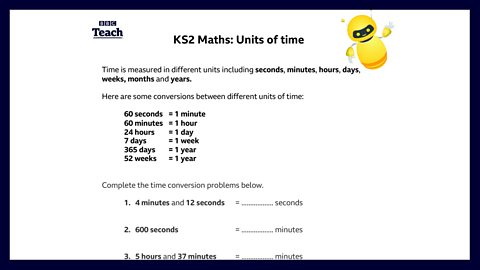
You might want to check children’s prior learning around units of time, with questions such as:
- How many months are there in a year?
- How many days in a week?
- How many weeks in a year?
- How many hours/minutes/seconds in a day?
During the film
You may want to pause the film while the children are answering each question, to allow your pupils to work the answers out themselves, or to ensure understanding of the bar model and how it represents the question.
After watching
You could give the children opportunities to practise their fluency with converting between different units, for example by completing a table with a number of conversions, such as:
| Hours | Minutes | Seconds |
|---|---|---|
| 1 | 60 | 60 x 60 = |
| 7200 | ||
| 300 |
You could then give them some reasoning and problem solving questions based on the type tackled in this episode, such as; Kayla finished the race in 4 minutes 20 seconds and Zach finished it in 245 seconds. Which child finished the race first?
You could ask your pupils to come up with some similar problems for a partner to solve.
Check the answers for the activity sheets here (PDF, 690KB)
Curriculum notes
This short film is suitable for teaching maths at KS2 in England and Northern Ireland, 2nd Level in Scotland and Progression steps 2 and 3 in Wales.
More from Neon City: Measurement and Geometry
Measuring area. video
Ada introduces Zach and Kayla to the concept of area, and different ways to measure and calculate the area of rectangles, triangles and composite shapes.

Perimeter. video
Zach and Kayla are creating windows for their virtual house design and Ada explains how they can work out the perimeter for the windows they want.
Volume. video
Kayla and Zach decide to build a swimming pool for their virtual city and Ada explains how to calculate the volume and capacity of a cuboid shape.

Metric and imperial measurements. video
Kayla and Zach decide to build a new hovertrain system from the city to the beach, but they get confused between kilometres and miles. Ada explains how to calculate betwen the two measurement systems, metric and imperial.

Measuring angles - Part 1. video
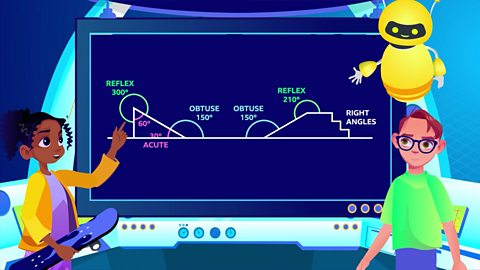
Kayla and Zach are designing ramps for the skatepark and Ada explains that designing ramps requires us to measure angles – the amount of turn between two lines.
Measuring angles - Part 2. video
Whilst adding ramps to their virtual skatepark, Zach and Kayla progress from measuring angles to calculating angles on a straight line and full turn.

Missing lengths and angles. video
A computer virus has corrupted the Neon City software. Zach and Kayla must answer four questions within three minutes, or their city will be erased.

Regular and irregular polygons. video
Zach’s design for a pond in the virtual city park leads to Ada explaining the properties of regular and irregular polygons.

Coordinates on a grid. video
Kayla and Zach are designing a fairground and need to plot where to place the different rides, so Ada teaches them about the x-axis and y-axis on a coordinate grid.