KAYLA: Let’s build the new hover train system from the city to the beach.
ZACH: Yeah, they are 20 kilometres apart.
KAYLA: Great, so we can make the tracks 20 miles long.Ta-da!Oh, what?That looks way too long!What’s going on, Ada?
ADA: Kilometres and miles are not the same.In the UK, we use two measurement systems: metric and imperial.Imperial is the older system and metric is the more modern system.Do you know which of these are metric and which are imperial?
ZACH: On my street, I saw a traditional style milk van, delivering pints of milk.So, I reckon pints are the old way.Imperial!Yes!
KAYLA: Measuring something with your feet seems like a pretty old school method too, so I’m going to say feet are imperial.
Get in!
ZACH: Our Satnav always talks in miles, so maybe that’s modern?Metric!
ADA: Actually, miles are imperial but they’re still the most commonly used measurement for roads and distances in the UK.
KAYLA: Well, that means kilometres are modern metric units.
ZACH: If kilometres are metric, I bet kilograms and metres are too.
ADA: Very good.Take a look at the rest of the answers.
KAYLA: Hmm, so getting back to our hover track, that’s a little too long.How many kilometres is this track I made?
ADA: 1 mile equals 1.6 kilometres.Can you work out what 20 miles is in kilometres?
KAYLA: 20 x 10.6 = 32 kilometres.Definitely too long.Okay, let’s fix it.
ZACH: Looking cool!Now, shall we build the train platform?
ADA: Good idea.The hover train is 60 feet long and the platform should match.Roughly how long does the platform need to be in metres?
KAYLA: Ah, look!It says three feet equals approximately one metre.
ZACH: So, 60 ÷ 3 = 20 metres.
ADA: Close enough.Look, the platform is a little longer than the train.The thing about approximations is that they give you a rough answer.
ZACH: You’ve got some big bags there, Ada.ADA: Yes, I like to be prepared for a trip to the beach.This red one weighs 25 pounds and this blue one weighs 16 kilograms.Can you work out which is heavier?
KAYLA: If one kilogram is about two pounds, then what are 16 kilograms in pounds?
ZACH: 2 x 16 = 32.So, the blue bag weighs 32 poundsand the red bag is 25 pounds.
KAYLA: Well, 16 kilograms is heavier.The blue bag is heavier.
ADA: You’re right.
ANNOUNCEMENT Train now boarding for Cyber Beach.
ADA: That’s me!See you next time, Zach and Kayla!
Kayla and Zach decide to build a new hovertrain system from the city to the beach, but they confuse kilometres with miles, meaning that their tracks are far too long.
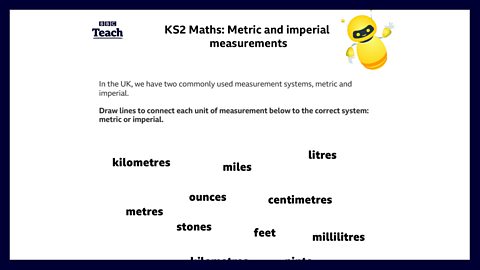
Ada explains that we have two measurement systems, metric and imperial. She asks the children to identify which measurements are metric and imperial from a selection such as feet, pints and kilograms.
Returning to their track, which they built as 20 miles long, Ada explains that one mile is the same as 1.6km. Kayla works out that a 20 mile track must therefore be 20 times 1.6, which is 32km. They then try to build a station platform to match the hovertrain, which is 60 feet long.
Ada explains that three feet is approximately one metre, so to work out 60 feet in metres, you can divide it by three, to give approximately 20 metres. The screen displays a bar model to show this visually.
Zach and Kayla then have to work out which of Ada’s suitcases is heavier. One weighs 25 pounds and the other 16 kilograms.
Activity sheet - metric and imperial measurements. document
Download/print an A4 activity sheet for this episode (PDF, 168KB). See link below for answers.
Ada helps them convert between the two, by explaining that 1 kilogram is approximately 2 pounds, and so 16 kilograms is approximately 32 pounds. Again, a bar model is used to help with understanding.
This short animated film is from the BBC Teach series, Neon City: Measurement and Geometry.
Teacher notes
Before watching
You may want to have given the children the opportunity to carry out measuring activities using imperial measurements, for example using rulers with inches and cm both marked on so that the children can see exactly how the measurements compare.
Discuss why we have both systems and why we still use some imperial measurements as well as some metric. Discuss why metric measurements are easier to convert than imperial.
During the film
Depending on the focus of your lesson, you may want to pause the episode at appropriate points to focus on converting between miles and kilograms, feet and metres, or kilograms and pounds. Ensure the children understand the concept of conversion, and give them opportunities to discuss their experience of different types of measurement and how they are used, for example their parents or grandparents may still measure their height in feet and inches.
You may also want to recap the meaning of the word approximate and discuss why we might use approximate conversions to make the calculations easier to do in our heads. You could also provide a more accurate figure for conversion, for example, 1kg = 2.2 pounds and discuss ways to solving problems using this.
After watching
You could use further bar models to provide visual representations of conversion and give the children plenty of opportunities to practise converting between imperial and metric in different contexts, using bar models to help them.
Use the stem sentences provided on the film to ask the children to formulate their own calculations. For example:
- “1kg is approximately 2 pounds. Therefore 2kg is approximately …pounds” or “…kg is approximately 8 pounds”.
Give the children opportunities to practise their reasoning and problem solving, with questions such as:
- Baby Erica weighs 8 pounds and baby Asif weighs 4.3kg. Which baby weighs more?
- Amina is 4 feet 6 inches tall, and Isaac is 132cm tall. Who has the furthest to grow until they reach 140cm?
Give the children a recipe in imperial measurements and ask them to convert the units to metric (using both grams and millilitres) before baking the cake.
Check the answers for the activity sheets here (PDF, 690KB)
Curriculum notes
This short film is suitable for teaching maths at KS2 in England and Northern Ireland, 2nd Level in Scotland and Progression steps 2 and 3 in Wales.
More from Neon City: Measurement and Geometry
Measuring area. video
Ada introduces Zach and Kayla to the concept of area, and different ways to measure and calculate the area of rectangles, triangles and composite shapes.

Perimeter. video
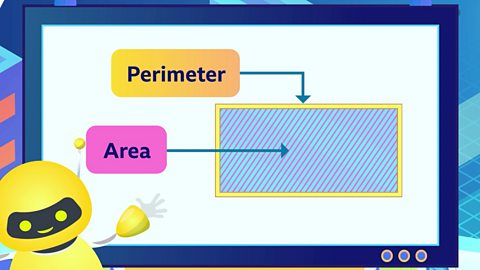
Zach and Kayla are creating windows for their virtual house design and Ada explains how they can work out the perimeter for the windows they want.
Volume. video
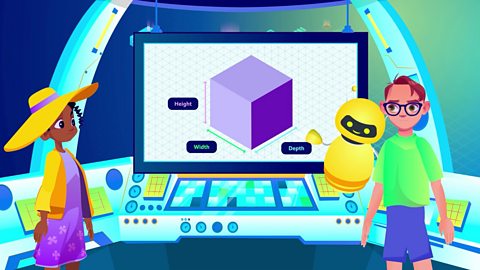
Kayla and Zach decide to build a swimming pool for their virtual city and Ada explains how to calculate the volume and capacity of a cuboid shape.
Measuring angles - Part 1. video
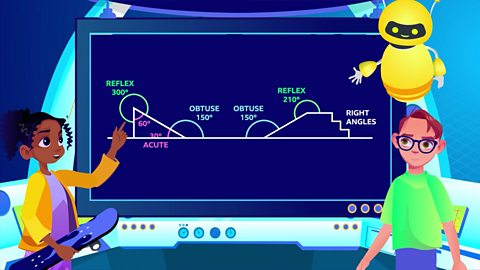
Kayla and Zach are designing ramps for the skatepark and Ada explains that designing ramps requires us to measure angles – the amount of turn between two lines.
Measuring angles - Part 2. video
Whilst adding ramps to their virtual skatepark, Zach and Kayla progress from measuring angles to calculating angles on a straight line and full turn.

Missing lengths and angles. video
A computer virus has corrupted the Neon City software. Zach and Kayla must answer four questions within three minutes, or their city will be erased.

Regular and irregular polygons. video
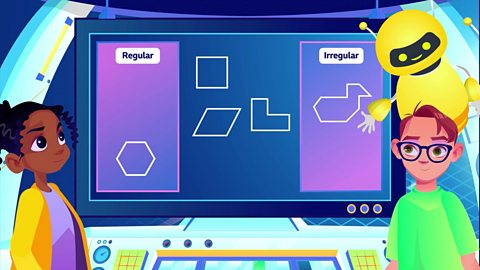
Zach’s design for a pond in the virtual city park leads to Ada explaining the properties of regular and irregular polygons.
Coordinates on a grid. video
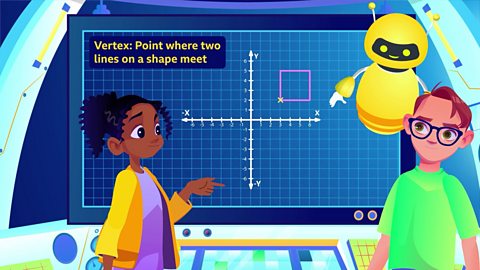
Kayla and Zach are designing a fairground and need to plot where to place the different rides, so Ada teaches them about the x-axis and y-axis on a coordinate grid.
Units of time. video
Ada asks Kayla and Zach a series of quiz questions, requiring them to convert from one time measurement unit to another.