KAYLA: It’s skatepark building day in the virtual city.Woohoo!
ZACH: Did you see my 180?Sweet, dude!Okay, let’s do it.
ADA: Building the skatepark is going to require lots of angles.An angle is a measure of the amount of turn between two lines.
ZACH: Okay, let’s start with the steps up to the ramp.Here.
ADA: These angles are right angles.You can tell from this special symbol.A right angle is a quarter of a full turn.And there are 360 degrees in a full turn.
KAYLA: What’s that little circle symbol?
ADA: That is the degree symbol.Angles are measured in degrees.Can you work out how many degrees in a right angle?
KAYLA: If there are four right angles in a full turn and that is 360 degrees, then we can work out the number of degrees in one right angle by dividing 360 by 4.
ZACH: 90 degrees.
ADA: Correct. A right angle is 90 degrees.
KAYLA: Ah, look!Stairs are made of lots of right angles.Come on, let’s make a skate ramp next.
ZACH: What if we make the angle 70 degrees?
ADA: Whoa!!That is very steep!
KAYLA: How about 30 degrees?
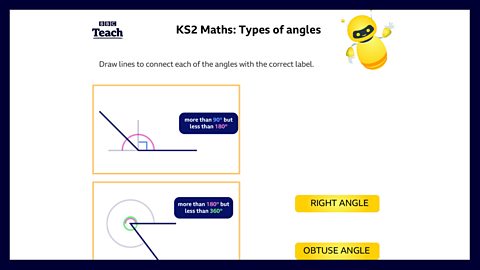
ADA: Much more pleasant, thank you.That’s enough of that.Let’s look at the angles in your design in a bit more detail.There are lots of different types of angles here.If an angle is less than 90 degrees, it’s called an acute angle.
KAYLA: Because it’s small and cute!
ADA: That could be a good way of remembering it.Can you spot the acute angles in your design?
ZACH: There’s one, and there’s another on our ramp.
ADA: That’s right.If an angle is more than 90 degrees but less than 180 degrees then it is obtuse.Like these ones, here.
BOTH: Ah!
ADA: And if an angle is more than 180 degrees but less than 360 degrees, then it’s called a reflex angle.Can you spot any reflex angles in your design?
KAYLA: Ah, yes!Around the edge of our ramp.Look!
ZACH: Ada, how do you measure angles?
ADA: You can measure angles with a very helpful tool called a protractor.
KAYLA: Cool! How does it work?
ADA: Line up one of the lines with the zero and make sure the point where the lines meet, which is called the vertex, is in the middle.Like this.Have a go.
KAYLA: Let’s measure this angle here.Okay, baseline lined up to zero and the pointy vertex in the middle.And if we start from zero, it says this angle is 150 degrees.
ADA: Very good.
ZACH: My turn!So, this angle at the top of our ramp, baseline lined up, vertex lined up…There.And starting from zero, I can see the angle is 60 degrees.
ADA: That’s right.How would you measure this reflex angle here?
KAYLA: Hmm… I don’t know.The protractor isn’t big enough.
ADA: But you do know that this angle is 60 degrees and a whole turn is 360 degrees.Can you work it out?
ZACH: We could use a part-whole model.The whole is 360 degrees, and one part is 60 degrees.So, the missing part must be 300 degrees.
KAYLA: Ah, yes!That angle is 300 degrees.So many awesome angles in our skatepark, dudes.Want to go for another skate, Ada?
ADA: Okay then.Woo woo!
KAYLA: Ada, you’ve got skills!
It’s skatepark day in the virtual city! Kayla and Zach are designing ramps for the skatepark. Ada explains that designing ramps requires us to measure angles – the amount of turn between two lines.
They start by measuring the steps up to the ramp, which are formed from a number of right angles. Ada explains that angles are measured in degrees, there are 360 degrees in a full turn, and also explains the degree symbol.
Kayla discovers that you can work out the number of degrees in a right angle by dividing the full turn by four (90 degrees). Zach and Kayla experiment with designing ramps of various angles from the ground – 70 degrees is too steep, but 30 degrees is OK.
Ada explains the names of the different types of angle – acute, obtuse and reflex – and Kayla and Zach try to spot each type in their design.
Ada goes on to explain how to use a protractor to measure angles, describing how to line it up with the lines in the angle. Kayla and Zach use the key vocabulary 'vertex' and 'baseline' as they measure a few angles.
Activity sheet - measuring angles - part 1. document
Download/print an A4 activity sheet for this episode (PDF, 420KB). See link below for answers.
At the end of the episode, Ada explains how to calculate the size of a reflex angle by using a part/whole model to demonstrate subtracting the missing part from 360 degrees.
This short animated film is from the BBC Teach series, Neon City: Measurement and Geometry.
Teacher notes
Before watching
You might want to recap what the children have already learned about angles, asking questions such as:
- What is an obtuse angle?
- How does an acute angle compare to a right angle?
- What unit of measurement do we use to measure angles?
You could give them opportunities to practise turning whole, half and quarter turns.
During the film
You might want to pause the film at various points to reinforce the key concepts and vocabulary, ensuring that the children are secure in their understanding of the different types of angle.
After watching
You could give the children opportunities to practise measuring angles using a protractor. If appropriate, give the children examples of reflex angles that can be worked out by subtracting a missing part from 360 degrees.
Check the answers for the activity sheets here (PDF, 690KB)
Curriculum notes
This short film is suitable for teaching maths at KS2 in England and Northern Ireland, 2nd Level in Scotland and Progression steps 2 and 3 in Wales.
More from Neon City: Measurement and Geometry
Measuring area. video
Ada introduces Zach and Kayla to the concept of area, and different ways to measure and calculate the area of rectangles, triangles and composite shapes.

Perimeter. video
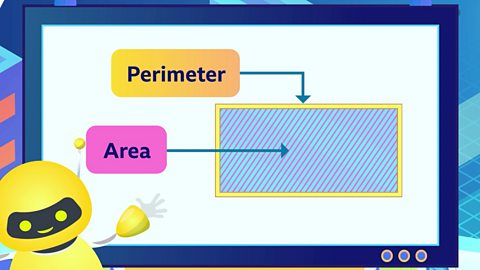
Zach and Kayla are creating windows for their virtual house design and Ada explains how they can work out the perimeter for the windows they want.
Volume. video
Kayla and Zach decide to build a swimming pool for their virtual city and Ada explains how to calculate the volume and capacity of a cuboid shape.

Metric and imperial measurements. video
Kayla and Zach decide to build a new hovertrain system from the city to the beach, but they get confused between kilometres and miles. Ada explains how to calculate betwen the two measurement systems, metric and imperial.

Measuring angles - Part 2. video
Whilst adding ramps to their virtual skatepark, Zach and Kayla progress from measuring angles to calculating angles on a straight line and full turn.

Missing lengths and angles. video
A computer virus has corrupted the Neon City software. Zach and Kayla must answer four questions within three minutes, or their city will be erased.

Regular and irregular polygons. video
Zach’s design for a pond in the virtual city park leads to Ada explaining the properties of regular and irregular polygons.

Coordinates on a grid. video
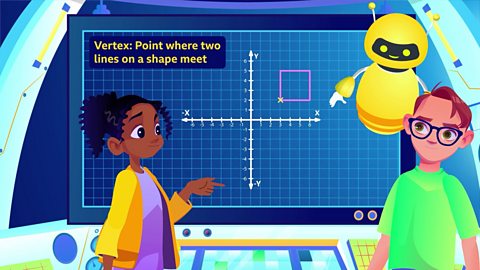
Kayla and Zach are designing a fairground and need to plot where to place the different rides, so Ada teaches them about the x-axis and y-axis on a coordinate grid.
Units of time. video
Ada asks Kayla and Zach a series of quiz questions, requiring them to convert from one time measurement unit to another.