ZACH: Our virtual house design is looking pretty cool. There’s something missing though.
KAYLA: Some windows might be nice.
ZACH: Oh yeah, I designed some earlier.
ADA: To build the windows, you need to work out the perimeters of the designs, so you know how much wood you need for the frames.
KAYLA: What’s perimeter?
ADA: Perimeter is the length of the lines around the closed 2D shape.If we look at this window here; the area is the glass bit in the middle and the perimeter is the frame.Can you work out the perimeter of this rectangle?
ZACH: Oh, I know.We could measure it with a ruler.100 centimetres this side, 50 this side – 150!
KAYLA: And if we add all four sides together, that gives us the length all the way around.The perimeter is 300 centimetres.
ADA: Precisely. That’s one way to do it. But there’s a quicker way.Remember, rectangles have two pairs of equal sides.
ZACH: Okay, so if these horizontal sides are the same and these vertical sides are the same, we could do 100 x 2 + 50 x 2 = 300!
ADA: That’s right!Next window.
KAYLA: Hmm, well, this one is a square and squares have four equal sides.So, if one side is two metres, that means all the others are too.2m x 4 = 8m
ZACH: Nice one!Now let me show you my favourite design.
KAYLA: Oh, Zach!Why are your artistic visions so complicated?
ADA: ‘Don’t worry,’ as you humans are so fond of saying.We can still work out the perimeter.Start off with what you do know.
KAYLA: Right, hmm…So, the horizontal side on the top is 100 centimetres.
ZACH: And this vertical side is 1.5 metres.Hang on, metres, that’s a different measurement.
ADA: Different units can cause a muddle, so best to turn them both into centimetres.
ZACH: Okay. 1.5 metres is the same as 150 centimetres, so the left side is 150 centimetres.
KAYLA: But then it gets more complicated.
ADA: How can you work out this missing side?
ZACH: 100cm – 65cm = 35cm.And 65cm + 35cm = 100cm.
KAYLA: That’s the same as the top side.
ADA: Exactly. And look at the right hand side.You can see this length and this length equal the same as the left side.
ZACH: So, these two make 150cm; the same as the opposite side.
KAYLA: Now, we just need to add up all those measurements.So, the perimeter is 150 + 100 + 150 + 100 = 500cm.Let’s build it!
ADA: After that, I need a recharge.
ZACH: Sorry, Ada, I forgot to add the curtains!
Zach and Kayla are pleased with their virtual house design, but something is missing – windows!
Ada explains that they need to work out the perimeter of the windows they want, so they know how much wood they need to build them. Ada explains that perimeter is the length of the lines around a closed 2D shape, like the frame around a window.
Zach starts to work out the perimeter of the window they want by measuring the sides with a ruler. Ada explains that a quicker way is to remember that rectangles always have two pairs of equal sides, so they can measure one length and width and multiply both by two.
They then apply this knowledge to working out the perimeter of a rectangle and a square. Zach then displays his favourite window, which is a composite rectilinear shape.
The children talk through ways to work out the missing lengths in a composite shape, as well as discussing how important it is to make sure you are using the same unit of measurement for every side.
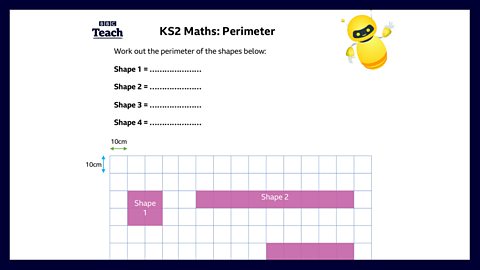
Activity sheet - perimeter. document
Download/print an A4 activity sheet for this episode (PDF, 304KB). See link below for answers.
This short animated film is from the BBC Teach series, Neon City: Measurement and Geometry.
Teacher notes
Before watching
You may wish to recap previous learning on perimeter, for example checking whether the children are able to measure the perimeter of a rectangle by counting squares or using a ruler. You may want to check for any misconceptions or common mistakes in using these methods.
During the film
Depending on the focus on your lesson, you may wish to use only the beginning of this episode, or to focus on the second half. Stop the episode in appropriate places to check for understanding, or to ask the children to repeat or explain key facts or sentences. For example, Perimeter is the length of the lines around a closed 2D shape. You could use the calculation that Zach formulates when working out the perimeter of the window, and ask the children to apply this to another shape, e.g. 100cm x 2 + 50cm x 2= 300cm.
As Zach and Kayla try to work out the perimeter of the composite shape, stop the film and ask your pupils to work it out before they do. What might be the tricky aspects of this? Where might they go wrong?
After watching
You might want to ask the children to design their own virtual house, with their own ideal windows, which can be any rectangular or composite shape they like. Can they work out how much wood they would need to design the windows they need?
You could provide the children with a number of examples to improve their fluency with working out the perimeter of shapes. You could also provide them with opportunities to develop their reasoning and problem solving skills, such as: the perimeter of a shape is 40cm. What length might its sides be? Or Always, Sometimes, Never: the perimeter of a shape is a higher number than the area of the same shape? Can the children provide examples to prove their answer?
Check the answers for the activity sheets here (PDF, 690KB)
Curriculum notes
This short film is suitable for teaching maths at KS2 in England and Northern Ireland, 2nd Level in Scotland and Progression steps 2 and 3 in Wales.
More from Neon City: Measurement and Geometry
Measuring area. video
Ada introduces Zach and Kayla to the concept of area, and different ways to measure and calculate the area of rectangles, triangles and composite shapes.

Volume. video
Kayla and Zach decide to build a swimming pool for their virtual city and Ada explains how to calculate the volume and capacity of a cuboid shape.

Metric and imperial measurements. video
Kayla and Zach decide to build a new hovertrain system from the city to the beach, but they get confused between kilometres and miles. Ada explains how to calculate betwen the two measurement systems, metric and imperial.

Measuring angles - Part 1. video
Kayla and Zach are designing ramps for the skatepark and Ada explains that designing ramps requires us to measure angles – the amount of turn between two lines.
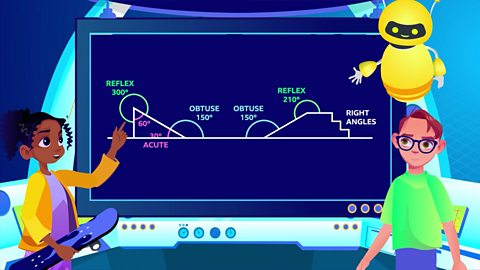
Measuring angles - Part 2. video
Whilst adding ramps to their virtual skatepark, Zach and Kayla progress from measuring angles to calculating angles on a straight line and full turn.

Missing lengths and angles. video
A computer virus has corrupted the Neon City software. Zach and Kayla must answer four questions within three minutes, or their city will be erased.

Regular and irregular polygons. video
Zach’s design for a pond in the virtual city park leads to Ada explaining the properties of regular and irregular polygons.

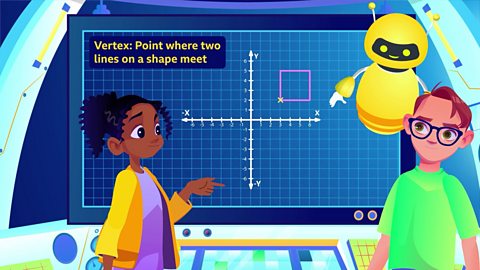
Coordinates on a grid. video
Kayla and Zach are designing a fairground and need to plot where to place the different rides, so Ada teaches them about the x-axis and y-axis on a coordinate grid.
Units of time. video
Ada asks Kayla and Zach a series of quiz questions, requiring them to convert from one time measurement unit to another.