ZACH: The virtual city park plan is coming together nicely.
KAYLA: We just need to add my bandstand.
ZACH: And my pond!
KAYLA: That’s a weird looking pond, Zach.
ZACH: It’s an awesome pond.It’s shaped like a duck.
ADA: Do you know what type of shape it is?
KAYLA: Er… a duck-tangle?
[LAUGHS]ADA: Not quite.What would you say about the sides of the shape?
ZACH: Well, all the sides are straight…
KAYLA: And it’s a closed shape.It wouldn’t be much good as a pond otherwise.
ADA: These properties tell us it’s a polygon.A polygon is a closed shape made of straight lines.Your pond is a type of polygon called a decagon, because it has ten sides and ten angles.And because all the lengths and angles are different, we know it’s an irregular decagon.
ZACH: What does a regular decagon look like?Oh! So different.
ADA: Yes. In a regular decagon, all the sides are the same length and all the angles are the same size.Let’s have a look at your bandstand design too, Kayla.What shape is it?
KAYLA: It’s a hexagon.But wait a minute, it’s a closed shape made of straight lines, so does that mean it’s actually a polygon?
ADA: It’s both.A hexagon is a type of polygon.A hexagon is a polygon with six sides and six internal angles.We can see that this shape is a regular hexagon because all its’ sides are the same length and all its’ angles are the same size.Polygons come in many shapes and sizes.Here are some more examples.
ZACH: Nice!
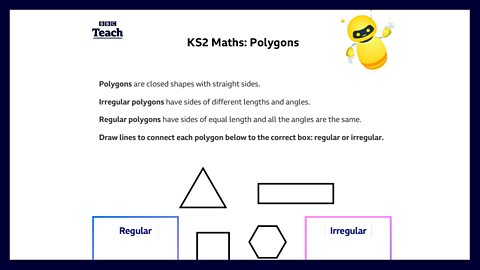
ADA: Can you tell which are regular polygons and which are irregular polygons?We already know that this one is regular, and this one is irregular.Drop the others into the right boxes.Remember, regular polygons have equal lengths and angles.
KAYLA: A square has equal length sides, and all of the angles are right angles.So, that’s got to be regular.Yay!
ZACH: This L-shape has all right angles too.
KAYLA: Oh yeah!But it doesn’t have equal length sides, so it must be irregular.
ZACH: Does that shape have a name?
ADA: It has six sides and six internal angles.This means it’s a hexagon, even though it doesn’t look much like a regular hexagon.
ZACH: Ah! How about this shape?What’s that called?
ADA: That is a rhombus.
ZACH: The sides are the same length, but what about the angles?I know, the angles are different… irregular.
ADA: Excellent work, team.
ZACH: Let’s build them!
KAYLA: You know what, your irregular decagon pond looks pretty cool, Zach.
ZACH: Told you!
ADA: A duck-lightful decagon.
Neon City is coming together nicely, but Zach and Kayla need to add the bandstand and the pond to make their park perfect.
Zach’s design for the pond looks like a duck, but what is the name of the shape? Ada explains that the properties of the shape mean that it is a polygon, a closed shape with straight sides.
Zach’s shape is a decagon, because it has 10 sides and 10 angles. The sides and angles are all different, so it is an irregular decagon.
Zach asks what a regular decagon would look like, and Ada explains that in a regular polygon, all the sides are the same length and all the angles are equal. They look at the bandstand design, which is a regular hexagon.
Ada gives the children more examples of regular and irregular polygons to sort, and they talk through their reasoning.
This short animated film is from the BBC Teach series, Neon City: Measurement and Geometry.
Activity sheet - regular and irregular polygons. document
Download/print an A4 activity sheet for this episode (PDF, 173KB). See link below for answers.
Teacher notes
Before watching
You may wish to recap previous learning on the names of shapes and their properties, such as number of sides and angles.
You could check pupils' understanding of the terms 'regular' and 'irregular', and recap the names of familiar polygons such as hexagon and octagon.
During the episode
You could pause the film as the children discuss their shapes, to check that your pupils are able to name and describe the shapes displayed. Can they explain what a polygon is, with reference to its properties? Can they explain the difference between a regular hexagon and an irregular hexagon?
After watching
You could give pupils a selection of regular and irregular polygons to sort, and ask them to explain their reasoning using stem sentences or key vocabulary, using Zach and Kayla’s examples as a basis, making sure they reference both the sides and the angles. For example:
- I know this shape is regular because its sides are______ and its angles are ______.
You could give the children opportunities to draw regular and irregular polygons and label their properties. How many types of irregular decagon can they come up with?
Check the answers for the activity sheets here (PDF, 690KB)
Curriculum notes
This short film is suitable for teaching maths at KS2 in England and Northern Ireland, 2nd Level in Scotland and Progression steps 2 and 3 in Wales.
More from Neon City: Measurement and Geometry
Measuring area. video
Ada introduces Zach and Kayla to the concept of area, and different ways to measure and calculate the area of rectangles, triangles and composite shapes.

Perimeter. video
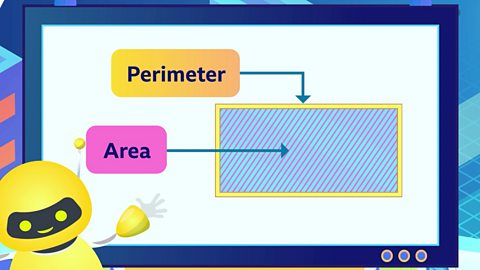
Zach and Kayla are creating windows for their virtual house design and Ada explains how they can work out the perimeter for the windows they want.
Volume. video
Kayla and Zach decide to build a swimming pool for their virtual city and Ada explains how to calculate the volume and capacity of a cuboid shape.

Metric and imperial measurements. video
Kayla and Zach decide to build a new hovertrain system from the city to the beach, but they get confused between kilometres and miles. Ada explains how to calculate betwen the two measurement systems, metric and imperial.

Measuring angles - Part 1. video
Kayla and Zach are designing ramps for the skatepark and Ada explains that designing ramps requires us to measure angles – the amount of turn between two lines.

Measuring angles - Part 2. video
Whilst adding ramps to their virtual skatepark, Zach and Kayla progress from measuring angles to calculating angles on a straight line and full turn.

Missing lengths and angles. video
A computer virus has corrupted the Neon City software. Zach and Kayla must answer four questions within three minutes, or their city will be erased.

Coordinates on a grid. video
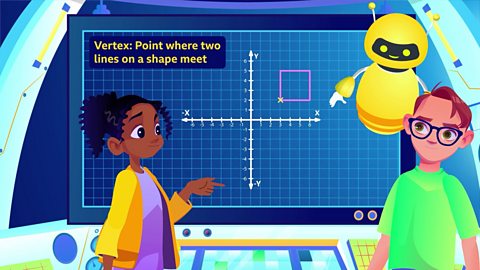
Kayla and Zach are designing a fairground and need to plot where to place the different rides, so Ada teaches them about the x-axis and y-axis on a coordinate grid.
Units of time. video
Ada asks Kayla and Zach a series of quiz questions, requiring them to convert from one time measurement unit to another.