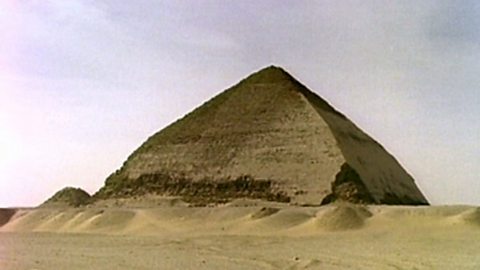
MIRANDA KRESTOVNIKOFF: The building of the Great Pyramid was an incredible achievement. It's 147 metres from the ground to the top, and each side of the base is 230 metres long.
It's more than twice the height of Big Ben and the sides are longer than two full-sized football pitches.
The puzzle is, how did the ancient Egyptians build this amazing structure?
One answer seems to be by measuring very accurately. The base of a pyramid is a square. The builders must have marked out that square on the ground to begin building. But how?
By studying pyramids, archaeologists have learnt a fascinating fact. The sides face north, south, east and west.
Knowing that, they think the builders started the square by marking out a line pointing north.
Another question: without one of these, a compass, how did they find the direction north?
Most archaeologists today think they used the stars.
Ancient Egyptian writings show that they noticed the stars in the night sky moved. At least they thought they moved. We know it's the Earth that moves, not the stars.
They watched the stars gradually "cross" the sky and disappear below the horizon.
But in one patch of sky, there was a cluster of stars that never disappeared. They called these the Indestructibles. We call them the circumpolar stars, because they circle the North Pole of the Earth.
Archaeologists think the pyramid builders lined the pyramid up with these stars, which lined it up with north.
Once they found north they could mark out the line. Archaeologists think they used rope to do this, but rope stretches.
So after the line was laid out approximately, the exact length of the side of the pyramid must have been measured, probably using something like this, a cubit rod.
Video summary
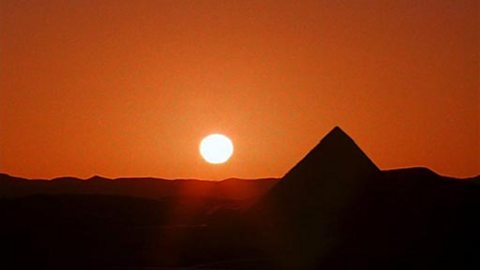
The Great Pyramid of Khufu is 147m from the ground to the top and each side of the base is 230m long. The Egyptians positioned the sides of the pyramid facing north, south, east and west.
They did not have compasses so archaeologists believe that they used the stars as a guide. They used the circumpolar stars that circle the North Pole of the Earth. The ancient Egyptians also used a cubit rod to measure out the sides of the pyramid.
This clip is from the BBC Primary History series, Pyramid - The Great Pyramid of Khufu.
Teacher Notes
Pupils could build pyramid shapes from interlocking plastic cubes. If the tip of their pyramid is a square made up of four cubes, how many cubes will be needed to make the layer immediately below? What about the layer below that?
Pupils could go on to calculate how many cubes would be needed to build a one-metre-high model of a pyramid.
Pupils could share their experiences of star gazing in class.
This video is relevant for teaching KS2 History in England, Wales and Northern Ireland and second level in Scotland.
Building the pyramids - part 1 of 5. video
How were the mighty pyramids built? This reconstruction shows how a young Egyptian boy is recruited to leave his family and work on an incredible project.
Building the pyramids - part 2 of 5. video
In this reconstruction, Nakht and Deba take a boat up the River Nile with other slave workers to start work on the building of the pyramid.

Building the pyramids - part 3 of 5. video
This reconstruction shows the young enslaved workers join an army of haulers dragging blocks of stone into position as the building of the pyramid begins.

Building the pyramids - part 4 of 5. video
This clip presents an explanation of the kind of tools the ancient Egyptians used in fashioning stone blocks for the pyramids as the workers get a first glimpse of the huge project they are working on.
Building the pyramids - part 5 of 5. video
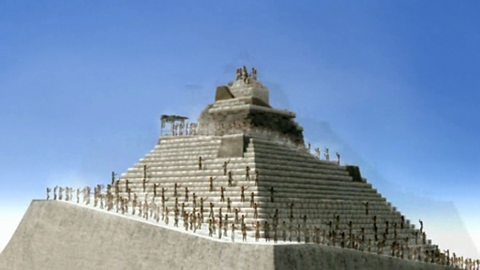
A video reconstruction describing how the final touches were added to the Great Pyramid of Khufu.
Ancient Egyptian beliefs and the construction of the pyramids. video
The ancient Egyptians believed in a God of the Sun who could be reborn in the afterlife. They also believed the position of the stars pointed the way to the afterlife.
Building the pyramids accurately - part 2 of 2. video
The Egyptians needed to be precise in their calculations to build the pyramids. Miranda Krestovnikoff uses the example of the 'bent pyramid' in Egypt to show what happens when those calculations go wrong.