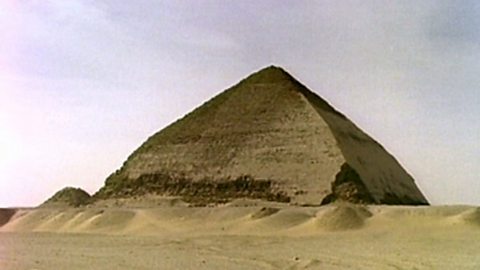
MIRANDA KRESTOVNIKOFF: How and why did the ancient Egyptians build the pyramids?
These two questions puzzled generations of people who came across these gigantic, mysterious structures in the Sahara Desert.
Today we're able to answer them.
Because the dry climate of the Sahara preserved so much of what was built, written and made by the ancient Egyptians, there's a huge quantity of evidence for us to study.
Using this, archaeologists have built up a picture of how and why the pyramids were constructed.
Writing and objects, tools and drawings all provide clues. We've put all the clues together to create the story of one person.
He's not a real person, but we've given him a name: Nakht. It means ‘victorious’.
By piecing together evidence we can tell, through his eyes, the story of building the greatest pyramid of all - The Great Pyramid of Khufu at Giza.
[MAN SPEAKING FOREIGN DIALOGUE]
NAKHT: ‘In the name of the King. In the name of the King.’ When I heard those words one evening late in summer, I knew my life was about to change.
As Karema led the King's men into my village, I said to my brother Deba, ‘It's our turn to leave home and go to work in the service of the King’.
Just as our father had, and his father before him. Was I afraid? A little.
My village was the only world I knew. It was hard to leave.
We worried how the family would manage until we returned.
My sister cried. My mother, she simply looked at me and said, ‘Nakht, you're the older one. Take care of Deba.’
Video summary
Using writing, objects, tools and drawings, archaeologists have pieced together the story of the ancient Egyptians.
In this reconstruction, we meet an Egyptian enslaved worker who was summoned to leave his family when he was very young to go to the desert and help build the pyramids.
This clip is from the BBC Primary History series, Pyramid - In the Name of the King.
Teacher Notes
Before watching this clip, pupils could list everything they already know about Egypt and the Egyptians. These facts, ideas and experiences could be organised into a large mind map for the wall or completed individually.
Additional questions the pupils may have could also be included.
Pupils could then view the clip and add any new information to their mind map. Information could continue to be added throughout their study of the Egyptians.
Pupils could complete an activity in which they have to write a short story or journal entry about Egyptian life and circumstances, how difficult it was and what their needs were, thus essentially providing the justification for the building of pyramids.
Please note, these clips contain a dramatised reconstruction of people building the pyramids, including some scenes of the working conditions they faced that young audiences might find disturbing. Teacher review is advised prior to showing to your class.
This video is relevant for teaching KS2 History in England, Wales and Northern Ireland and second level in Scotland.
Building the pyramids - part 2 of 5. video
In this reconstruction, Nakht and Deba take a boat up the River Nile with other slave workers to start work on the building of the pyramid.

Building the pyramids - part 3 of 5. video
This reconstruction shows the young enslaved workers join an army of haulers dragging blocks of stone into position as the building of the pyramid begins.
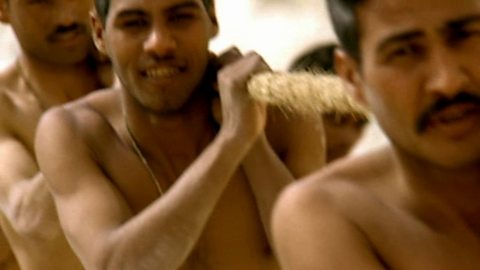
Building the pyramids - part 4 of 5. video
This clip presents an explanation of the kind of tools the ancient Egyptians used in fashioning stone blocks for the pyramids as the workers get a first glimpse of the huge project they are working on.
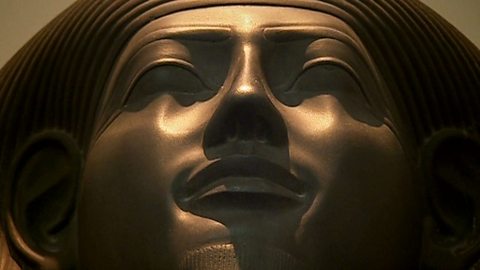
Building the pyramids - part 5 of 5. video
A video reconstruction describing how the final touches were added to the Great Pyramid of Khufu.
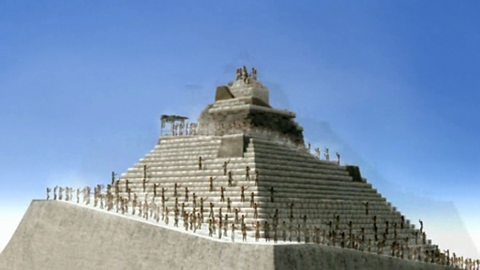
Ancient Egyptian beliefs and the construction of the pyramids. video
The ancient Egyptians believed in a God of the Sun who could be reborn in the afterlife. They also believed the position of the stars pointed the way to the afterlife.
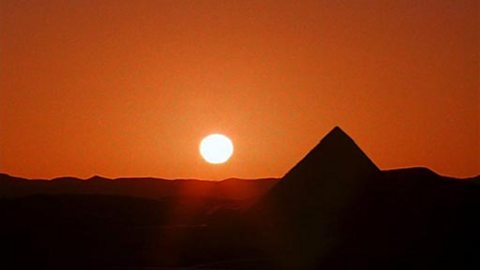
Building the pyramids accurately - part 1 of 2. video
To build the pyramids, the ancient Egyptians had to use incredible precision and exact measurements. In this clip, Miranda Krestovnikoff explains how they did this.
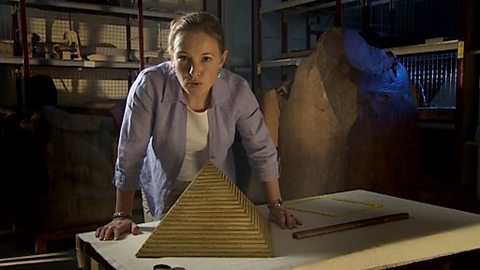
Building the pyramids accurately - part 2 of 2. video
The Egyptians needed to be precise in their calculations to build the pyramids. Miranda Krestovnikoff uses the example of the 'bent pyramid' in Egypt to show what happens when those calculations go wrong.