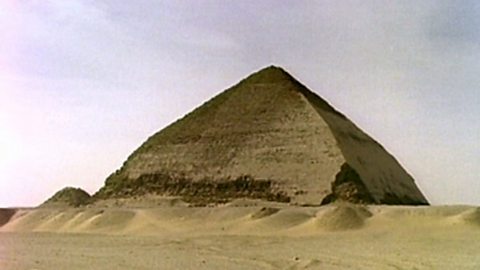
NAKHT: We were told to fill pots with water, and report to a gang of stone-haulers. They called themselves"Khufu's Drunkards". Our job was to water the ground in front of their sled, so it didn't stick. They pulled the sled along a track of wooden planks covered in earth.
Because there is clay in the ground at Giza, you can make the earth slippery by pouring water on it. If you add just the right amount of water, the sled slides across the ground with ease. So our life in the quarry began, and so it continued.
After a few months, some of those who had come into the service of the King with us were sent back to their villages. But Deba and I were not. Yunu the foreman thought we were quick learners - we were kept on.
The work was hard - backbreaking - but when each day was over, we washed, ate and sat around the fire telling stories of our villages. We missed home and often talked about our families.
But with Deba beside me, I was never lonely.
Video summary
Using writing, objects, tools and drawings, archaeologists have pieced together the story of the ancient Egyptians.
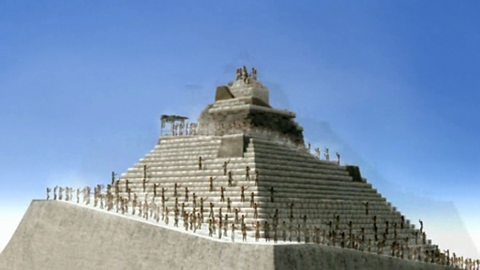
In this reconstruction, the army of enslaved workers use a variety of the techniques to move the enormous stone blocks into place as they build the pyramid.
This clip is from the BBC Primary History series, Pyramid - In the Name of the King.
Teacher Notes
Pupils could consider the question: 'Was working at the quarry a bad experience?' They could use evidence from the clip and from other sources to answer this.
Pupils could explore the lives of the boys in this clip by 'stepping into their shoes'. Standing on paper footprints, they could imagine they are one of the characters.
When they are tapped on the shoulder, it is their turn to bring their character to life and express their thoughts and feelings out loud.
Pupils could also portray their character in writing on their footprint, for display.
This video is relevant for teaching KS2 History in England, Wales and Northern Ireland and second level in Scotland.
Building the pyramids - part 1 of 5. video
How were the mighty pyramids built? This reconstruction shows how a young Egyptian boy is recruited to leave his family and work on an incredible project.
Building the pyramids - part 2 of 5. video
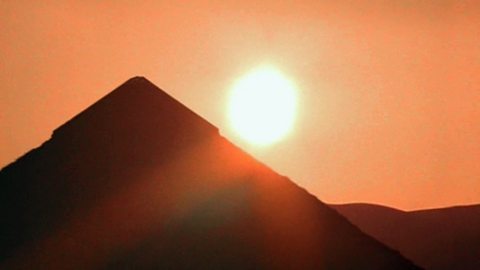
In this reconstruction, Nakht and Deba take a boat up the River Nile with other slave workers to start work on the building of the pyramid.

Building the pyramids - part 4 of 5. video
This clip presents an explanation of the kind of tools the ancient Egyptians used in fashioning stone blocks for the pyramids as the workers get a first glimpse of the huge project they are working on.
Building the pyramids - part 5 of 5. video
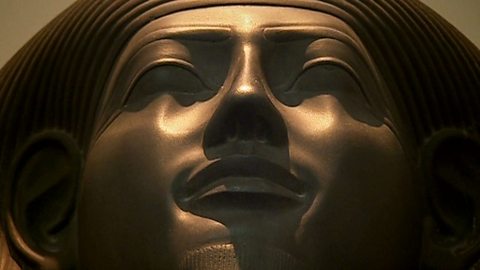
A video reconstruction describing how the final touches were added to the Great Pyramid of Khufu.
Ancient Egyptian beliefs and the construction of the pyramids. video
The ancient Egyptians believed in a God of the Sun who could be reborn in the afterlife. They also believed the position of the stars pointed the way to the afterlife.
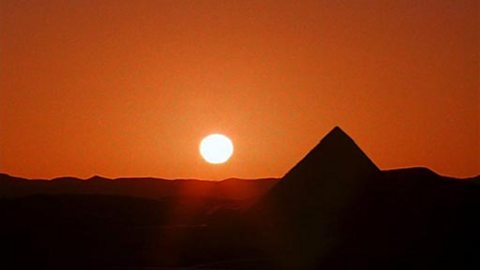
Building the pyramids accurately - part 1 of 2. video
To build the pyramids, the ancient Egyptians had to use incredible precision and exact measurements. In this clip, Miranda Krestovnikoff explains how they did this.
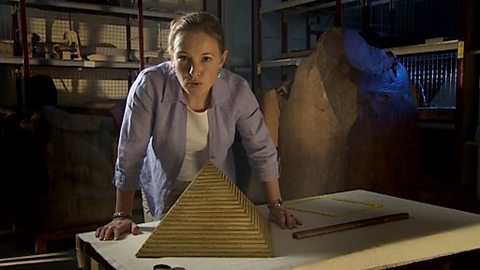
Building the pyramids accurately - part 2 of 2. video
The Egyptians needed to be precise in their calculations to build the pyramids. Miranda Krestovnikoff uses the example of the 'bent pyramid' in Egypt to show what happens when those calculations go wrong.